Federal Workers Still Struggle a Year After Mass Job Cuts
A year after significant federal job cuts, many former government employees are still struggling to find work. Stories from individuals like John Berg and Dave Harbaugh reveal challenges with unemployment, lower pay, and forced relocation. These experiences underscore the lasting impact of workforce reduction initiatives on dedicated public servants.


Federal Workers Face Lingering Job Struggles Post-Layoffs
A year after widespread federal job cuts, many former government employees continue to face significant challenges finding stable, comparable employment. The Trump administration’s initiative to reduce the federal workforce, which led to an estimated 300,000 workers and contractors losing or leaving their jobs, has left a lasting impact on individuals and their families. Many are still unemployed or working in roles that pay less and offer fewer benefits than their previous government positions.
Stories of Disruption and Resilience
John Berg, a former Treasury Department employee with extensive experience in international development, found his two-decade career abruptly ended by a phone call. His work with the U.S. Agency for International Development (USAID) in Afghanistan concluded on January 31, 2025. This sudden change forced Berg to adapt quickly, becoming a general contractor and handyman in his Takoma Park neighborhood.
He described the physical demands of his new work, stating, “Balancing on ladders with a nail gun and holding lumber up with one hand and a nail gun in the other. There’s really no time or opportunity to to be depressed. You really have to stay focused and just get work done.”
Dave Harbaugh also experienced a similar disruption when he was let go from the Food and Drug Administration (FDA) in April 2025. He shared the emotional toll of job loss, saying, “It’s really terrifying as a parent to feel that you’ve suddenly lost your ability to provide for your family.” After numerous job applications, Harbaugh secured a position as an infant safety contractor. However, this new role requires him to travel extensively, often leaving home for weeks at a time.
Widespread Impact and Difficult Transitions
NBC News spoke with over a dozen former federal workers and contractors affected by the layoffs. The findings reveal a difficult transition for many. More than half of those interviewed remain unemployed.
Several individuals have resorted to taking on side jobs that pay significantly less than their former federal salaries. Nearly a third of former employees have been forced to relocate to find new employment opportunities, disrupting their lives and families.
The focus on government efficiency has been cited as a driving force behind these workforce reductions. “There’s been this relentless focus on efficiency, so let me not expand my workforce.
Let me focus on what I can do with the workforce that currently exists, and that has really been driving a lot of this slowdown,” one former worker explained. This approach has created a challenging environment for those seeking to re-enter the federal service or find comparable private sector jobs.
Looking Ahead: The Long Road to Recovery
John Berg reflected on the dedication of his former colleagues, noting, “It was an organization filled with passionate, hardworking people who did their absolute best on behalf of this country for the benefit of people around the world.” The experiences of Berg, Harbaugh, and many others highlight the ongoing human cost of large-scale government workforce reductions. As these individuals continue to seek stable employment, the long-term effects of these policy decisions on experienced federal workers and the services they provide remain a significant concern.
Source: A year later, many federal workers fired by DOGE are still struggling to find work (YouTube)

Related Articles

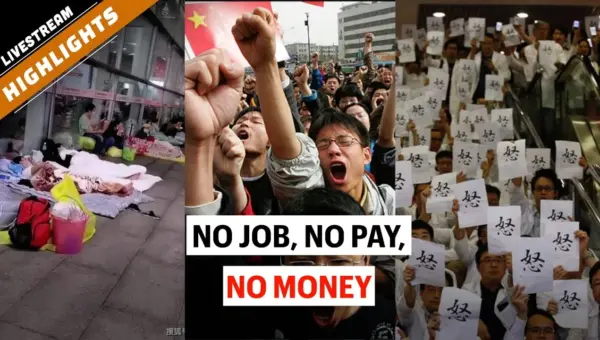
China’s Cracks Show: From Hospitals to Banks, a System Under Strain
China is facing a deep crisis affecting hospitals, banks, and society. Hospitals are closing while overloaded, banks restrict withdrawals and deposits vanish, and religious sites are exploited for funds. Wages are falling, jobs are scarce, and homelessness is rising dramatically, especially among the young. This points to a systemic breakdown and a closing of opportunity for an entire generation.


USAID Whistleblower Details Devastating Impact of Trump-Era Cuts
A former USAID official reveals that budget cuts and dismantling efforts during the Trump administration led to over 750,000 preventable deaths, many among children. Nicholas Enrich, author of "Into the Wood Chipper," described the agency's leadership as "clueless buffoons" whose incompetence destroyed vital global health, education, and democracy programs. The cuts also left pro-democracy groups in countries like Iran more vulnerable.


Ex-General: Push Unemployed Youth Into Military Service
Retired Major General Tim Cross warns of a serious defense funding crisis in Britain, blaming "corrosive complacency." He proposes enlisting unemployed youth into the military as an alternative to welfare, arguing the nation must prepare for a dangerous world.