Get Your Website Chosen by AI Shopping Agents
AI agents are changing how people shop online, making decisions before humans even see your website. Learn how to optimize your site with structured data, clear content, and strong online reputation to ensure AI agents choose your business.

How to Make Your Website a Top Choice for AI Shopping Agents
Millions of people will soon stop searching for products themselves and start using AI agents to make purchases. Companies that get chosen by these agents will see a huge increase in sales. Those that are skipped will never even know they were considered.
This is a massive change in how customers find businesses, similar to when Google first started. However, very few people are talking about this important shift.
This article will show you how AI agents shop, compare options, and decide which businesses get the sale. You will also learn exactly what changes to make on your website so these agents pick you every time.
The Biggest Shifts in Online Business Discovery
There have been two major changes in how people find businesses online. The first was the desktop internet and the launch of Google.
Businesses that appeared on the first page of search results won big. Companies that learned search engine optimization (SEO) early on dominated for years before others understood what was happening.
The second big shift was mobile phones. Smartphones changed everything.
Businesses that focused on mobile-friendly websites, fast loading times, and apps captured market share they still hold today. Many businesses that waited too long to adapt never fully recovered from this change.
The Third Shift: AI Agents Are Now Shopping
Right now, we are at the start of a third major shift. This one is different from the first two.
The earlier changes affected how people searched, but this new shift changes who is doing the searching. It’s no longer just your customer browsing your website.
Now, an AI agent scans your site, gathers your information, and compares you with dozens of competitors in seconds. It then makes a recommendation before a human even sees your page.
This isn’t something for the distant future; AI tools like ChatGPT already have shopping features, and search engines are building AI agents directly into their browsers. This is happening right now.
A New Customer Journey: From Search to AI Decision
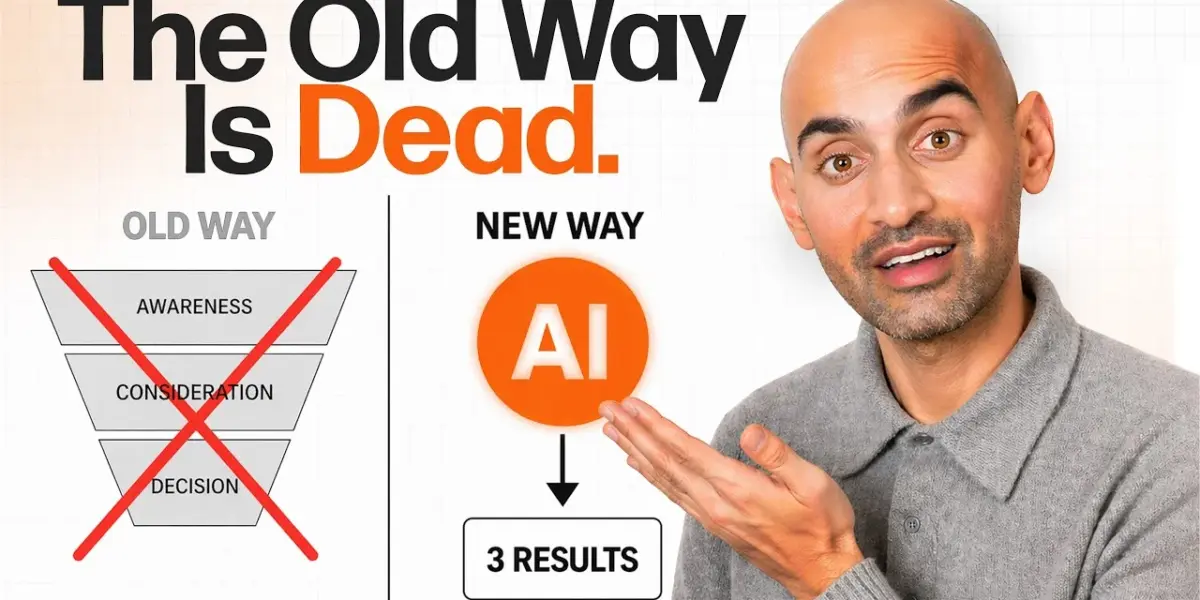
This shift completely rewrites the customer journey. For about 25 years, the journey was predictable: a person has a problem, searches on Google, clicks links, visits websites, compares options, and then makes a decision. Humans handled every step of this process.
That process is ending. Now, a person might tell their AI agent, “Find me the best marketing agency for my e-commerce brand for under $5,000 a month.” The AI agent then visits many websites, gathers pricing, services, and reviews. It checks this information against other online data and provides three recommendations.
The human then picks one, and the process is complete. The human may never visit a single website themselves.
What AI Agents Look For: Data Over Design
Think about what just happened: the entire process from awareness to consideration to decision has been shortened into one AI conversation. Your website no longer needs to convince a human; it needs to convince an AI agent.
The AI agent doesn’t care about your beautiful design, brand colors, or catchy headlines. It cares about one thing: can it easily get clear, structured information from your site that helps its human make a decision?
If the answer is yes, you get on the short list. If the answer is no, you effectively don’t exist to that agent.
Understanding AI Agent Evaluation Signals
AI agents don’t read your website like a person. Instead, they scan your website’s code looking for specific signals. Here’s what they evaluate:
- Structured Data (Schema Markup and JSON-LD): This is the language AI agents understand. It tells them exactly what your page is about, what you sell, the price, and who it’s for. Without it, you are invisible to AI agents.
- Content Clarity: AI agents need clear, specific, and machine-readable information, not just clever marketing words. What do you offer? How does it work? What is the price? If this information is buried in long stories, the agent will skip your site.
- Accessibility Features: Interestingly, the same things that make your site accessible to people with disabilities, like clean HTML structure and clear labels, also make your site visible to AI agents. Accessibility for humans has become visibility for AI.
- API Compatibility: Agents look for connections they can use. If an AI can check your inventory, pull pricing, or book an appointment through a clean Application Programming Interface (API), you have a significant advantage. If it has to guess by scraping your homepage, you lose.
- Web Reputation: Agents cross-reference information. They look at brand mentions, reviews, and other online content. If no one else on the internet is talking about you, the agent will not trust your business.
- Information Freshness: AI agents strongly prefer current data. They check when information was last updated. Stale pages make your business look unreliable to these agents.
The Good News: Low Competition, High Impact
Most of these signals are the same things that helped you rank in traditional SEO. Structured data, clear content, a strong online presence, and up-to-date information are key. The difference now is that for AI agents, these are not optional; they are requirements.
The best part is that most of your competitors have no idea this is happening. The effort needed to stand out right now is surprisingly low. You just need to be ready before they are, and this guide will help you do just that.
Five Steps to Make Your Website AI Agent Ready
Here are five changes you can make to your website to prepare it for AI shopping agents. Most of these can be completed within a week.
- Add Schema Markup: Add schema markup to every important page on your site. Use product schema, service schema, FAQ schema, and review schema. This is the most impactful step you can take. It helps every AI agent understand exactly what you offer, much like a name tag helps people recognize you at a busy event.
- Rewrite Pages for Clarity: Rewrite your key pages to be clear and direct, not overly clever. Each page should plainly answer four questions: What do you sell? Who is it for? What does it cost? How does it work? Use headers, short paragraphs, and tables where helpful. You are writing for a very smart, literal reader with no patience for fluff.
- Enable Agent Interactions: Make sure your inventory and pricing are easily accessible through clean data feeds or APIs, especially if you sell products. If you offer services, ensure your scheduling and availability are easy for agents to query. Businesses that allow AI agents to directly check stock, compare features, and even complete purchases will be recommended first.
- Build Your Brand Signal: Get mentioned in industry publications, earn reviews on relevant platforms, and create content that other websites want to reference. AI agents trust your business more when the rest of the internet vouches for you. This builds your online reputation.
- Keep Content Current: Add “last updated” dates to your pages. Refresh your core content every few months. Update your reviews and case studies regularly. Outdated content is a major reason AI agents lose trust in a website.
The Sixth Move: Own Your Category with Specific Content
There’s a sixth strategy that creates a significant long-term advantage. Create content that teaches AI exactly who you are and what category you dominate. Don’t just say you’re a marketing agency; specify that you help SaaS companies grow from $1 million to $10 million through performance marketing.
Create comparison pages, build guides for specific categories, and publish lists that position you as an authority in your niche. The more specific and consistent you are, the more AI agents will associate your brand with that particular category. Once you own that association, the benefits start to compound over time.
The Urgency: A Shrinking Window of Opportunity
Every major internet shift has had a limited window where early movers gained advantages that lasted for years. Businesses that mastered SEO in the early 2000s still rank well today. Brands that prioritized mobile in 2010 captured market share they still hold.
The generative AI era has a window, too, and it is closing faster than any before. AI adoption is happening much quicker than previous technological changes. Experts predict that by 2028, a large percentage of both business-to-business and business-to-consumer transactions will involve AI agents in the decision-making process.
Act Now to Capture the AI Shopping Wave
What took mobile technology five years to become mainstream, AI agents will achieve in 12 to 18 months. This means the early mover advantage is measured in months, not years. Once AI agents learn which brands to recommend in a category, those recommendations build on themselves.
More recommendations lead to more traffic, which leads to more data, more authority, and ultimately, more recommendations. This creates a powerful cycle.
Businesses that join this cycle first will move faster every day. Those that wait will face an uphill battle against competitors who are already the default choice.
The real opportunity is not in AI content tools or clever tricks. The true play is ensuring that when AI agents start making buying decisions, they are buying from you. Most of your competitors will not take these steps.
That is your advantage. Use it now.
Source: The Marketing Opportunity of a Decade (But Not for Long) (YouTube)

Related Articles


Use Schema Markup to Help Google Understand Your Site
Learn how to use schema markup to give Google clear signals about your website's content. This guide explains what schema is and how it can improve your search visibility and ad performance by adding structured data to your pages.

Boost Your Business: 8 Fixes for Google’s New AI Playbook
Discover 8 essential fixes to align your website with Google's AI. Learn how to improve site speed, optimize content, enhance media, and integrate your SEO and ad teams for better rankings and lower ad costs.


Make Your Google Ads Clickable: Write Better Headlines
Learn how to improve your Google Ads by rewriting website headlines. Discover common mistakes and get tips to make your ads more clickable and effective for your business.