China’s Cracks Show: From Hospitals to Banks, a System Under Strain
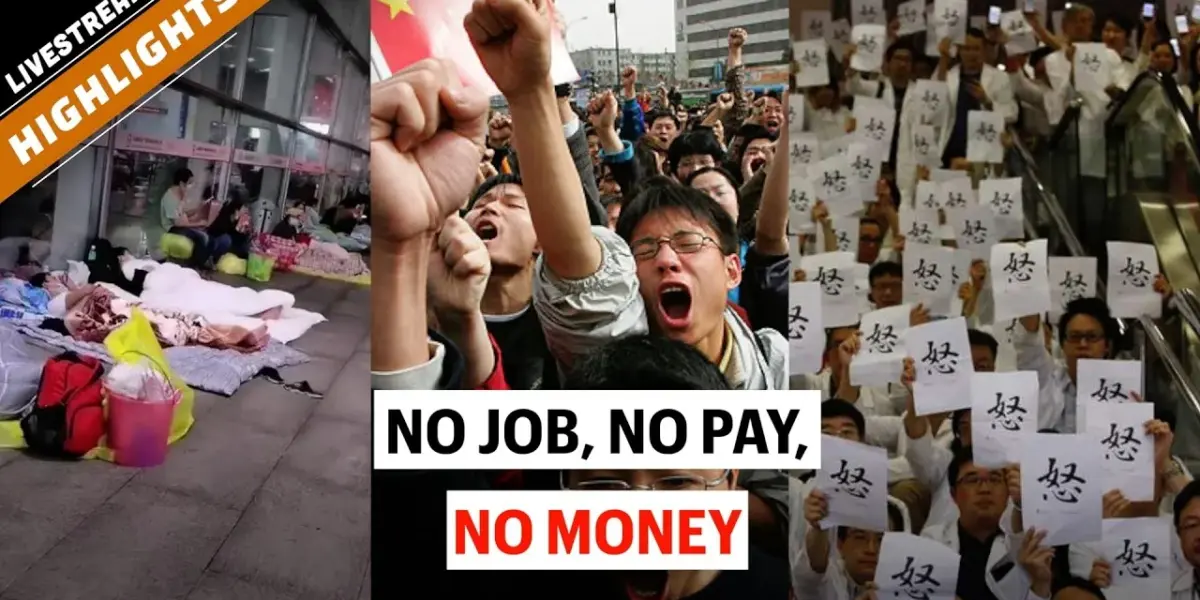
China is facing a deep crisis affecting hospitals, banks, and society. Hospitals are closing while overloaded, banks restrict withdrawals and deposits vanish, and religious sites are exploited for funds. Wages are falling, jobs are scarce, and homelessness is rising dramatically, especially among the young. This points to a systemic breakdown and a closing of opportunity for an entire generation.

China’s Cracks Show: From Hospitals to Banks, a System Under Strain
When we think about essential services, hospitals always come to mind. People get sick no matter what the economy is doing. Viruses don’t check GDP numbers.
In recent years, China has faced many health crises, meaning more patients and more demand for medical care. Logically, hospitals should be doing well, but the opposite is happening.
Major hospitals across China have been overwhelmed by outbreaks and diseases. Yet, at the same time, many smaller hospitals, including public ones, are closing down. This strange situation is hard to ignore.
According to the China Hospital Association, private hospitals were closing at a rate of 1.4 per day in 2024, losing millions of yen each. By the first half of 2025, this number jumped to about seven closures daily.
Even large, well-funded hospitals are struggling. A striking example is Lu Shinan Hospital in Shandong, a massive project that went bankrupt with over a billion yuan in debt.
Six hundred employees hadn’t been paid for eight months. This crisis is no longer just about private hospitals; it has spread to the public system, with reports of unpaid wages coming from public hospitals in various regions.
Why Are Hospitals Collapsing?
A doctor explained that the three years of COVID lockdowns drained China’s medical insurance funds. As reimbursements dropped, hospital income was cut drastically. This creates a difficult cycle.
Large city hospitals are full but losing money on each patient because insurance doesn’t cover full costs anymore. Meanwhile, hospitals in smaller towns and rural areas are shutting down due to declining populations and not enough patients to stay open.
This breakdown in healthcare is like a tear in the social safety net. But problems in the financial sector strike at the core of the social contract itself.
Stories of people struggling to withdraw money from banks have flooded social media. One lawyer tried to withdraw about $32,000 USD and was questioned extensively, treated like a criminal.
Banks are now using anti-fraud requirements to limit access to people’s money. To open a card, get a transfer, or withdraw cash, you need to explain your job, your relationship to the recipient, and how you plan to use the money.
This makes it very difficult to access your own funds. It’s like a constant audit of your assets.
Deposits Vanishing, Trust Eroding
Even more alarming than withdrawal difficulties is the disappearance of deposits. In one case, a woman reported that 800,000 yuan vanished from her ICBC account.
The bank allegedly loaned it to a real estate developer who then collapsed, leaving the bank unwilling to repay her. She was seen crying on the bank floor, with no one offering help.
Another incident involved a woman who deposited 29 million yuan into a special account at the Agricultural Bank of China for a land auction. After confirming the security of the deposit with the bank manager, the balance was zero a week later.
The bank president refused to address her concerns, and the manager claimed he was tricked. Her attempts to share evidence online were quickly deleted.
These are not isolated incidents; they show a widespread loss of trust in the financial system. Banks are under pressure, losing money due to low interest rates and high levels of bad debt.
Some institutions are using depositors’ money as a temporary fix for financial problems. This marks a point where access to your own money is no longer guaranteed.
The Religious Sector Becomes an ATM
When money from healthcare and finance isn’t enough, pressure shifts to other parts of society, including religious institutions. In recent weeks, there have been reports of large-scale actions targeting major religious sites.
Armed vehicles have been seen at temples, with security personnel inside sacred spaces. Some sites are now managed like military bases.
This campaign is expected to continue until at least 2027, involving multiple government agencies. Some believe this is happening because people are seeking spiritual comfort in difficult times, which clashes with the Communist Party’s ideology. However, there’s another reason: fiscal pressure.
Religious sites in China are tightly controlled by the state and often function as government assets and tourist attractions. They can be very profitable. During economic downturns, donations and tourism income are increasingly being redirected into state-controlled channels.
Some of these funds may even support government expenditures, including defense. Essentially, temples have become cash machines for the government to extract resources for its own survival.
Wages Fall, Jobs Become Scarce
Meanwhile, wages are falling. In some provinces, jobs like preschool assistants or hotel receptionists now pay only $140 to $160 a month.
This is barely enough to live on and is comparable to salaries from 30 years ago. Even having a job doesn’t guarantee you’ll get paid.
A case involving Beijing Ri and Technology highlighted this issue. Over 300 employees demanded unpaid wages for two years, but were threatened with the suspension of their social security payments.
This company, jointly owned by the Ministry of Public Security and a state-owned enterprise, owes over 80 million yuan in unpaid wages. The fact that a state-linked company in Beijing can’t pay its workers for two years shows the depth of China’s financial stress.
This stressful environment creates deep insecurity. In a strange turn of events, 12 people in Guangdong paid a total of $45,000 USD in fees just to secure jobs as high-speed rail security inspectors.
These jobs pay about $300 a month and require 16-hour shifts. People are willing to pay a year’s salary as a bribe for a low-paying, long-term government job.
The 35-Year-Old Rule and Growing Homelessness
This desperation is partly driven by the so-called ’35-year-old rule’ in high-paying industries like tech and finance, where companies often stop hiring people over 35. Many people prefer the perceived stability of a government job, even a low-paying one, over the uncertainty of the open market. This reflects a fear of not having a stable future.
For those at the very bottom, even these options are unavailable. The downward spiral is creating a growing, often hidden, population of displaced people.
According to China’s National Bureau of Data, there were approximately 47.5 million homeless people in China as of August last year. This is a fivefold increase since 2020.
Worryingly, 61% of these homeless individuals are under the age of 33. The face of homelessness in China is getting younger. In places like Beijing, long lines form daily for 70-cent meals.
For many unemployed workers and recent graduates, this is their only option. With wages as low as $140 a month in smaller cities and basic meals costing 70 cents, the idea of upward mobility is gone. This is no longer just an economic slowdown; it’s the closing of opportunity for an entire generation.
Why This Matters
The widespread issues in healthcare, banking, the religious sector, and the job market point to a systemic crisis in China. The government’s attempts to control these situations through financial extraction and suppression reveal a regime focused on survival. The falling wages, the high cost of securing basic jobs, and the dramatic rise in homelessness, especially among young people, signal a deep societal malaise.
Implications and Future Outlook
The current situation suggests a period of prolonged economic difficulty for China. The government’s reliance on extracting resources from various sectors may provide short-term relief but is unsustainable and erodes public trust. The growing desperation among the population, particularly the youth, could lead to social instability.
The trend of declining opportunities and increasing insecurity suggests that upward mobility, a key promise of China’s economic miracle, is becoming a distant dream for many. The government’s response, focusing on control and resource extraction rather than addressing root economic causes, may exacerbate these problems.
Historical Context
China’s rapid economic growth over the past few decades lifted millions out of poverty and created a sense of progress. However, this growth was often built on debt, real estate speculation, and a focus on exports.
The current problems are a consequence of these past policies catching up. The government’s tight control over information and its historical approach to managing dissent mean that public discontent could be suppressed but not eliminated.
The targeting of religious sites and the control over financial institutions echo historical patterns of state control over societal resources. The current fiscal pressures seem to be pushing the government to adopt more aggressive measures to secure funds, regardless of the social cost. The struggle for survival is evident across multiple sectors.
The situation is dire, with official data showing a fivefold increase in homelessness since 2020, and a majority of those affected being under 33. This younger generation, who grew up expecting continuous improvement, now faces a future of scarcity and limited opportunity. The government’s actions, from draining healthcare funds to treating bank depositors with suspicion, indicate a state under immense pressure.
The crisis is not just economic; it is social and psychological. The desperation is palpable, leading people to pay exorbitant sums for low-paying jobs and face the reality of homelessness. The closing of opportunity for an entire generation is the starkest indicator of China’s escalating crisis.
Source: China’s Crisis Is Escalating—From Hospitals to Banks to Society (YouTube)

Related Articles


Trump: US Navy Blockade Closed Strait of Hormuz
President Trump asserted that the U.S. Navy's blockade, not Iran's claims, has closed the Strait of Hormuz amid rising U.S.-Iran tensions. U.S. intelligence also suggests China may be considering supplying Iran with advanced radar systems, though Beijing denies sending weapons. Skepticism surrounds China's reported economic growth figures, with experts pointing to inconsistencies.
Markets Rally as Panic Fades, Banks Set Upbeat Tone
Stock markets have reached new record highs as investor panic subsides, bolstered by strong bank earnings and improving economic data. Strategists believe the market has found its bottom, with recent positive news easing concerns. The ongoing impact of AI is seen more as an opportunity for efficiency and new job creation rather than widespread disruption.

US Threatens China Banks Over Iran Business Deal
The US is warning Chinese banks against doing business with Iran, threatening "secondary sanctions" if Iranian money flows through their accounts. This move is part of the US "maximum pressure" campaign on Tehran. The strategy aims to isolate Iran economically, with China's oil purchases previously serving as a key lifeline.