Tag

#astrophysics

36 articles

Science & Space

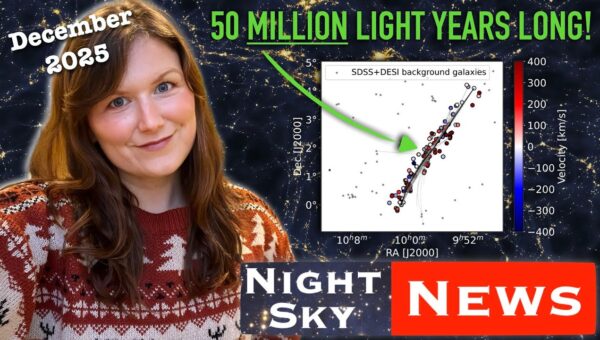
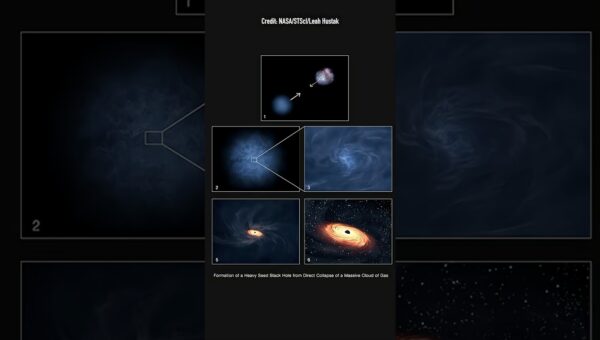
Supermassive Black Holes: A Cosmic Journey Resumes

The pursuit of understanding supermassive black holes has resumed, promising new insights into cosmic evolution. Following a period of personal recovery, astrophysical research is back on track, with 2026 anticipated to bring significant discoveries. This renewed focus aims to make complex science accessible to all.

2 months ago
Science & Space

Interstellar Visitor 3I/ATLAS Reveals Cosmic Secrets

Interstellar visitor 3I/ATLAS has revealed surprising details about its composition and behavior. Passing near the Sun, it exhibited intense outgassing and color changes, and was confirmed by radio telescopes to be a water-rich comet, not an artificial object. Its unique chemistry suggests it has been "cooked" by cosmic rays over billions of years.

2 months ago
Science & Space

CERN’s LHC: No Doomsday Black Hole Threat

Could CERN's Large Hadron Collider create a doomsday black hole? While theoretically possible under certain speculative physics, the scientific consensus and evidence suggest the risks are vanishingly small, with microscopic black holes likely evaporating instantly or having negligible gravitational impact.

2 months ago
Science & Space

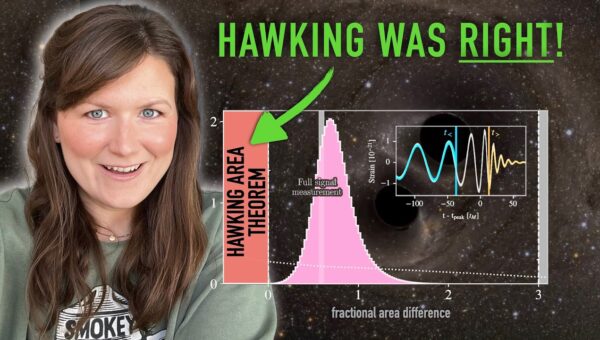
LIGO Detects Strongest Evidence Yet for Hawking’s Area Theorem

LIGO's latest observations of a black hole merger, GW250114, provide the strongest evidence yet for Stephen Hawking's 1971 area theorem. The data confirms that the surface area of the resulting black hole was greater than the sum of the areas of the merging black holes, validating a key prediction about these cosmic enigmas.

2 months ago
Science & Space

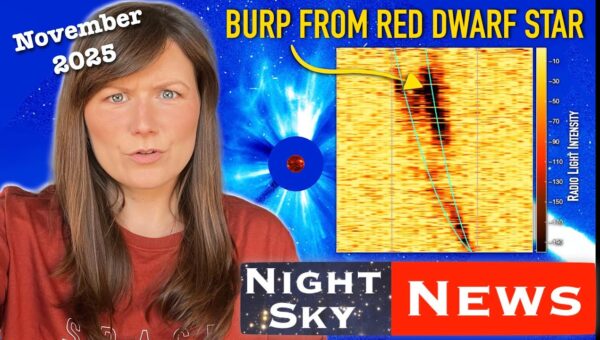
Galactic Radiation Bursts: First Detection on Distant Star

Scientists have detected a powerful coronal mass ejection from a distant star for the first time, offering new insights into stellar activity and planetary habitability. Meanwhile, the James Webb Space Telescope faces record proposal submissions, and new research suggests interstellar comets may be altered by cosmic radiation.

2 months ago
Science & Space

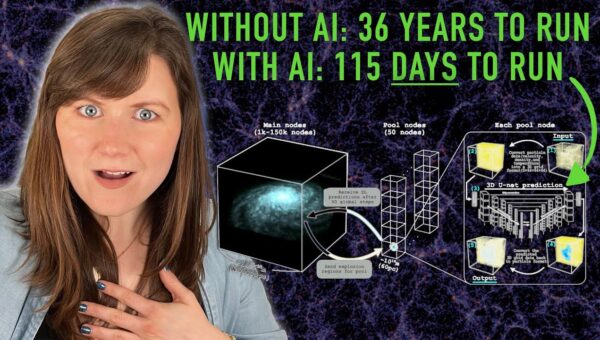
AI Accelerates Milky Way Star Simulation by 113x

Researchers have developed an AI-powered simulation that models the Milky Way's 100 billion stars 113 times faster than previous methods. This breakthrough dramatically accelerates galactic simulations by using neural networks to predict supernova impacts, reducing a 36-year run time to just 115 days.

2 months ago