Artemis II Astronauts Set New Human Distance Record
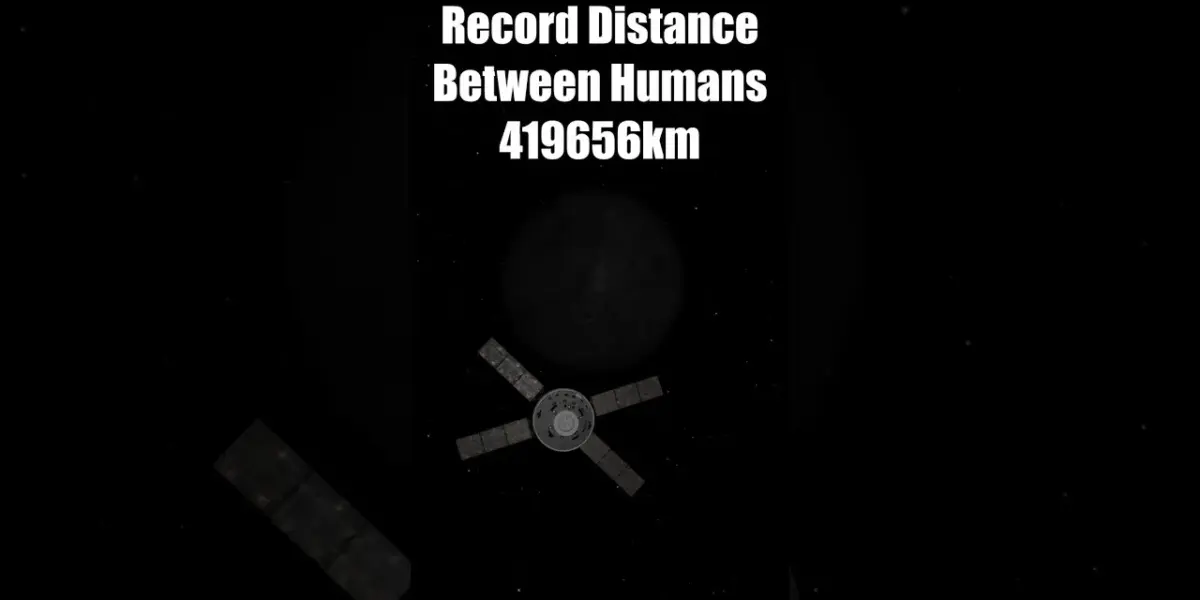
The Artemis II mission set a new human distance record, reaching 413,145 km from Earth. The mission also established a record for the greatest distance between two groups of humans, with astronauts on China's Tiangong space station being 419,656 km away from the Artemis II crew.

Artemis II Astronauts Set New Human Distance Record
The Artemis II mission, which sent four astronauts on a journey around the Moon, has officially set a new record for the greatest distance ever traveled by humans from Earth. While the mission’s duration was relatively short, the data now confirms the incredible reach of this lunar flyby.
Record-Breaking Distance Achieved
Astrophysicist Jonathan McDowell has calculated the precise maximum distance achieved by the Artemis II crew. They reached an astonishing 413,145 kilometers (about 256,720 miles) from the center of the Earth. This distance is more than a thousand times farther than the average distance to the Moon, which is about 384,400 kilometers.
McDowell also pointed out that for people on the far side of the Earth, the astronauts were even farther away. At its furthest point, the spacecraft was approximately 6,400 kilometers (about 4,000 miles) beyond the opposite side of our planet. This point in space was located over the Atlantic Ocean, roughly between Bermuda and Haiti.
A New Definition of Human Spacing
The Artemis II mission’s record isn’t just about how far a single spacecraft traveled. It also highlights a new record for the greatest distance between two groups of humans. This expanded definition considers people in different locations, including those aboard orbiting space stations.
International Space Station Crew
The International Space Station (ISS) was in orbit during the Artemis II flyby. While the ISS was not perfectly positioned on the opposite side of the Earth when Artemis II was at its farthest, it was in a favorable location about 45 minutes earlier. At that moment, the distance between the ISS crew and the Artemis II astronauts was calculated to be 419,578 kilometers (about 260,715 miles). This marked a new record for distance between NASA astronauts.
Chinese Space Station Crew
However, the record was further extended when considering the Chinese space station, Tiangong. Due to its different orbital inclination, Tiangong was in a better position to be farther from the Artemis II crew. Calculations show that the distance between the Chinese space station and the Artemis II astronauts reached 419,656 kilometers (about 260,767 miles). This is 78 kilometers (about 48 miles) greater than the distance between the ISS and Artemis II.
A Global, Yet Complicated, Record
This achievement represents the most widely spaced group of humans in history. It is, in a technical sense, a collaboration between astronauts from the United States and China. However, this record presents a unique challenge due to U.S. law. The Wolf Act, passed in 2011, generally prohibits NASA from engaging in bilateral cooperation with China. This means NASA cannot officially claim this record as a joint achievement.
The situation is further complicated by the nationality of the astronauts. Jeremy Hansen, one of the Artemis II crew members, is from Canada. As Canadian citizens are not subject to the Wolf Act, the record for the greatest distance between humans could technically be attributed to a collaboration between China and Canada.
Historical Context and Future Implications
Previous distance records were often set by spacecraft traveling to the Moon, like the Apollo missions. For instance, Apollo 13 holds the record for the farthest humans from Earth at 400,171 km. The Artemis II mission surpassed this by over 13,000 km. This new record underscores humanity’s growing capability to venture farther into space.
The Artemis program aims to return humans to the Moon and eventually send them to Mars. Missions like Artemis II are crucial stepping stones, testing the technology and human endurance required for these longer journeys. Understanding the challenges and achievements of these missions helps pave the way for future exploration.
What Comes Next?
The Artemis II mission successfully demonstrated the capability of the Orion spacecraft and its systems for a lunar flyby. The data collected, including these distance records, will inform future missions. Artemis III is planned to land astronauts on the lunar south pole, and subsequent missions will aim for longer durations and greater distances, potentially including crewed missions to Mars.
This new human distance record is more than just a number. It represents a significant milestone in our ongoing journey of space exploration. It shows what we can achieve when we push the boundaries of our knowledge and technology. As we continue to explore the cosmos, such records remind us of our place in the vast universe and our potential to reach ever farther.
Source: The Artemis II Distance Record Calculated Exactly! (YouTube)

Related Articles


Mars Rover Detects Mysterious Lightning Signals
NASA's Perseverance rover has detected mysterious crackling sounds, providing the first tantalizing evidence of lightning on Mars. This discovery, along with a faint whistler wave detected by the MAVEN spacecraft, suggests that electrical discharges occur in Martian dust storms, impacting atmospheric chemistry and posing new challenges for future human exploration.


Artemis II: Humanity Reaches for the Moon Again
Artemis II marks humanity's return to lunar exploration, sparking public excitement and practical questions. The mission signifies progress and inspires future generations. It's a crucial step toward deeper space exploration.


Artemis II Rocket Sheds Escape System at Liftoff
Curious objects seen speeding away from the Artemis II rocket at liftoff were part of the Emergency Egress System. This high-tech zipline is designed to rapidly remove astronauts from danger in the event of a launchpad emergency before the rocket commits to flight.