Hungary Rejects Authoritarianism, Sending Shockwaves Globally
Hungary's decisive election of Peter Maguar over Victor Orban marks a significant victory against authoritarianism, impacting global politics. Orban's model influenced movements like MAGA, but his rejection offers critical lessons for the US. The election highlights the fight against corruption and foreign influence, signaling a potential shift in the global balance of power.


Hungary Rejects Authoritarianism, Sending Shockwaves Globally
In a stunning electoral victory, Peter Maguar has unseated Victor Orban in Hungary, ending his 16-year rule. This win, securing a supermajority, has sent waves of celebration through Hungary and signals a significant blow to the global rise of authoritarianism.
For years, Orban served as a key figure, a “proof of concept” for the far-right, authoritarian movement. He was not just an ally of the MAGA movement in the United States; he was, in many ways, their blueprint.
Figures like Steve Bannon hailed Orban as a hero, while Tucker Carlson broadcast his show from Budapest. Donald Trump hosted Orban at Mar-a-Lago. Just days before the election, JD Vance traveled to Hungary, appearing on stage with Orban in a last-ditch effort to support his ally.
This effort, however, failed. The Hungarian people, with nearly 80% turnout, overwhelmingly rejected Orban’s 16 years of corruption, broken promises, and attacks on democratic institutions. They sent a clear message: enough is enough.
A Blueprint for Authoritarianism, Now Rejected
Orban’s model involved a carefully constructed system: a controlled media landscape, a judiciary bent to his will, and a potent blend of Christian nationalism wrapped in nationalistic fervor. This entire project was decisively repudiated by over 3 million Hungarian voters. The implications of this election extend far beyond Hungary’s borders, offering a beacon of hope for those fighting similar battles against authoritarian tendencies worldwide.
The victory has immediate practical consequences. The European Union’s €9 billion in aid for Ukraine, previously blocked by Hungary, has been unfrozen.
This means Hungary’s obstruction of aid to Ukraine is over, and NATO will no longer have to contend with a disruptive force from within the alliance. Crucially, Vladimir Putin loses his last reliable supporter within the European Union, weakening his influence on the continent.
Lessons for the United States
The events in Hungary offer critical lessons for the United States. The MAGA movement has closely studied Orban’s methods for controlling courts, shaping media narratives, and manipulating election maps. Now, they will undoubtedly analyze how he lost and adapt their strategies accordingly.
The upcoming midterm elections in the US present a clear test. Trump and his allies have shown a discipline in learning from failures and applying those lessons.
It would be a mistake to assume that the factors that led to Orban’s downfall will automatically translate to the US. The threats to fair elections, a free press, and an independent judiciary are evolving. Vigilance, organization, and a clear understanding of these authoritarian tactics are essential.
The faces of the Hungarians who fought for their country’s freedom are a powerful reminder of what is at stake. Their fight is a mirror, reflecting a potential future for America if these threats are not countered.
“The authoritarian project he adapted from Orban and inflicted on this country has been discredited, dismantled and defeated. The day is coming when this scene will play out across America’s cities and towns when those flags will be the stars and stripes.”
Expert Insights on Authoritarian Networks
Olga Ldman, a senior fellow at the Center for European Policy Analysis, has dedicated her career to understanding how authoritarian movements operate. She tracks their funding, cross-border coordination, and how democracies can effectively resist them. Ldman is a leading expert on Russian and transnational organized crime networks and how Kremlin influence penetrates Western political systems.
She has meticulously traced the financial and ideological links connecting Putin’s apparatus to far-right movements in Europe and the US, including the networks that supported Orban and continue to operate within American politics. Ldman provides a clear-eyed view of authoritarian capture and the strategies needed to defeat it.
Why This Matters: A Global Fight Against Authoritarianism
The Hungarian election is significant not just for its national impact but for its global implications. Orban’s 16-year tenure saw him systematically undermine democratic institutions.
He rewrote the constitution, took control of universities, and manipulated the media, creating a playbook that authoritarians worldwide have studied. Influencers from the MAGA movement even made pilgrimages to Hungary to learn from his methods.
Orban became an ideological father figure for the MAGA movement, providing a roadmap for seizing control of key societal areas. Steve Bannon and Tucker Carlson’s father worked for him, and numerous CPAC events in Hungary highlighted his influence.
This connection is not coincidental. Investigations have shown Orban acting as a go-between for the Kremlin and far-right movements across Europe and the United States, including groups like Germany’s AfD and France’s National Front.
US Involvement and Russian Tactics
The election in Hungary also revealed a concerning joint US-Russian effort to keep Orban in power. Russia provided extensive information warfare, flooding social media with pro-Orban content and engaging in vote-buying tactics, including distributing care packages to voters. They even deployed GRU and FSB agents to Hungary to manage these operations.
The United States, under the Trump administration, also engaged in efforts to support Orban. JD Vance’s past actions, attempting to block aid to Ukraine through organizations like the Heritage Foundation, which has shifted its stance to be pro-Kremlin, illustrate this connection.
Vance’s campaign appearance with Orban was seen as a continuation of these efforts, essentially carrying out Russia’s agenda with Orban as a key intermediary. This joint operation aimed to prop up Orban, a key Russian proxy and ally of Trump.
A Glimmer of Hope and a Warning
The Hungarian people’s rejection of Orban, coupled with chants of “Russia Out,” signifies a powerful reclaiming of sovereignty. For decades, Orban has been a Kremlin puppet, a fact that baffled many given Hungary’s history with Soviet oppression. The election suggests a renewed memory of that past and a desire to break free from Russian influence.
While the MAGA brand appears to be weakening globally, as seen in failed attempts to influence elections in Romania, Moldova, and Albania, the closeness between the MAGA movement, Trump, and the Kremlin remains a stark warning. Their shared goal of supporting far-right movements and subverting democracies is a threat that requires constant vigilance. The Hungarian election offers a powerful example of a nation fighting back and winning, a victory that should inspire and galvanize democratic forces everywhere.
Looking Ahead: The Evolving Threat
The defeat of Orban is a significant win for democracy, but the fight is far from over. The authoritarian playbook has been studied, and its proponents will adapt. The threats to democratic institutions are not static; they will evolve.
Staying alert, getting organized, and understanding the interconnectedness of these movements are crucial steps in preserving democracy, both in Hungary and in the United States. The faces of those celebrating in Budapest are a reminder that the fight for freedom is a continuous one, requiring courage and a deep love for one’s country.
Source: MAGA Hit with FATAL LOSS amid GLOBAL COLLAPSE (YouTube)

Related Articles


Rogan Slams MAGA Movement: ‘A Bunch of Dorks’
Joe Rogan has openly criticized the 'Make America Great Again' movement, labeling its followers as 'a bunch of dorks.' He finds the slogan itself problematic, preferring the idea of making America 'greater' rather than 'great again.' Rogan's comments highlight concerns about the perceived intelligence and character of those drawn to the movement.

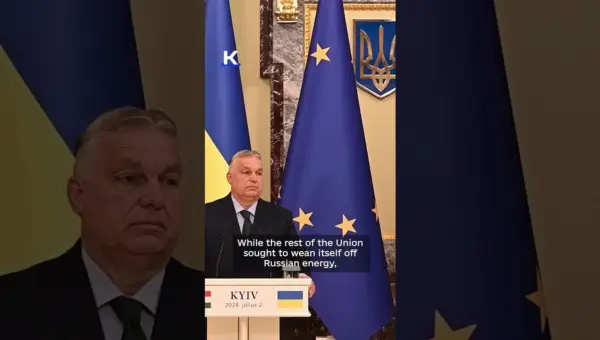
Hungary’s Orban Uses Ukraine War Fear in Election Push
Hungarian Prime Minister Viktor Orban is centering his election campaign on the war in Ukraine. Facing electoral pressure, Orban's Fides party is using fear-mongering tactics and an anti-Ukrainian campaign. He portrays himself as Hungary's sole protector against being drawn into the conflict.


J.D. Vance’s ‘Humiliation Tour’ Hits Rock Bottom Amid Empty Event
Senator J.D. Vance experienced a significant public relations setback this week, highlighted by a poorly attended Turning Point USA event and criticism for his remarks about Pope Francis. The senator's recent political engagements appear to have backfired, raising questions about his standing.