House Rejects War Powers Resolution on Iran
The House of Representatives narrowly defeated a resolution aimed at limiting President Trump's military actions against Iran, with a vote of 213-214. The close outcome revealed divisions among lawmakers, including key votes from a Republican and a Democrat who supported the measure. This decision reinforces the President's authority in foreign military engagements.

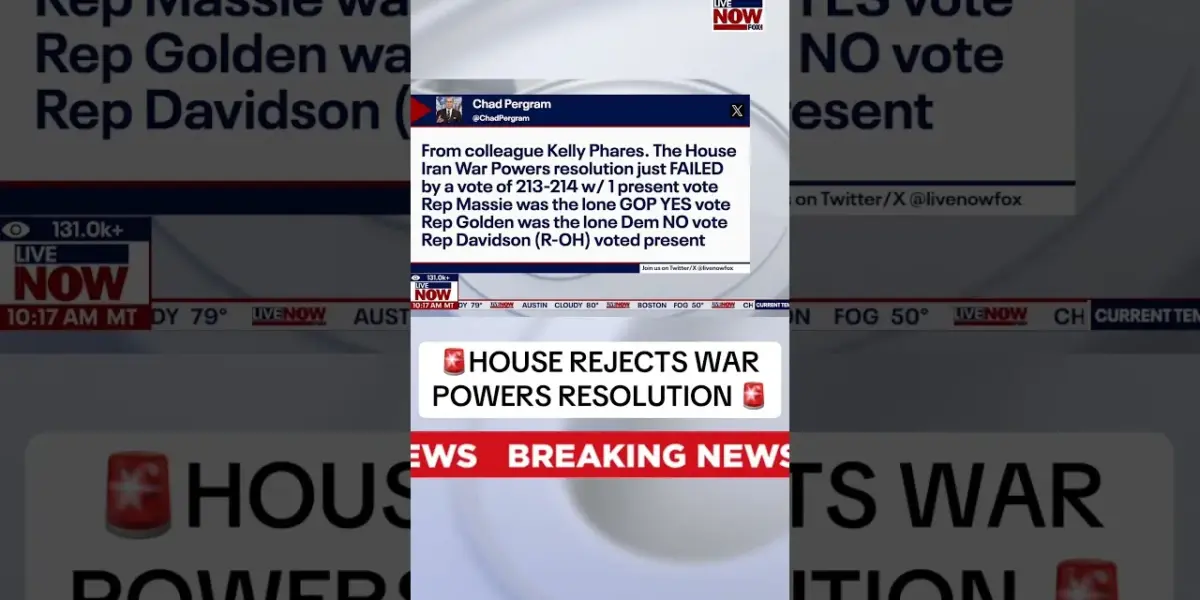
House Votes Down Iran War Powers Resolution
The House of Representatives narrowly rejected a resolution that would have limited President Trump’s ability to take military action against Iran. The vote, which occurred on Wednesday, saw 213 members vote no and 214 vote yes, with one member voting present. This close decision highlights deep divisions within Congress over presidential war powers and the nation’s engagement with Iran.
Key Votes Shape the Outcome
The War Powers Resolution, championed by Democrats, aimed to prevent further military escalation against Iran without congressional approval. Its failure to pass highlights the complex political dynamics at play.
Representative Thomas Massie, a Republican from Kentucky, cast a surprising vote in favor of the resolution. Massie has previously voiced strong disagreements with President Trump regarding military policy toward Iran.
On the other side, Representative Jared Golden, a Democrat from Maine, also voted in favor of the resolution. Golden represents a district that President Trump won by a significant margin in 2020.
Despite this, Golden has chosen not to seek re-election, opting to retire from Congress. His vote adds another layer to the political calculations behind this decision.
Division and Dissent
Representative Warren Davidson, a Republican from Ohio, was the sole member to vote present. Voting present means a member does not cast a ‘yes’ or ‘no’ vote, effectively abstaining from the decision.
This abstention, while not changing the final outcome, reflects the nuanced positions some lawmakers hold on matters of war and foreign policy. The razor-thin margin of the vote—just one vote—demonstrates the difficulty Congress faces in reaching a consensus on military interventions.
Context of War Powers
The War Powers Resolution of 1973 is a federal law passed over President Nixon’s veto. It requires the President to notify Congress within 48 hours of committing U.S. armed forces to military action.
It also prohibits armed conflict from continuing beyond 60 days without congressional authorization or a declaration of war. This resolution has been a point of contention between presidents and Congress for decades, as different administrations have interpreted its scope and requirements differently.
Recent tensions with Iran, including the killing of Iranian General Qasem Soleimani in January 2020, had prompted Democrats to push for this resolution. They argued that the President had not provided sufficient justification or congressional consultation for his actions. The White House, however, maintained that the President had the authority to act in self-defense and protect U.S. interests.
Broader Implications
The failure of this resolution has significant implications for the balance of power between the executive and legislative branches. It suggests that, at least for now, the President retains broad discretion in conducting foreign policy and military operations concerning Iran. This outcome could embolden the administration to continue its current approach without seeking further congressional input.
For members like Representative Golden, voting against the administration’s general foreign policy stance while representing a Trump-leaning district is a challenging political act. His decision to retire may signal the increasing difficulty for moderate Democrats in such districts to win re-election. The vote also highlights the ongoing debate about Congress’s constitutional role in authorizing the use of military force.
Looking Ahead
While this specific resolution did not pass, the debate over war powers and U.S. policy toward Iran is likely to continue. Future actions by the administration or developments in the region could prompt further attempts by Congress to assert its authority. Lawmakers on both sides of the aisle will continue to grapple with how to best balance national security concerns with the need for democratic oversight in matters of war.
Source: House rejects war powers resolution (YouTube)

Related Articles


Iran’s Economy Crippled, Gas Prices May Hit $3 Soon
A U.S. senator claims Iran's military and economy are crippled, suggesting "game over" for the nation. Simultaneously, optimism is high for gas prices to fall below $3 per gallon by late summer or early fall, referencing historical trends.

Senator Duckworth Slams ‘Incoherent War’ Threatening Global Stability
Senator Tammy Duckworth has strongly criticized the current military operations as an "incoherent war" lacking clear objectives and planning, which is unsettling allies. She plans to repeatedly bring the War Powers Resolution to a vote, urging Congress to reclaim its constitutional authority over decisions to go to war.


Iran’s Missile Claims Debunked by US Intel
Recent claims of Iran's complete military defeat are being challenged by U.S. intelligence, which suggests Iran retains significant missile capabilities. This discrepancy highlights potential misrepresentations of conflict outcomes and impacts diplomatic efforts.