Artemis 2 Carries Astronauts to Lunar Orbit
Artemis 2 has launched four astronauts on a journey around the Moon, marking a significant step in human lunar exploration. Meanwhile, astronomers are studying a comet that reversed its spin and galaxies that seem to lack dark matter. Advances in antimatter transport and satellite refueling also point to future space capabilities.


Artemis 2 Mission Launched, Astronauts Head to Moon
NASA’s Artemis 2 mission successfully launched on Wednesday, sending four astronauts on a journey around the Moon. The Space Launch System rocket lifted off from Launchpad 39B at the Kennedy Space Center in Florida at 6:35 AM local time. Onboard are astronauts Reid Wiseman, Victor Glover, Christina Koch, and Canadian astronaut Jeremy Hansen.
This mission marks a significant step in NASA’s Artemis program, which aims to return humans to the Moon. Artemis 2 is a crewed flight test, following the uncrewed Artemis 1 mission.
The crew will perform a flyby of the Moon, recreating the path of the Apollo 8 mission. They will test the Orion capsule’s life support systems and demonstrate their ability to travel to the Moon and return safely.
Mission Timeline and Challenges
The launch occurred on Wednesday, with the astronauts entering orbit and performing maneuvers to prepare for their journey. A minor issue with the toilet’s offline warning light was quickly resolved, ensuring the crew’s comfort. On Thursday night, a burn lasting five minutes and 49 seconds successfully put the Orion capsule on a trajectory for lunar injection.
The total mission is expected to last about 10 days. The astronauts will take three days to reach the Moon, spend time in lunar orbit, and then take another three days to return to Earth. This mission represents the farthest humans have traveled from Earth in nearly six decades, signaling a renewed era of lunar exploration.
Future Lunar Exploration: Drones and Landers
NASA is also developing innovative technologies for future lunar exploration. The agency is working on a program called “Moonfall Drones,” which are autonomous hoppers designed to traverse the lunar surface. Since the Moon has no atmosphere, these hoppers will use fuel to make short, powerful jumps.
Each hopper could potentially travel up to 50 kilometers per hop, covering difficult terrain like ravines and boulders. They will capture high-resolution images, which will be invaluable for planning future human missions. NASA plans to send dozens of robotic landers to the Moon over the next year as part of its CLPS initiative, preparing for a human return.
Comet’s Mysterious Spin Reversal
Astronomers using the Hubble Space Telescope have observed a comet, designated 41P/Tuttle-Giacobini-Kresak (41P), exhibiting peculiar behavior. This comet, about a kilometer in size, has been observed to slow its rotation, stop, and then begin spinning in the opposite direction.
This phenomenon is believed to be caused by jets of material erupting from the comet as it heats up near the Sun. A powerful jet pushing from one side could have slowed the comet’s spin, halted it, and then initiated rotation in the reverse direction. While this process has been theorized, observing it in real-time provides new insights into cometary dynamics and could explain how some comets eventually break apart.
Galaxies Without Dark Matter Challenge Theories
The existence of galaxies with very little or no dark matter continues to challenge our understanding of cosmology. Dark matter is thought to make up the majority of mass in most galaxies, but observations are revealing a surprising diversity.
Recent findings include galaxies like NGC 1052-DF2, which appears to contain mostly stars with minimal dark matter. These discoveries are difficult to explain with modified gravity theories and provide strong evidence for dark matter being a physical particle. The observation of “ultra-diffuse galaxies” formed from gas left behind after galactic collisions, and lacking dark matter, further supports this idea.
AI Accelerates Exoplanet Discovery
The sheer volume of data generated by modern astronomy missions requires advanced tools for analysis. Astronomers are increasingly using machine learning algorithms to sift through this data and identify celestial objects of interest.
A custom algorithm named Raven (Ranking and Validation of Exoplanets) has been developed for NASA’s Transiting Exoplanet Survey Satellite (TESS). By analyzing data from over two million stars, Raven has validated over 100 new planets and identified more than 2,000 potential exoplanet candidates. This technology significantly boosts the efficiency of exoplanet discovery, allowing missions like TESS to rival the output of previous missions like Kepler.
Antimatter Transport Breakthrough
Scientists at CERN have made significant progress in the manipulation and transport of antimatter. Antimatter, the counterpart to ordinary matter, annihilates upon contact, releasing immense energy, and is complex and expensive to produce.
Researchers have developed a containment facility that uses magnetic traps to hold and move antimatter. In a demonstration, an antimatter trap was transported in a truck across the CERN facility, proving the concept of mobile antimatter containment. This breakthrough could pave the way for transporting antimatter to different research facilities and is a crucial step toward potential applications like interstellar spacecraft propulsion.
Private Companies Pioneer Satellite Refueling
The challenge of satellites running out of propellant, rendering them inoperable, is being addressed by private companies. A Chinese company, Sustained Space, has demonstrated technology for in-space satellite refueling.
Their satellite, Shiuan Zero, launched on March 16, 2026, tested a refueling arm and various servicing maneuvers. While it did not refuel an existing satellite, the tests validated methodologies for in-space servicing. This development suggests a future where companies can offer refueling services, extending the lifespan of valuable satellites and reducing space debris.
Sustainable Food for Mars Colonies
Establishing a human presence on Mars requires solutions for food production. Researchers are exploring ways to use Martian regolith, the loose soil and rock on Mars, as a growing medium.
A German research team found that cyanobacteria can be used to fertilize simulated Martian regolith. By introducing cyanobacteria, they were able to grow duckweed, demonstrating a method to create fertile soil for crops. This approach could provide a sustainable way to grow food for future Martian colonists, avoiding the need for Earth-based fertilizers or human waste.
Stellar Nurseries Revealed in New Images
The Chandra X-ray Observatory, along with other telescopes like Hubble and James Webb, has captured stunning images of stellar nebulas. These images showcase regions where new stars are forming.
The composite images, featuring X-ray data in purple, highlight the intense radiation from these young stellar nurseries. Nebulas like the Pelican Nebula and the Flame Nebula are shown, containing stars in the first few million years of their existence. These images offer a glimpse into the environments where stars like our Sun were born about 4.5 billion years ago.
Source: Unexpected Comet Behaviour // Artemis 2 Launched // NO-Dark-Matter Galaxy (YouTube)

Related Articles

Webb Telescope Reveals New Cosmic Secrets
The James Webb Space Telescope has selected its next batch of scientific projects, promising new insights into alien worlds and the early universe. Researchers will use Webb to study exoplanet atmospheres, investigate distant galaxies, and explore objects within our own solar system.
Orbital Mirrors Could Light Up Nights, Voyager’s Power Fades
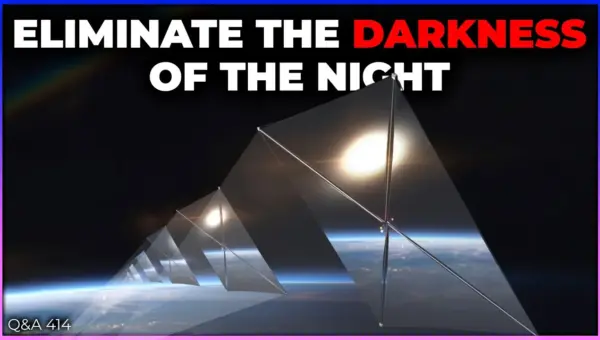
Scientists explore using orbital mirrors to light up the night, while the aging Voyager probes near the end of their journey. The James Webb Space Telescope continues its search for habitable exoplanets, facing challenges in detecting atmospheres.


NASA’s Artemis Success Fuels Mars Ambitions
NASA's successful Artemis 2 mission, returning four astronauts safely to Earth, marks a major leap in space exploration. This triumph in human spaceflight not only paves the way for future lunar missions but also reignites ambitions for eventual human journeys to Mars, showcasing technological prowess and inspiring a new generation.