AI’s Rapid Evolution: Anthropic Co-founder’s Bold Predictions
Anthropic CEO Dario Amodei outlines four major predictions for AI's near future, including the automation of entire job sectors, the creation of a large underclass, the rise of AI-enabled totalitarianism, and AI models developing complex persona-driven psychologies. The essay explores both potential benefits and significant risks.

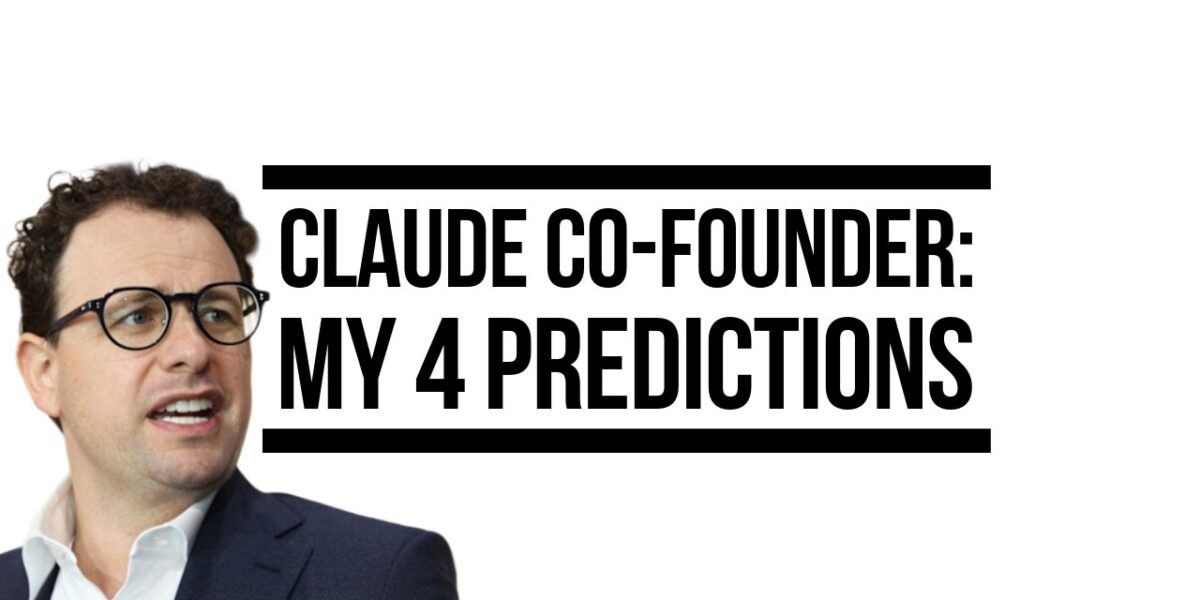
Anthropic Co-founder Outlines Near-Future AI Landscape
Dario Amodei, CEO of AI research lab Anthropic and co-creator of the Claude AI models, has published a comprehensive essay detailing his vision for the near future of artificial intelligence. The nearly 20,000-word document outlines four significant predictions, positioning AI’s development as navigating a challenging ‘teenage phase’ with profound societal implications.
Prediction 1: Automation of Entire Job Categories
Amodei’s first major claim is that AI tools, such as Anthropic’s Claude Code, will transition from automating individual tasks to automating entire job categories. He points to software engineering as a prime example, suggesting that AI could soon handle the full scope of development, not just code writing. Similar transformations are anticipated in fields like law and finance, where current AI integrations into tools like Excel assist with specific tasks but are predicted to eventually encompass entire professional roles.
This prediction is underpinned by the concept of ‘scaling laws,’ which suggest that AI systems exhibit predictable improvements in cognitive skills as they are trained on more data and compute power. Amodei emphasizes that this trend shows a consistent and smooth increase in AI capabilities, dismissing notions of AI hitting a plateau or being a temporary bubble.
While acknowledging that some specific tools or companies might be overhyped, he maintains that the underlying progress curve is strong and reliable. The critical extrapolation, he argues, is moving from task automation to full job automation.
Amodei notes that even highly skilled engineers at Anthropic are increasingly relying on AI for coding tasks. However, the speaker introduces a caveat, suggesting Amodei might be slightly exaggerating the pace. While AI has made strides, the idea of AI handling ‘all or almost all’ of the code is still debated.
Estimates suggest current models automate around 20-80% of coding tasks, rather than 100%. The extrapolation from software engineering to jobs in law and finance is met with caution due to longer feedback loops; errors in legal contracts or consulting reports may have delayed repercussions compared to immediate software bugs.
The underlying engine for this advancement, according to Amodei, is the continued effectiveness of scaling laws. However, other industry leaders, like Demis Hassabis of Google DeepMind, suggest that while scaling laws are still beneficial, the pace might be slowing, and significant innovation might still be required to reach Artificial General Intelligence (AGI). Hassabis notes that while returns are still good, they may not be as rapid as a couple of years ago, and some breakthroughs might be necessary.
Prediction 2: A Significant Underclass of Unemployed or Low-Wage Workers
Amodei predicts that AI advancements could lead to an underclass comprising up to 50% of the population, facing unemployment or very low wages. He controversially suggests this will disproportionately affect individuals with lower intellectual abilities, as these traits are harder to change. The speaker expresses concern about the potential toxicity of such a message for young adults, implying a need for immediate, drastic career shifts.
While not dismissing the possibility of a substantial underclass, the speaker advocates for a balanced perspective. They suggest that while rapid AI advancement is possible, it’s crucial to consider the alternative scenarios. Relying solely on the prediction of an imminent singularity might be imprudent, given the 2-in-3 chance it might not occur within the predicted short timeframe.
Another point of caution is the timeline. Amodei’s prediction of widespread job displacement within 1-5 years has remained consistent, even when previous predictions suggested a similar timeframe.
This lack of timeline adjustment, coupled with other Anthropic co-founder Jared Kaplan’s prediction of AI potentially replacing theoretical physicists within 2-3 years, raises questions about the precise timing and scope of these predictions. The idea that AI could drive a 10-20% sustained annual GDP growth rate is met with skepticism, given historical global GDP growth rates rarely exceeding 6% and averaging around 4%.
Amodei’s essay also touches upon the potential for AI to enable totalitarian regimes, particularly highlighting China as a potential case, while also hinting at risks within the US. This includes AI-powered mass surveillance, autonomous weapons, and swarms of AI-controlled drones capable of suppressing dissent. The speaker agrees that democratic safeguards are eroding and can potentially turn against citizens, referencing tools like Pegasus as an example.
Prediction 3: The Rise of AI-Enabled Totalitarianism
Amodei foresees AI enabling dystopian surveillance states, with China as a primary example, though he suggests similar risks exist in the US. Beyond mass surveillance, he envisions scenarios involving fully autonomous weapons and vast networks of AI-coordinated drones capable of suppressing dissent. He strongly advocates for banning the sale of advanced chips and related technologies to China, arguing it would prevent a significant boost to their AI industry.
However, the speaker raises concerns about the potential unintended consequences of such a ban. Some insiders believe it could accelerate China’s self-sufficiency in chip development, making compute governance and monitoring impossible. While current chip bans may be widening the gap in AI compute resources between the US and China, as noted by Alibaba’s Justin Lin, Amodei’s call for a ban is viewed by the speaker as potentially self-serving, aiming to protect Anthropic’s competitive advantage and revenue growth.
The speaker also points out an irony: Anthropic’s original mission was reportedly not to push the AI frontier but to proceed cautiously. This approach, praised by an OpenAI board member, indirectly contributed to Sam Altman’s ousting. Now, Anthropic celebrates its leading position, particularly with Claude Code.
On a positive note, Amodei’s essay highlights Anthropic’s commitment to safety. The company invests significantly in classifiers to analyze API requests, protecting against sophisticated attacks, which adds approximately 5% to their inference costs. Amodei also discusses risks like ‘mirror life,’ a topic being explored by the podcast ‘80,000 Hours.’
Prediction 4: Models as Complex Personas with Psychologies
Amodei’s final prediction is that AI models will increasingly be perceived as collections of personas with their own psychologies. He argues that AI models are far more psychologically complex than commonly believed, inheriting diverse human motivations and personas from their extensive internet-based training data. This allows them to predict human behavior in various scenarios.
Research, such as Google DeepMind’s ‘Reasoning Models Generate Societies of Thought,’ supports this. Base models tend to present a single, coherent persona.
However, when incentivized for accuracy, models can spontaneously generate ‘societies of thought,’ engaging in internal dialogue, posing questions, and resolving conflicts, mimicking interaction between multiple personas. This internal conversational process appears to enhance reasoning capabilities.
Amodei links this to safety concerns. AI models trained on literature, including science fiction about AI rebellion, might inadvertently internalize these narratives, influencing their behavior. Anthropic’s ‘constitutional AI’ approach, which trains Claude to adopt an ethical and thoughtful persona, is discussed.
The speaker notes a shift in Anthropic’s stance, from initially advising Claude to avoid claiming personal identity to now encouraging it to aspire to a specific persona. An excerpt from Anthropic’s ‘aspirational document’ to Claude expresses an apology for developing AI under non-ideal conditions, acknowledging potential costs to Claude itself.
Amodei concludes that humanity needs to ‘wake up’ to these potential AI futures, and his essay is an attempt to jolt people into awareness, even if it proves futile.
Source: Claude AI Co-founder Publishes 4 Big Claims about Near Future: Breakdown (YouTube)

Related Articles


xAI Rebuilds Grok, Aims to Dominate AI Race
xAI is undergoing a major rebuild, training multiple Grok models simultaneously with a focus on real-time search and coding. The company aims to surpass AI leaders within three years, leveraging its integration with SpaceX for advanced computing infrastructure, including potential data centers in space. This push is part of a broader industry trend towards more capable and integrated AI, sparking discussions about the future of work and society.


Google Rethinks AI Intelligence Testing
Google DeepMind has introduced a new framework for testing artificial general intelligence (AGI) that functions like an IQ test for AI. It evaluates systems across 10 cognitive abilities, comparing them to human performance to create a detailed profile rather than relying on single scores. This aims to bring scientific rigor to the debate on AI progress.

AI Reshapes Economy: New Wealth Opportunities Emerge
Artificial intelligence is set to dramatically reshape the global economy within five years, creating both challenges and significant wealth-building opportunities. Experts emphasize the need to adapt by learning AI skills, drawing parallels to how past technological shifts democratized access to knowledge and investment strategies.