OpenAI Hints at GPT-5.5’s Smarter, Faster AI Future
OpenAI's upcoming AI model, possibly GPT-5.5 "Spud," is set to offer significant improvements in understanding, speed, and problem-solving after a two-year development cycle. Early previews suggest enhanced capabilities in coding, reasoning, and native multimodality, aiming to make AI a more autonomous digital worker.


OpenAI Hints at GPT-5.5’s Smarter, Faster AI Future
New information suggests OpenAI’s upcoming AI model, possibly named GPT-5.5 or “Spud,” will offer significant leaps in understanding and problem-solving.
Greg Brockman, a co-founder of OpenAI, has discussed the model’s potential, indicating it will tackle much harder problems and understand instructions with greater nuance. He described a feeling of “big model smell” when models become much smarter and more capable, bending more to the user’s will.
A New Foundation for AI
This next-generation model has reportedly been in development for two years, suggesting it’s built on an entirely new foundation rather than being a simple update. This long development cycle points to a “step change” in capabilities, enabling users to perform tasks previously out of reach.
Brockman explained that “Spud” is seen as a new base, a fresh pre-training effort incorporating two years of research. He expects the world to experience this as improved capabilities, with an “engine of progress” that moves faster over time.
Early User Feedback and Benchmarks
Individuals who have previewed “Spud” describe it as an incredible and usable model, potentially on par with or even surpassing competitors like Anthropic’s Opus 4.7. Early reports suggest it offers faster generation times and more detailed, coherent outputs compared to current models.
While exact benchmark numbers are not yet public, expected results indicate a 10-15% improvement across various areas. This could allow OpenAI to regain the lead in certain benchmarks, particularly in coding and complex reasoning tasks, where competitors have recently excelled.
Beyond Text: Multimodality and Autonomy
A key rumored advancement is native multimodality, meaning the AI could process different types of information like text, images, and audio directly. Current models often convert everything to text first, which can be less reliable.
The model is also being developed as an “autonomous digital worker.” Unlike earlier versions focused on coding assistance, “Spud” is expected to handle enterprise workflows and deep reasoning with more independence. This focus on computer use, long context understanding, and seeing visual information is crucial for AI agents to become truly helpful assistants.
Potential Capabilities in Action
Early examples shared online hint at “Spud’s” impressive performance, particularly in generating complex applications from simple prompts. One user noted that generations are three to four times faster and significantly better, making it a “material upgrade” for tasks like coding.
Examples show the model creating functional code for games and applications with surprising coherence and speed. This improved coding ability, combined with common-sense reasoning, could significantly challenge existing AI leaders in enterprise-focused areas.
Image Generation Gets an Upgrade
In addition to text-based advancements, OpenAI is also preparing to launch “Images v2” for ChatGPT. This new image generation model is reportedly better than existing high-end models in specific, nuanced scenarios.
While everyday users might not immediately notice the difference, “Images v2” seems to possess a better “world model,” understanding physics, shapes, and styles more effectively. This leads to higher fidelity and more aesthetically pleasing images, particularly in complex or artistic prompts.
Why This Matters
The anticipated improvements in GPT-5.5, including its enhanced reasoning, speed, and multimodal capabilities, point towards AI becoming more integrated into daily work and complex problem-solving. For businesses, this could mean more capable AI agents handling intricate tasks, automating workflows, and driving innovation.
For individual users, the promise is an AI that understands instructions better, requires less explanation, and becomes a more intuitive tool for creative and practical endeavors. The advancements in image generation also suggest a future where AI can produce highly specific and artistic visuals with greater ease.
OpenAI’s continued focus on these areas suggests a strategic push to make AI more autonomous, versatile, and deeply integrated into user workflows. The release of “Images v2” is expected this week, with further details on GPT-5.5 likely to follow.
Source: The GPT 5.5 Leaks Are Wild (YouTube)

Related Articles


Trump: US Navy Blockade Closed Strait of Hormuz
President Trump asserted that the U.S. Navy's blockade, not Iran's claims, has closed the Strait of Hormuz amid rising U.S.-Iran tensions. U.S. intelligence also suggests China may be considering supplying Iran with advanced radar systems, though Beijing denies sending weapons. Skepticism surrounds China's reported economic growth figures, with experts pointing to inconsistencies.


Iran’s AI-Powered ‘Slopaganda’ War Targets Americans Online
Iran is employing advanced AI to create and spread 'slopaganda,' using internet culture to influence American views on global conflicts. This digital strategy bypasses traditional media, reaching younger audiences directly through memes and fake videos. Experts warn that this approach exploits information gaps and highlights a need for better U.S. online communication strategies.

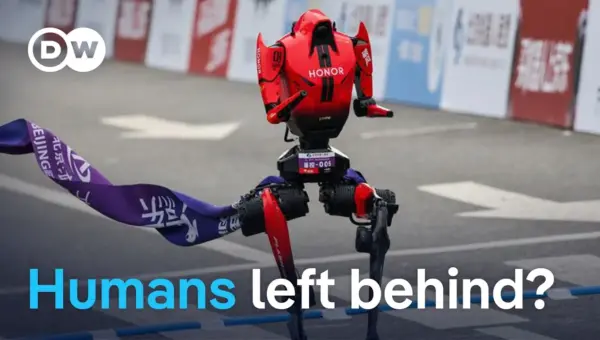
Robot Runner Beats Human Champion in Half Marathon
A recent half marathon in Beijing saw a robot named 'Lightning' shatter human records, finishing the 21km race nearly seven minutes faster than the men's world record. Experts highlight this as a significant milestone in robotics, driven by advances in hardware, control, and AI, while also cautioning against overstating current capabilities in areas like independent thought and home integration.