Robot Runner Beats Human Champion in Half Marathon
A recent half marathon in Beijing saw a robot named 'Lightning' shatter human records, finishing the 21km race nearly seven minutes faster than the men's world record. Experts highlight this as a significant milestone in robotics, driven by advances in hardware, control, and AI, while also cautioning against overstating current capabilities in areas like independent thought and home integration.

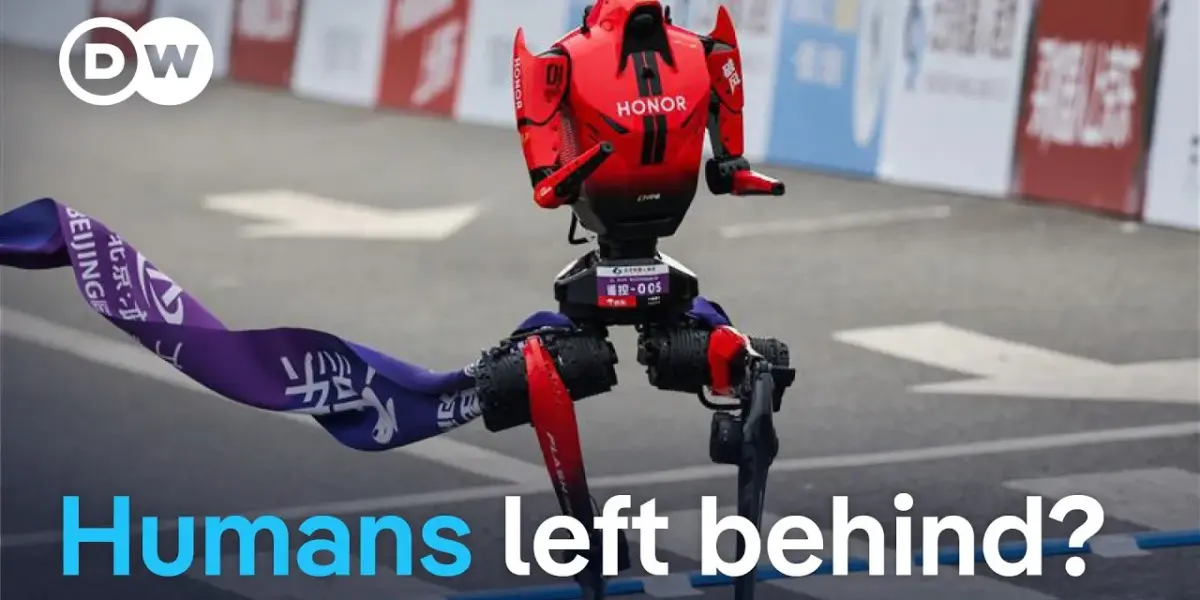
Robots Outpace Humans in Beijing Half Marathon
Beijing recently hosted a unique half marathon where human runners were left behind by a record-breaking robot. Thousands of participants gathered at the start line, not just to compete against each other, but also against dozens of robots showcasing their advanced athletic and navigation abilities. The event featured separate lanes for humans and robots to prevent any accidents, making it the only global competition of its kind with over 100 robot runners, including international teams from Germany, France, and Brazil.
‘Lightning’ Sets New Speed Record
The winning robot, aptly named ‘Lightning,’ delivered an astonishing performance. It completed the 21-kilometer course in an impressive 50 minutes and 26 seconds. This time was nearly seven minutes faster than the current men’s half marathon world record.
The first human to finish the race, a 29-year-old Chinese runner, admitted he was soundly beaten by the machine. He reported seeing five or six robots pass him within the first five kilometers, noting the incredible speed of one particular red robot.
Expert Insights on Robotic Advancement
Professor Rainder Da, an expert in robotic touch sensing from Northeastern University, described the event as an important milestone, though largely symbolic. He explained that while robots have come a long way since early models like Sony’s Aibo over 20 years ago, this race highlights significant progress in key areas. Advances in energy efficiency, motor control, and lightweight materials have led to better batteries and more precise movements, allowing robots to achieve greater endurance and optimization.
How Robots Achieve High Performance
Professor Da outlined three main reasons for these robots’ athletic capabilities: better hardware, improved control systems, and enhanced learning through artificial intelligence (AI). Modern robots utilize efficient motors and advanced batteries for longer, more powerful movements.
Sophisticated control systems help maintain balance and coordination during running. AI plays a key role, enabling robots to learn optimal movement patterns through simulations and years of collected data, much like human athletes improve with training.
Robots in Everyday Life and Security
The discussion also touched upon the increasing presence of robots in our lives, citing examples like robotic dogs used for security patrols. Professor Da noted that robots are gradually entering specific domains where they offer immediate value, such as security inspection and monitoring in structured environments. While not yet universally present in daily life, they are steadily embedding themselves into specialized roles across society.
Can Robots Truly ‘Think’ and ‘Plan’?
Regarding robots performing household tasks, like those demonstrated by Google DeepMind, Professor Da clarified that robots are not yet capable of true independent thought or planning in the human sense. Systems that combine large language models with robotics can execute multi-step tasks, but they rely heavily on learned patterns and structured environments with available data. They still struggle with uncertainty and dynamic conditions, unlike the controlled marathon environment where only one robot ran at a time.
Safety Concerns for Home Robots
Widespread deployment of robots in homes still faces significant safety hurdles. Homes are unpredictable environments, and current robots lack the advanced sensing capabilities, particularly touch, needed for safe interaction with humans and objects.
Achieving safe integration requires combining vision, touch, and audio sensors with intelligent control. While simple robots like vacuum cleaners exist, more complex household robots are still some way off.
Robotics in Military Applications
The increasing use of autonomous machines in military applications, such as in Ukraine, raises concerns. Professor Da acknowledged the clear benefits of using robots for dangerous tasks like landmine detection and bomb disposal, which can save human lives.
However, the growing capability and autonomy of robots also bring serious ethical questions about accountability, decision-making, and potential misuse. Cybersecurity is another critical consideration, emphasizing the need for strong ethical frameworks and international oversight.
The Future of Work and Robotics
Concerns about robots taking over human jobs were addressed as a transformation rather than a complete replacement. Robots can be beneficial in replacing humans in repetitive, physically demanding, or hazardous tasks, improving productivity and quality of life.
Many jobs will evolve, and new roles will emerge. The key challenge lies in managing this transition to be socially and economically inclusive.
Ethical Frameworks and Policy Development
The development of mechanisms to check the use of robotic technology is an ongoing process. Ethical considerations in AI and robotics are being explored alongside research advancements.
As robots become more common in public spaces, policies and regulations will emerge. The professor concluded that while robots are still far from widespread use in homes, their integration into public life is a work in progress, with corresponding policies still under development.
Source: China: Humanoid robots leave humans behind on the racetrack | DW News (YouTube)

Related Articles


Iran’s Digital Barrage: How Social Media Targets Trump
Iranian social media accounts are using AI and rapid content creation to mock Donald Trump and his allies. They employ satire and direct accusations, turning Trump's own tactics against him. This digital campaign highlights the growing role of social media in international influence operations.


AI Unleashes New Shockwaves Across Software Sector
New AI models like Claude are rapidly disrupting the software industry, challenging traditional business models and impacting stock valuations. Investors are shifting focus from software companies to the underlying AI infrastructure and cloud services powering these advancements. The trend suggests a significant revaluation of software assets as AI takes over human-driven workflows.

Gen Z’s AI Enthusiasm Dips Sharply
New data shows Gen Z's excitement for AI has sharply declined, with anxiety and anger on the rise. This contrasts with AI experts' high optimism about the technology's impact on jobs. Bridging this perception gap is crucial for AI's future.