US Launches ‘Operation Epic Fury’ with Over 1,000 Strikes in Iran
The U.S. military has launched 'Operation Epic Fury,' conducting over 1,000 aerial strikes in Iran. Directed by President Trump, the operation aims to neutralize Iran's nuclear program, ballistic missiles, and naval capabilities, marking a significant escalation after decades of hostility.

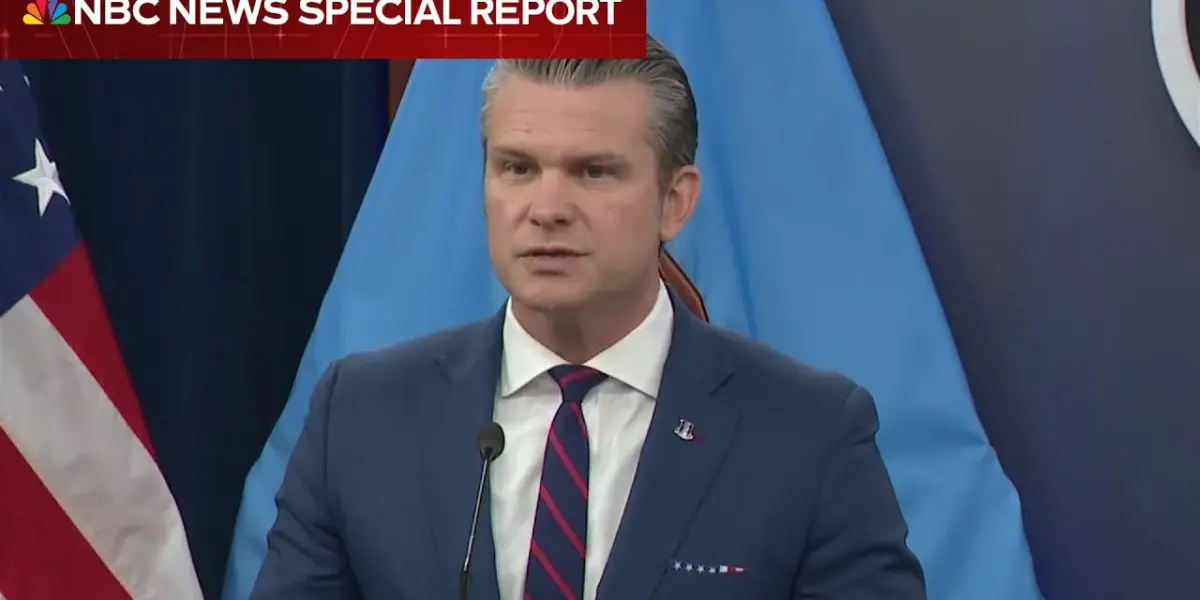
US Launches ‘Operation Epic Fury’ with Over 1,000 Strikes in Iran
WASHINGTON D.C. – In a dramatic escalation of tensions, the United States military has initiated ‘Operation Epic Fury,’ launching more than 1,000 aerial strikes inside Iran. Defense Secretary Pete Hegseth announced the commencement of the operation, described as the “most lethal, most complex and most precise aerial operation in history,” directed by President Donald J. Trump.
The operation, which began on Saturday, February 28th, at 01:15 EST, marks a significant shift in U.S. Policy towards Iran, which Hegseth characterized as a 47-year “one-sided war” against America. “We didn’t start this war, but under President Trump we are finishing it,” Hegseth stated at a Pentagon briefing. “Their war on Americans has become our retribution against their Ayatollah and his death call.”
Decades of Hostility Culminate in Military Action
Secretary Hegseth detailed a long history of Iranian aggression, citing car bombs in Beirut, rocket attacks on U.S. Ships, murders at embassies, and roadside bombs in Iraq and Afghanistan, all allegedly funded and armed by Iran’s Quds Force and IRGC. He emphasized that President Trump’s administration has drawn a line after decades of Iranian belligerence, stating, “If you kill Americans, if you threaten Americans anywhere on Earth, we will hunt you down without apology and without hesitation and we will kill you.”
The operation is explicitly aimed at neutralizing Iran’s nuclear ambitions, ballistic missile program, and naval capabilities. Hegseth reiterated President Trump’s stance that regimes like Iran cannot possess nuclear weapons, calling it “common sense” that requires “guts to enforce.” He highlighted Iran’s pursuit of nuclear weapons, targeting of global shipping lanes, and its arsenal of ballistic missiles and drones as intolerable risks. “Iran was building powerful missiles and drones to create a conventional shield for their nuclear blackmail ambitions,” Hegseth explained.
Operation Epic Fury: Objectives and Execution
General Kaine, providing operational details, confirmed that the military objectives for U.S. Central Command (CENTCOM) are clear: to protect and defend the U.S. And its regional partners, prevent Iran from projecting power outside its borders, and be ready for follow-on actions. These objectives include destroying Iranian offensive missiles, missile production facilities, its navy, and other security infrastructure, while ensuring Iran never obtains nuclear weapons.
The initial phase of Operation Epic Fury involved a massive, synchronized wave of over 100 aircraft launched from land and sea, including fighters, tankers, bombers, and unmanned platforms. U.S. Navy Tomahawk missiles were deployed against Iranian naval forces, while precision standoff weapons were fired from the ground. In the first 24 hours, more than 1,000 targets were struck, focusing on Iran’s command and control infrastructure, naval forces, ballistic missile sites, and intelligence infrastructure.
“Coordinated space and cyber operations effectively disrupted communications and sensor networks across the area of responsibility, leaving the adversary without the ability to see, coordinate or respond effectively,” General Kaine noted. He also highlighted the significant role of American B-2 bombers, which conducted a 37-hour round trip sortie from the continental United States to drop precision-penetrating munitions on Iranian underground facilities.
Defense and International Cooperation
While the offensive operations are relentless, U.S. Defenses have also been robust. The integrated air and missile defense network, including Patriot and THAAD batteries, along with Navy destroyers, have intercepted hundreds of ballistic missiles and one-way attack UAVs. General Kaine expressed gratitude for the coordinated defense efforts with regional partners, including Qatar, the UAE, Kuwait, Jordan, and Saudi Arabia, emphasizing that “the defense of the region is not ours alone.”
The operation is not a regime change war, Hegseth clarified, but rather a decisive mission to destroy specific threats. “This operation is a clear, devastating, decisive mission.
Destroy the missile threat, destroy the navy, no nukes,” he stated. The U.S. Has also been working closely with Israel, which has separately executed hundreds of sorties against hundreds of targets.
U.S. Casualties and Future Outlook
Secretary Hegseth acknowledged that an operation of this scope would involve casualties, stating, “War is hell and always will be.” The nation is honoring the four Americans lost thus far and those injured. General Kaine offered condolences to the families of the fallen, emphasizing they are heroes and represent the best of the nation.
Regarding an exit strategy, Secretary Hegseth stated that President Trump sets the tempo and that the U.S. Will leave Iran when all objectives are met. “We will make sure that Admiral Cooper and his team have everything they need not just to defend — the best defense is good offense.
So we are aggressively pushing into that airspace over that southern flank to ensure that we control it and we destroy anything that moves that would attempt to shoot us,” he explained. The assessment of battle damage and targeting cycles will take time, unlike single operations.
The operation is designed to be a clear, decisive mission focused on specific military objectives, distinguishing it from previous long-term engagements like nation-building wars. “This is the opposite,” Hegseth asserted.
“This operation is a clear, devastating, decisive mission. Destroy the missile threat, destroy the navy, no nukes.”
Source: Special Report: Hegseth provides details about Operation Epic Fury in Iran (YouTube)

Related Articles


Hegseth Honors Fallen Troops, Criticizes Media at Pentagon Briefing
Defense Secretary Pete Hegseth and Air Force Gen. Dan Caine held a Pentagon press briefing, beginning with a tribute to fallen troops. Hegseth used the event to honor sacrifices while also sharply criticizing media coverage he described as inaccurate and biased. General Caine provided operational updates, reinforcing the military's readiness and the dedication of its personnel.


Oil Prices Spike After Attacks on Energy Sites
Oil prices surged this week following a wave of U.S. airstrikes in Iran and attacks on energy sites in Qatar. Vice President Vance called the price increases a 'temporary blip,' while intelligence briefings revealed disagreements over the immediacy of the threat from Iran. Military actions targeted missile facilities along the Strait of Hormuz.


North Korea Eyes Iran Attack: A Nuclear Deterrent Boost
An attack on Iran may be reinforcing North Korea's belief that nuclear weapons are essential for its survival. The perceived failure of allies to fully support Iran, combined with South Korea's preemptive strike capabilities, strengthens Pyongyang's resolve to maintain its arsenal. This highlights the challenges in future denuclearization efforts.