Orbital Mirrors Could Light Up Nights, Voyager’s Power Fades
Scientists explore using orbital mirrors to light up the night, while the aging Voyager probes near the end of their journey. The James Webb Space Telescope continues its search for habitable exoplanets, facing challenges in detecting atmospheres.

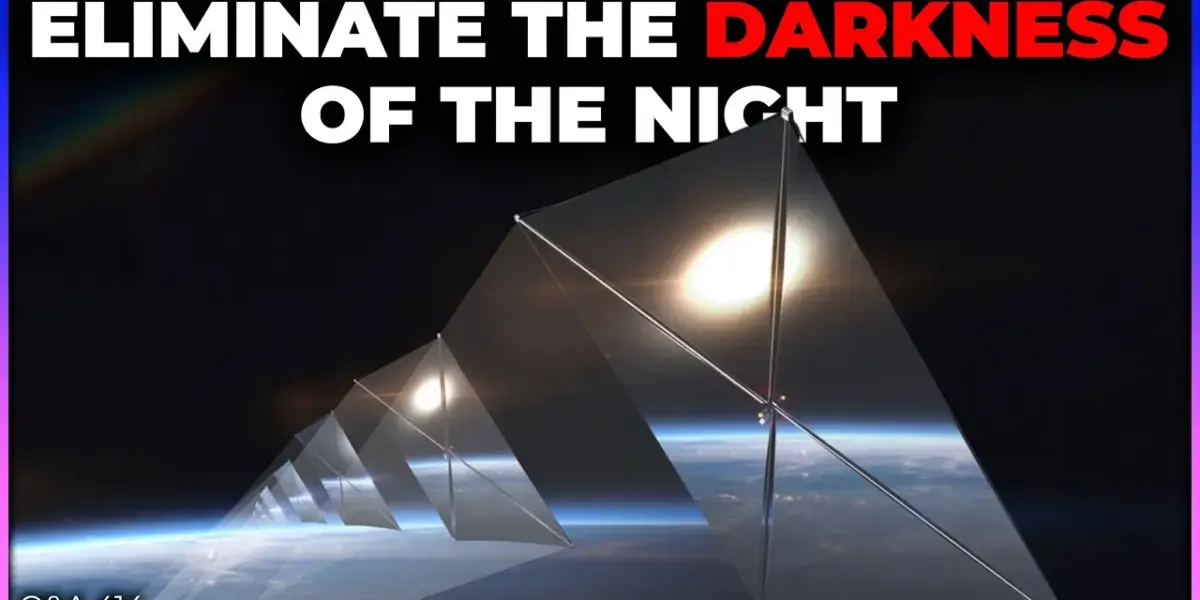
Orbital Mirrors: A Bright Idea or a Costly Dream?
Imagine a giant mirror floating in space, reflecting sunlight down to Earth to banish the darkness of night. This ambitious idea was explored by scientists, aiming to bring more light to regions with long winter nights, like the Arctic. While theoretically possible, the practical challenges are immense.
Building a reflector large enough to make a noticeable difference would require an enormous and expensive launch. The benefits would be minor, offering just a bit more light during twilight hours. Scientists also point out potential downsides: disrupting animal behavior, interfering with our own natural sleep cycles, and adding to Earth’s energy budget. Redirecting sunlight means more energy hitting our planet, which is concerning given our current climate challenges.
The sheer cost of putting anything significant into orbit is a major hurdle. Even futuristic ideas like space-based data centers face this reality. Launching components costs tens to hundreds of millions of dollars, and sending them to the Moon could cost a billion dollars. These costs often outweigh the potential benefits when compared to solutions we can implement right here on Earth.
Voyager Probes: Nearing the End of a Historic Journey
Launched in 1977, the twin Voyager spacecraft have traveled farther than any human-made objects, nearing their 50th anniversary. They are powered by Radioisotope Thermoelectric Generators (RTGs), which use the heat from decaying plutonium to create electricity.
Plutonium has a half-life, meaning it produces less heat and, consequently, less electricity over time. To conserve power, NASA has gradually shut down instruments on the Voyagers over the decades. Many instruments are no longer needed as the probes are in deep space, far from the Sun and unable to take new pictures.
Their current scientific value lies in detecting interstellar material and studying the boundary between our solar system and interstellar space. A few scientific instruments and communication systems remain active, allowing them to send valuable data back to Earth. However, the power supply continues to dwindle.
NASA estimates the Voyagers likely have less than 10 years of power remaining. The exact moment they will cease operations is unknown. Scientists are extracting every last bit of data, prioritizing science instruments or communication. When a choice must be made between operating a scientific instrument and sending data home, communication will likely take precedence.
The Deep Space Network, a global system of giant radio dishes used to communicate with spacecraft, also plays a role. As the Voyagers’ scientific output decreases, freeing up communication slots becomes important for other missions. While we might be in the final decade of the Voyagers’ mission, the exact end date remains uncertain.
The Habitable Zone: More Than Just a “Goldilocks” Sweet Spot
The term “habitable zone” refers to the region around a star where liquid water could exist on a planet’s surface. It’s a crucial concept when searching for Earth-like worlds, but it’s important to understand its limitations.
For a planet to be in the habitable zone, it must be at the right distance from its star. If it’s too close, the planet will be too hot for water to remain liquid, no matter how good its atmosphere. If it’s too far away, water will freeze solid, regardless of atmospheric conditions.
Venus and Mars are sometimes discussed in relation to the habitable zone, but they are not currently considered habitable. Venus has a runaway greenhouse effect, making it extremely hot, despite having a thick atmosphere. Mars has a thin atmosphere, and while it once had liquid water, it is now too cold and dry.
However, scientists suggest that with significant atmospheric changes, both Venus and Mars could theoretically become habitable. Adjusting Venus’s atmosphere could lower its temperature, allowing for liquid water. Thickening Mars’s atmosphere and altering its composition could also lead to surface water, though it would likely be colder than Earth and might require a global magnetic field for protection.
The habitable zone is a starting point, a broad filter. The next step involves examining planets within this zone to see if they possess actual indicators of habitability, like surface water. Detecting liquid water directly is extremely difficult with current technology. Instead, astronomers analyze planetary atmospheres for clues.
JWST’s Quest for Alien Atmospheres
The James Webb Space Telescope (JWST) is a powerful tool for studying exoplanet atmospheres. However, determining if a planet like Kepler-22b is an “ocean world” is challenging.
A study suggested Kepler-22b might be an ocean world based on chemicals detected in its atmosphere, such as methane and carbon dioxide. However, other scientists propose alternative explanations, like a “magma world” with volcanic gases, which could produce similar atmospheric signatures at JWST’s current resolution.
Some theories propose “Hycean worlds” – planets outside the traditional habitable zone with thick hydrogen atmospheres and deep water oceans – could be habitable. Even rogue planets could potentially sustain liquid water through tidal heating. However, these ideas are debated within the scientific community.
The interaction between a planet’s mantle and its water could also affect its composition, making the formation of a Hycean world less certain. Currently, JWST’s instruments are not precise enough to definitively distinguish between these possibilities for planets like Kepler-22b.
JWST has successfully gathered spectra from larger, hotter planets, revealing elements like iron in their atmospheres. The ultimate goal is to study planets in the habitable zones of red dwarf stars, searching for signs of atmospheres and water vapor. This is proving incredibly difficult due to “stellar contamination” – variations in the star’s light that can obscure the planet’s signals.
Astronomers are developing new methods to separate planetary data from stellar noise. Even observing planets like TRAPPIST-1e requires many transits (when a planet passes in front of its star) to get clear atmospheric data. Current observations suggest that detecting an Earth-sized planet with an atmosphere in the habitable zone of a red dwarf star is still a distant goal.
Space Race: Artemis vs. SpaceX
The development of space exploration involves different approaches, exemplified by NASA’s Space Launch System (SLS) and SpaceX’s rockets.
SpaceX has achieved remarkable successes with its Falcon 9 and Falcon Heavy rockets, including successful booster landings and the reliable Crew Dragon spacecraft for transporting astronauts to the International Space Station. Their “move fast and break things” philosophy has led to rapid technological advancements and cost efficiencies.
NASA’s Artemis program, using the powerful SLS rocket, aims to return humans to the Moon. The launch of Artemis 2 was a spectacular event, showcasing immense power and precision. However, the SLS program has faced significant delays and cost overruns, with its development taking longer than SpaceX’s entire journey from inception to its current Starship program.
The SLS rocket costs over $4 billion per launch, while SpaceX aims to lower Starship launch costs into the tens of millions. This cost difference means SpaceX could launch many more heavy-lift missions than SLS.
Both approaches have merits. SpaceX’s rapid iteration and cost-effectiveness contrast with SLS’s more deliberate, “measure twice, cut once” methodology. The future of lunar exploration likely involves collaboration, with SpaceX’s Starship playing a role in Artemis 4.
Ultimately, it’s too early to declare a definitive winner. Both organizations are pushing the boundaries of space exploration. The competition and collaboration between them will shape humanity’s return to the Moon and beyond. Enthusiasm for all efforts to advance space exploration is key as we await the outcomes of these ambitious endeavors.
Source: Illuminating The Earth, Voyagers' Lifetime, JWST's Planets | Q&A 414 (YouTube)

Related Articles


NASA Rockets to Moon’s South Pole After Crew’s Victorious Return
NASA's Artemis II astronauts have returned safely from lunar orbit, marking a major milestone after 50 years. The agency is now setting its sights on Artemis III, which aims to land humans on the moon. This program is building towards a sustained lunar presence and future Mars missions.


NASA Aims for Moon Base, Eyes Mars with Artemis Missions
NASA's Artemis program is advancing plans for a lunar base and future Mars missions, emphasizing scientific discovery and technological innovation. The Artemis II mission successfully tested key spacecraft systems, crucial for future landings and deep-space exploration.

Artemis II Astronauts Journey Beyond the Moon
Humans have journeyed beyond the Moon with the Artemis II mission, marking a historic return to deep space. The mission tested Orion spacecraft capabilities and provided stunning views, while a flurry of global rocket launches signals rapid advancements in space exploration.