AI Cracks Self-Driving Code With Open Reasoning System
A new open-source reasoning system is revolutionizing self-driving AI by enabling it to explain its decisions. This breakthrough promises enhanced safety, transparency, and the ability to tackle rare driving scenarios, moving beyond opaque 'black box' systems.

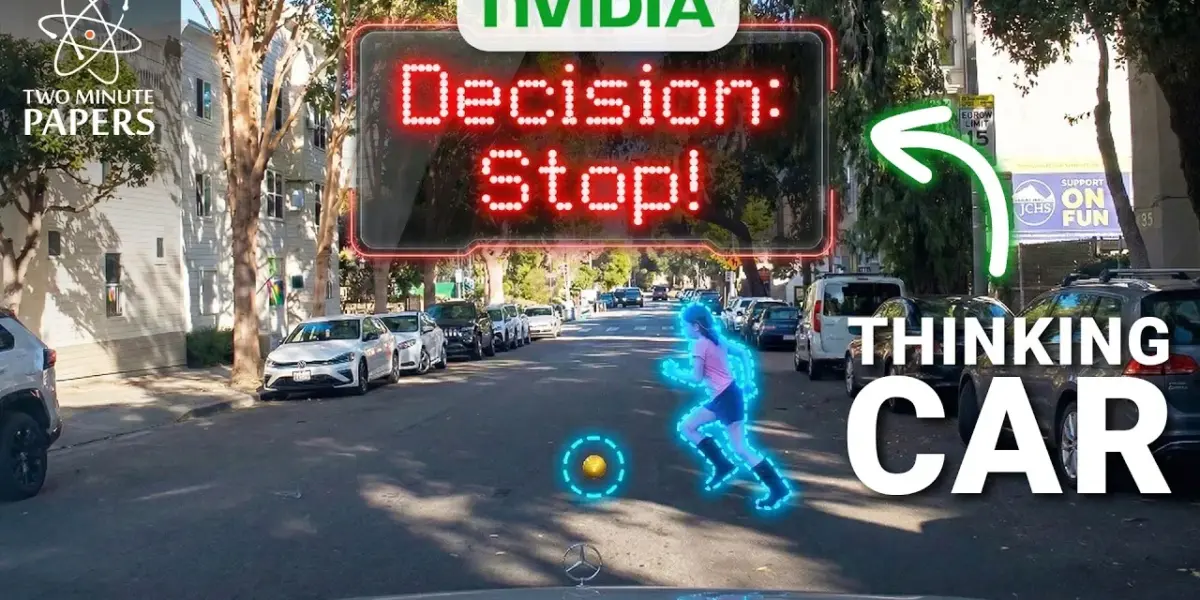
NVIDIA’s Breakthrough: Open Reasoning System Elevates Self-Driving AI
The quest for fully autonomous vehicles has long been hampered by a critical limitation: AI that acts without explaining why. Now, a groundbreaking open-source reasoning system, potentially spearheaded by NVIDIA, promises to change the game, offering unprecedented transparency and improved performance in self-driving technology. Unlike current proprietary systems that operate as black boxes, this new approach allows AI to articulate its decision-making process, marking a significant leap forward.
The ‘Black Box’ Problem in Autonomous Driving
For years, self-driving car technology has progressed rapidly, with companies like Waymo already offering extensive paid services. However, the inner workings of these AI systems have remained largely a mystery. Imagine being in a car where the driver suddenly accelerates without any apparent reason; this is akin to how many current self-driving AIs function.
They process sensor data from cameras and output commands for steering or acceleration, but the rationale behind these actions is opaque to developers and users alike. This lack of transparency makes debugging, improvement, and trust challenging.
Introducing Explainable AI for the Road
The new open reasoning system tackles this head-on. Instead of just performing actions, the AI now vocalizes its intentions and the reasons behind them. For instance, it might state, “We are nudging to the left because there is a car stopped on the right,” or “We keep left to follow the temporary corridor.” This ability to “think out loud” isn’t just a novelty; it demonstrably improves driving performance.
Early indications suggest a 25% reduction in close encounters simply by the AI verbalizing its thought process. When errors occur, the AI’s explanations provide clear insights into what went wrong, enabling targeted improvements.
Tackling the ‘Long Tail’ of Rare Events
A persistent challenge in autonomous driving is the “long tail” – the vast number of rare, unpredictable situations that AI models struggle to learn from. These include bizarre events like a unicyclist on a highway or complex hand signals from construction workers. Because these scenarios are infrequent, the AI doesn’t encounter them often enough during training to develop robust responses.
This new reasoning system appears to be designed to better handle these edge cases. It can reportedly understand and react appropriately to situations like a construction worker giving instructions, a crucial step towards reliable autonomous navigation in diverse real-world conditions.
Open Source: A Major shift for AI Development
Perhaps the most impactful aspect of this development is its commitment to open source. The release of model weights, inference code, and a subset of training data is a significant departure from the industry’s trend of proprietary secrecy. This move empowers researchers, students, and developers worldwide to access, study, and build upon a state-of-the-art self-driving AI.
It democratizes advanced AI research, potentially accelerating innovation far beyond what closed systems could achieve. This allows for collaborative improvement and reduces reliance on a few dominant tech giants.
Ensuring Consistency: The ‘Lie Detector’ for AI
A potential pitfall of AI that explains its actions is the risk of it fabricating justifications – saying one thing but doing another. To combat this, the system employs a technique called reinforcement learning with a consistency reward, effectively acting as a “lie detector.” If the AI states it will stop at a red light but proceeds through it, it receives a negative reward, penalizing the inconsistency. This mechanism forces the AI’s actions to align with its stated intentions, ensuring that its explanations are truthful and its behavior reliable.
Refining Motion: Conditional Flow Matching
Beyond verbal consistency, the system also addresses the smoothness and naturalness of driving movements. The introduction of “conditional flow matching loss” helps to refine shaky or jerky outputs into smooth, continuous actions. This ensures that the AI’s driving maneuvers are not only safe and logical but also human-like and comfortable for passengers.
Training the AI: From Data to Simulation
The training process for this advanced AI is extensive. It involves analyzing approximately 700,000 video clips, with the AI generating detailed diary entries for each to understand the causal relationships behind vehicle movements. This deep dive into causality is key to developing its reasoning capabilities.
For practical training, especially for dangerous scenarios, a hyper-realistic simulator called AlpaSim is utilized. This simulator, built using techniques like 3D Gaussian splatting to mimic real-world environments, allows the AI to practice and crash repeatedly in a safe virtual space before being deployed on public roads.
Lessons for Life Beyond Self-Driving
The principles behind this AI offer surprising parallels to human behavior and personal development. The emphasis on explaining actions before executing them is a powerful reminder for humans to pause, identify the root cause of emotions or decisions, and then act consciously. Similarly, the AI’s accountability for its stated intentions encourages individuals to align their actions with their declared values and priorities, prompting reflection on whether one’s calendar truly reflects what’s important.
Cost and Future Directions
While the reinforcement learning process is highly effective, it is also resource-intensive, akin to a 24/7 private tutor for the AI. Researchers are exploring more cost-effective methods.
One promising direction, demonstrated by scientists at DeepSeek, involves enabling the AI to generate and evaluate multiple plans internally, reducing the need for constant external grading. The potential for this technology was showcased running on Lambda GPU Cloud, utilizing NVIDIA GPUs for rapid and reliable execution of large-scale AI models.
Why This Matters
The development of an open, reasoning AI for self-driving cars is a key moment. It promises to accelerate the adoption of autonomous vehicles by increasing safety, transparency, and reliability. The open-source nature fosters global collaboration, potentially leading to faster advancements and wider accessibility.
Beyond the automotive industry, the underlying principles of explainable AI and consistent action have profound implications for human decision-making and personal accountability. This breakthrough signals a future where AI not only performs complex tasks but also understands and communicates the ‘why’ behind its actions, building greater trust and enabling more robust AI solutions across various domains.
Source: NVIDIA’s New AI Just Cracked The Hardest Part Of Self Driving (YouTube)

Related Articles


Nvidia Unveils Vera Rubin, Boosting AI Power 4x
Nvidia has launched its Vera Rubin platform, featuring new Grok 3 LPUs, to significantly boost AI capabilities. The system offers up to a 35x improvement in throughput per megawatt and nearly 4x the AI performance in a single rack compared to previous generations. This advancement is set to accelerate the development of intelligent AI agents.


AI Chip Demand Fuels Data Center Growth Past $25 Billion
The artificial intelligence boom is fueling massive demand for computing power, with companies like Anthropic seeing revenue growth potentially exceeding $25 billion. This surge is driving significant investment in data center infrastructure, though power delivery remains a key bottleneck. The market is increasingly focused on hardware solutions supporting AI inference.


AI’s Future: Disruption or a New Dawn for Humanity?
Artificial intelligence is advancing rapidly, promising transformation but also posing significant risks. Author Jamie Metzl emphasizes the need for ethical guidelines and human-centric development. Preparing for AI's impact on jobs and society requires adaptability and a focus on uniquely human skills.