Bondi’s Blunder: A $170 Billion Tariff Fumble?
A critical assurance made by Pam Bondi's Department of Justice in a court filing may have led to a $170 billion financial blunder for the United States. The alleged failure to refund tariffs as promised raises serious questions about accountability and competence.


Bondi’s Blunder: A $170 Billion Tariff Fumble?
The intricate dance of international trade policy is often fraught with legal challenges, and the Trump administration’s imposition of tariffs was no exception. These sweeping economic measures, designed to reshape global trade dynamics, quickly found themselves entangled in a web of lawsuits. At the heart of one such legal battle, a critical assurance made by the Department of Justice under then-Attorney General Pam Bondi may have led to a staggering financial miscalculation, potentially costing the United States billions of dollars.
The Tariff Tangle and the Supreme Court Standoff
When Donald Trump implemented tariffs, the immediate reaction from various entities was a wave of legal opposition. These challenges eventually ascended to the Supreme Court, which ultimately questioned the executive branch’s authority to unilaterally declare economic emergencies as justification for such tariffs, deeming it an unsupported power. However, before reaching the apex of the judicial system, a key moment occurred in the International Trade Court.
In the initial stages of a case, Pam Bondi’s Department of Justice (DOJ) presented a specific argument to the court. They assured the judge that if the tariffs were eventually overturned by a higher court, any collected funds could simply be refunded to those affected. This promise was made to persuade the court to allow the tariffs to remain in place during the appeal process.
A Promise Made, A Price Paid?
The judge, persuaded by the DOJ’s assurance of a straightforward refund mechanism, agreed to keep the tariffs operational pending appeal. The condition was explicit: the government was promising to repay the collected funds should the tariffs be ultimately ruled unlawful.
The transcript suggests a clear affirmation from Bondi’s DOJ: “Oh yeah, absolutely, judge.” This commitment, made to secure a temporary judicial green light, now appears to be at the center of a significant financial predicament. The implication is that if this promise was not upheld, and the tariffs were indeed overturned, the government might have been obligated to refund the tariffs, but failed to do so, leading to a substantial financial liability.
The Scale of the Potential Loss
The figure of $170 billion is not a trivial sum. It represents a significant portion of the national budget and could have been allocated to numerous public services, infrastructure projects, or deficit reduction.
The alleged failure to adhere to the court’s conditional approval, based on the promise of refunds, raises serious questions about the competence and diligence of the legal team involved, and by extension, the leadership at the time. This potential financial fallout highlights the critical importance of accurate legal representation and the adherence to judicial directives, especially when dealing with matters of national economic policy and substantial sums of public money.
Historical Context of Trade Tariffs
Tariffs, taxes on imported goods, have a long and complex history in economic policy. Historically, they have been employed for various reasons, including protecting domestic industries, generating revenue, and as a tool of foreign policy. However, their use has often been debated, with economists pointing to potential downsides such as increased consumer prices, retaliatory tariffs from other nations, and reduced overall economic efficiency.
The Trump administration’s approach to tariffs marked a significant departure from recent decades, signaling a more protectionist stance and a willingness to challenge established international trade norms. This shift in policy naturally invited significant legal scrutiny, as demonstrated by the numerous lawsuits that followed.
Why This Matters
The events surrounding the tariff lawsuits and the alleged misstep by the DOJ are more than just a legal footnote; they highlight critical issues of governmental accountability, the rule of law, and the responsible stewardship of public funds. If the allegations hold true, this situation demonstrates a potentially severe dereliction of duty, where a legally binding promise made to a court was not honored, leading to a massive financial exposure for the United States. It raises questions about:
- Accountability: Who is responsible for this alleged oversight, and what consequences, if any, will they face?
- Competence: Does this incident reflect a broader pattern of incompetence within the DOJ or the administration’s legal teams?
- Transparency: How transparent has the government been about this potential financial liability?
- Rule of Law: The integrity of the judicial process relies on parties adhering to court orders and promises. A failure to do so can erode public trust.
Implications, Trends, and Future Outlook
The implications of this alleged $170 billion blunder are far-reaching. It could lead to significant financial penalties for the U.S. Government, impacting future budgets and economic planning. It could set a precedent for how future administrations handle trade disputes and judicial oversight.
The trend towards more aggressive trade policies, as seen under the Trump administration, may continue to be met with robust legal challenges. Future administrations will likely be more cautious about making assurances to courts, and judges may be less inclined to grant temporary approvals without stronger guarantees.
The long-term outlook suggests a heightened need for meticulous legal strategy and a commitment to upholding judicial mandates in economic policy. The incident also is a clear reminder that even the most powerful executive actions are subject to legal checks and balances, and that adherence to these processes is paramount, especially when substantial financial stakes are involved.
The core of the issue appears to be a broken promise to a court, potentially resulting in a financial penalty of astronomical proportions. This highlights the gravity of legal commitments made by government entities.
Source: Pam Bondi commits MAJOR screw up (YouTube)

Related Articles
Trump’s Energy Plan Sparks $164M Alaska Lease Sale
President Trump's "energy dominance" strategy is driving significant investment, highlighted by a record $164 million Alaska lease sale. Policies focus on increasing domestic production and utilizing strategic reserves to lower energy costs and boost economic prosperity.
Frost Demands Pam Bondi Testimony Over Epstein Probe Trust Issues
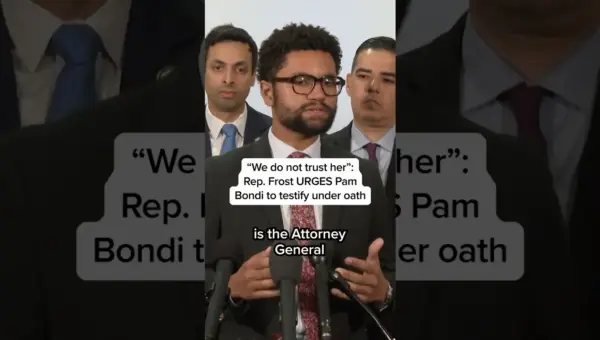
U.S. Representative Maxwell Frost expressed a lack of trust in Pam Bondi, demanding her sworn testimony regarding the Epstein investigation. House Oversight Democrats walked out of a closed-door briefing with Bondi, citing dissatisfaction with the information provided. Bondi is scheduled to testify under oath on April 14, a move intended to ensure transparency and accountability.
Powell Stays Fed Chair If No Successor Named
Federal Reserve Chairman Jerome Powell confirmed he will continue leading the central bank as Chair pro tem if no successor is confirmed by May 15th. He also stated he will not leave the board until an ongoing investigation concludes with transparency. His remarks aim to ensure leadership stability at the Fed.