Historian: Constitution Built for Today’s Democratic Crisis
Historian Jon Meacham argues the U.S. Constitution was designed for moments of crisis like the present. Drawing parallels to Frederick Douglass and past national struggles, he emphasizes that while the republic is fragile, its endurance relies on citizens actively preserving it.

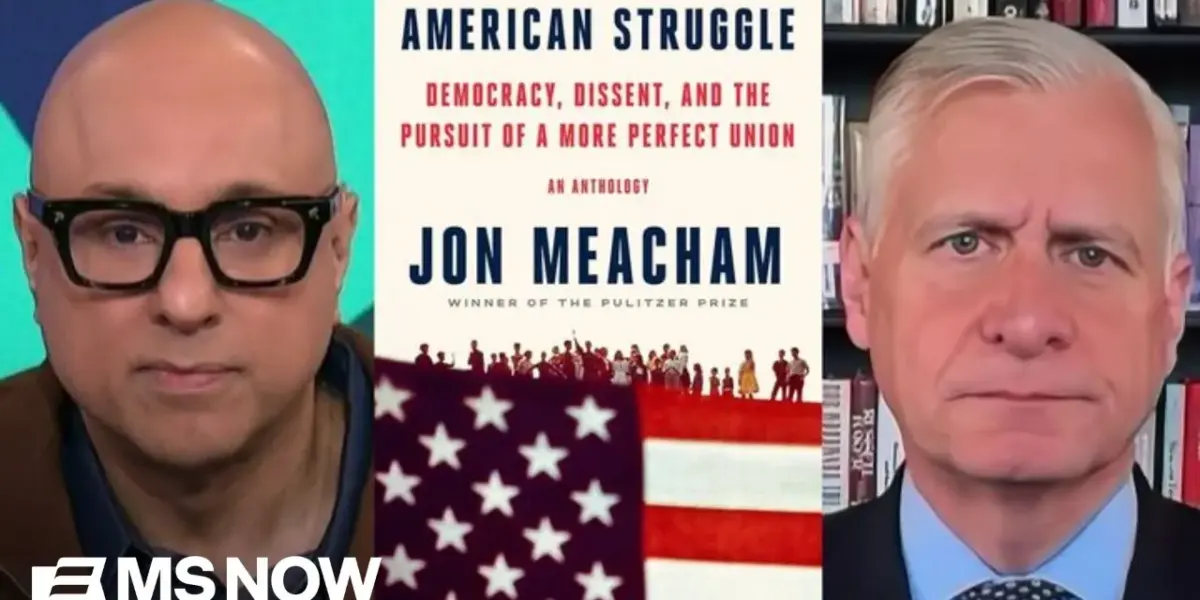
Constitution Forged for Tumultuous Times, Historian Argues
In an era marked by deep political division and anxieties about the future of American democracy, Pulitzer Prize-winning historian Jon Meacham asserts that the U.S. Constitution was intentionally designed to withstand the very challenges the nation faces today. Drawing parallels to historical moments of profound national struggle, Meacham emphasizes that while the present may feel unprecedentedly dark, history offers a roadmap for navigating these turbulent times.
Echoes of Frederick Douglass in a Nation Divided
Meacham opens by invoking the powerful words of Frederick Douglass, spoken in his 1852 speech, “What to the Slave Is the Fourth of July?” Though delivered 11 years before the Emancipation Proclamation, Douglass’s declaration, “Notwithstanding the dark picture I have this day presented of the state of the nation, I do not despair of this country,” resonates as a guiding principle for contemporary Americans. The historian notes the current landscape, characterized by “a war of choice where civilians and soldiers are dying,” the targeting of “peaceful protesters shot by federal agents,” and the erosion of social safety nets, all while a “strong man slides us toward authoritarianism.” He observes a pervasive sense of exhaustion and helplessness among citizens, leading to a troubling silence.
“Our country has been led into a war of choice where civilians and soldiers are dying. We are watching our neighbors snatched from their homes, peaceful protesters shot by federal agents in the street, our civil service and social safety nets decimated, all while an inspiring strong man slides us toward authoritarianism, enriching himself and punishing his perceived political enemies in the process.”
– Jon Meacham, referencing contemporary concerns
The Fragility and Resilience of the Republic
Meacham’s new collection of speeches and letters, titled “American Struggle: Democracy, Dissent, and the Pursuit of a More Perfect Union,” aims to illuminate how Americans have historically confronted and overcome such crises. He highlights the recurring themes of “nativism, xenophobia, cultural populism and broad political fear” that have reshaped the republic since its inception. Quoting James Madison’s foundational insight that “If men were angels, then no government would be necessary,” Meacham highlights the founders’ understanding of human fallibility.
He posits that American politics is inherently dramatic, prone to inflammatory rhetoric, and that progress has always been contingent. “The republic has always been fragile,” Meacham states, “but it has endured because American citizens have always understood that it is our job not to despair the attacks against it, but to fight to preserve it.”
A Historical Perspective on Democracy’s Endurance
The historian elaborates on the profound courage of Frederick Douglass, a man born into slavery who became a vocal advocate for a democracy that did not yet fully include him. Douglass’s willingness to speak out in 1852, just five years before the Dred Scott decision further denied Black people their humanity in the eyes of the law, is presented as proof of unwavering conviction.
Douglass’s hope, Meacham suggests, was rooted in a belief in a higher order, a force that also propelled figures like John Lewis and soldiers on Omaha Beach and at Gettysburg. This conviction, he argues, stems from the nation’s founding on an idea rather than blood or soil.
Meacham cautions against both uncritical nostalgia and utter despair, stating in his book’s introduction, “We do ourselves no favors by pretending that American history is either cheerfully grand or unrelievably bleak. For American history is a human undertaking, and it is as subject to selfishness and to greed, to cruelty, and to injustice as we are in our own lives.” He emphasizes that understanding the cyclical nature of American struggles—from the Civil War and suffrage movements to the Civil Rights era—reveals a consistent pattern of overcoming adversity.
Navigating the Current “Illiberal Moment”
Addressing the common questions Meacham encounters – “Has it ever been like this?” and “How do we get out of it?” – he acknowledges the widespread feeling that the current political climate, often termed an “illiberal moment,” is uniquely dire. However, he points out that previous generations also perceived their own times as existential threats, citing fears surrounding the elections of Ronald Reagan and George W. Bush, which many today would now welcome.
The crucial distinction, Meacham explains, lies in the breakdown of a shared understanding of political process. Earlier leaders, across the political spectrum, viewed politics as an “arena of contention” with established rules, where differing interests could vie for resolution before returning to the electoral process.
This constitutional vision, characterized by tension but adherence to rules and a noble end in mind, has faltered. The current challenge, he suggests, is not about achieving a singular ideological victory but about restoring fair debate, upholding checks and balances, and continuing the pursuit of a “more perfect union.”
The Path Forward: Opponents, Not Enemies
Meacham concludes by stressing the vital importance of viewing fellow citizens as opponents or rivals, rather than mortal enemies. The descent into viewing everyone as an enemy, he warns, leads to autocracy—the very system the American experiment was designed to prevent.
The Constitution, conceived with an awareness of human frailty and selfishness, was indeed written for moments like the present. Its enduring relevance lies in its framework for managing disagreement and its call for citizens to actively participate in preserving the democratic experiment.
“American Struggle: Democracy, Dissent, and the Pursuit of a More Perfect Union” offers a timely reminder that while the republic is fragile, its resilience is ultimately dependent on the active engagement and commitment of its people to uphold its foundational ideals, even in the darkest of times.
Source: Jon Meacham: 'The Constitution was written for moments like this' (YouTube)

Related Articles


Congress Proposes New Way to Judge President’s Fitness
A new bill proposes creating a bipartisan commission to assess presidential fitness, using a provision of the 25th Amendment that Congress has never acted upon. Introduced by Congressman Jamie Raskin, the legislation aims to provide an independent check on a president's ability to serve. This aims to ensure governmental stability and address concerns about presidential capacity.


Congresswoman’s Bold Stand: Military Must Reject Unlawful Orders
Senator Alyssa Slotkin and other military veterans in Congress issued a video reminding service members of their duty to refuse unlawful orders. This bold stance faced political backlash and legal inquiries, which Slotkin resisted, citing constitutional rights and the dangers of intimidation.


Birthright Citizenship: Is the 14th Amendment Outdated?
The 14th Amendment's guarantee of birthright citizenship is under intense debate. Panel guests discuss whether the long-standing interpretation is outdated and explore the practical challenges and historical context surrounding this core American principle.