Kansas’s Baffling Fouls Cost Them in Final Seconds
Kansas's baffling decision to repeatedly foul in the final seconds backfired spectacularly, allowing St. John's to score a game-winning layup. The strategy, intended to burn clock, was executed poorly and left no fouls to stop a clear path to the basket.


Kansas’s Baffling Fouls Cost Them in Final Seconds
The biggest head-scratcher of the game came in the final 13 seconds with the score tied. Kansas, inexplicably, used all four of its fouls to stop the clock against St. John’s. This strategy allowed St. John’s to easily bring the ball down the court and score the winning layup.
A Strange Strategy Unfolds
With only 13 seconds left and the game tied, Kansas found itself in a position to make a defensive stand. Instead, they chose to repeatedly foul St. John’s, burning precious seconds off the clock. The initial assumption was that Kansas wanted to prevent St. John’s from running a full play and perhaps to use up their fouls so they wouldn’t carry over.
The logic of not wanting to take fouls into a critical moment is understandable. However, the execution was far from ideal. The first foul occurred just 1.8 seconds after St. John’s inbounded the ball, a move that seemed premature and ineffective.
Following this, another foul was called just 1.5 seconds later. While taking time off the clock is a valid strategy, Kansas failed to maximize this opportunity. They could have let St. John’s advance further up the court, perhaps to midcourt, before committing a foul.
Missed Opportunities and Defensive Lapses
Experts watching the game were puzzled by the decision-making process. Instead of letting the opponent get into their offensive set and then fouling, Kansas seemed to rush the process. This gave St. John’s an easy path to the basket after the final foul was committed.
“The first foul was 1.8 seconds after inbounding it. Right.
That seemed dumb,” one observer noted, highlighting the questionable timing. The next foul followed just 1.5 seconds later, further emphasizing the rushed approach.
The strategy might have been to bleed the clock, but it felt like a missed opportunity. A more effective approach would have been to let St. John’s bring the ball to half-court before fouling. This would have used more time and potentially forced St. John’s into a less advantageous offensive set.
Even after using two fouls, Kansas still had two more to give. The plan should have involved using another foul to burn more clock. This would have left them with one final foul to use strategically, perhaps to stop a clear run to the basket.
The Cost of Poor Clock Management
The most critical mistake came when St. John’s guard had a clear lane to the basket with no defenders nearby. In such a compromised defensive position, having a foul to give would have allowed Kansas to stop the play 25 to 30 feet from the basket. This would have prevented the easy game-winning layup.
The ability to foul intentionally from a distance is a crucial defensive tool. It prevents opponents from getting uncontested shots at the rim. Kansas’s failure to preserve a foul for such a situation proved to be their undoing.
The game ended with a simple right-handed layup, a forgettable buzzer-beater that capped off a confusing sequence of events. The decision-making in the final moments will surely be a topic of discussion for Kansas throughout the offseason. It highlights the importance of smart clock management and strategic fouling in close games.
Source: Why Kansas’s strategy against St. Johns late didn’t make sense (YouTube)

Related Articles


Alabama Rolls Past Rhode Island in NCAA Opener
The Alabama Crimson Tide defeated the Rhode Island Rams 80-70 in the first round of the NCAA Women's Basketball Tournament. Led by strong performances from Diana Collins and Jessica Timmons, Alabama advances to face Louisville in the next round.


UConn Dominates Rival, Secures Sweet 16 Berth
The UConn Huskies delivered a dominant performance to secure their Sweet 16 berth, overwhelming their rivals in a statement victory. Their star player led the charge with an exceptional offensive display, showcasing the team's readiness for a deep tournament run.

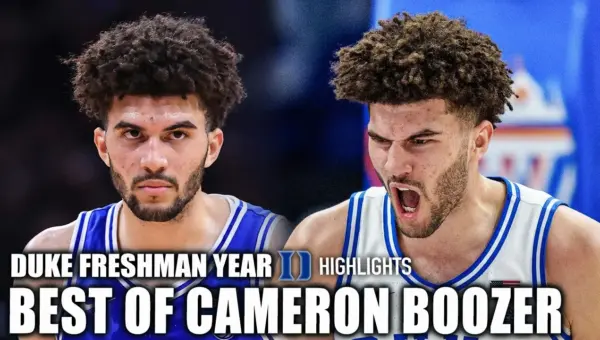
Boozer Dominates: Duke Freshman Puts On A Show
Cameron Boozer's freshman year highlights showcase a dominant force for Duke. The talented forward displayed a versatile scoring ability, powerful dunks, and crucial plays on both ends of the court, signaling a bright future.