US Pivots: $2 Trillion Push to Rebuild Industries
The United States is strategically pivoting its economy from financialization towards industrialization, aiming to rebuild domestic manufacturing. This shift, utilizing tools like tariffs, introduces market volatility but signals a long-term focus on tangible production and economic resilience.


US Signals Major Economic Overhaul: Shifting from Financialization to Industrialization
The United States is embarking on a significant economic transformation, signaling a strategic pivot away from an era dominated by financialization towards a renewed focus on industrialization. This ambitious shift aims to revitalize domestic manufacturing and rebuild the nation’s industrial base, moving beyond its traditional role as a net exporter of dollars.
The Rationale Behind the Industrial Push
Fundamentally, the U.S. Government’s objective is to “build things again.” This sentiment reflects a desire to re-establish a robust domestic manufacturing sector, create high-value jobs, and enhance national economic resilience. The strategy involves leveraging national power through various tools, including tariffs, to rebalance global trade and encourage domestic production.
“The US wants to build things again and not necessarily just export dollars.”
Tariffs as a Tool of National Power
Tariffs, often viewed as a trade policy instrument, are being reframed as a critical component of national economic strategy. By imposing tariffs on certain imported goods, the U.S. Aims to make domestic products more competitive, thereby incentivizing companies to invest in and expand their manufacturing operations within the country. This approach is part of a broader effort to recalibrate the nation’s economic priorities.
Understanding Financialization vs. Industrialization
The concept of financialization refers to the increasing dominance of financial motives, financial markets, financial actors, and financial institutions in the operation of domestic and international economies. In simpler terms, it means an economy becomes more reliant on financial services and speculation rather than on the production of physical goods and services.
Industrialization, conversely, emphasizes the growth of manufacturing, production, and the creation of tangible goods. It involves investing in factories, machinery, skilled labor, and the entire supply chain required to produce goods domestically. This shift suggests a move towards an economy where tangible output and manufacturing prowess are prioritized over financial engineering and services.
The Role of Volatility in the Financial Markets
From the perspective of the financial industrial complex, the implementation of policies like tariffs can introduce volatility into the stock market. Volatility is a statistical measure of the dispersion of returns for a given security or market index. In simpler terms, it refers to how much the price of an asset or market fluctuates over time. High volatility means prices can change dramatically and rapidly, both upward and downward.
While volatility can be perceived as risk, it also presents opportunities. For sophisticated investors and traders, significant market swings can offer chances to profit from price movements. However, for the average investor, market volatility often translates to increased uncertainty and risk to their portfolios.
Market Impact and Investor Considerations
The U.S.’s strategic shift towards industrialization, coupled with the use of tariffs, is expected to have a complex impact on financial markets. Investors will need to closely monitor several key areas:
- Sectoral Shifts: Industries directly benefiting from reshoring and domestic manufacturing initiatives, such as industrials, materials, and potentially certain technology sectors involved in advanced manufacturing, may see increased investment. Conversely, sectors heavily reliant on imports or those facing increased competition from domestic producers could experience pressure.
- Inflationary Pressures: Tariffs can sometimes lead to higher consumer prices as the cost of imported goods increases or domestic producers raise prices due to reduced competition. This could contribute to inflationary pressures, influencing monetary policy decisions by the Federal Reserve.
- Global Trade Dynamics: The U.S. Policy shift could alter global trade flows and relationships. Countries that are major exporters to the U.S. May need to adjust their own economic strategies, potentially leading to retaliatory measures or shifts in global supply chains.
- Investment Opportunities and Risks: While the long-term goal is economic strength, the transition period may be marked by increased market volatility. Investors need to assess the specific impacts on companies within their portfolios and consider diversification strategies to mitigate risks associated with these economic policy changes.
Long-Term Implications
The long-term success of this industrialization strategy hinges on sustained investment, innovation, and the ability to compete globally on quality and efficiency. If successful, it could lead to a more robust and self-sufficient U.S. Economy, characterized by higher-paying manufacturing jobs and a stronger domestic industrial base.
However, the path is likely to be complex, involving careful navigation of international trade relations, domestic policy implementation, and adaptation to evolving global economic landscapes. The transition from financialization to industrialization is not merely an economic policy choice; it represents a fundamental redefinition of the U.S. Economic model for the 21st century.
Source: The U.S. Is Trying to Build Again (YouTube)

Related Articles

Trump’s Energy Plan Sparks $164M Alaska Lease Sale
President Trump's "energy dominance" strategy is driving significant investment, highlighted by a record $164 million Alaska lease sale. Policies focus on increasing domestic production and utilizing strategic reserves to lower energy costs and boost economic prosperity.


Powell Stays Fed Chair If No Successor Named
Federal Reserve Chairman Jerome Powell confirmed he will continue leading the central bank as Chair pro tem if no successor is confirmed by May 15th. He also stated he will not leave the board until an ongoing investigation concludes with transparency. His remarks aim to ensure leadership stability at the Fed.

Fed Holds Rates Steady Amidst Oil Price Surge and Tariff Uncertainty
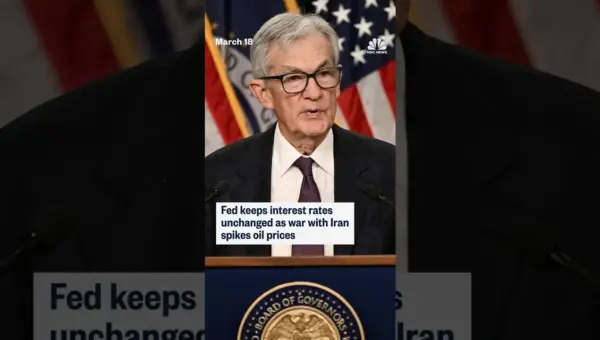
The Federal Reserve has held interest rates steady for a second consecutive meeting, citing economic uncertainty. Soaring oil prices due to the conflict with Iran and the recent Supreme Court ruling on tariffs are key factors influencing the decision. The Fed is carefully balancing inflation concerns with the need to support economic growth.