AI Agent Progress Accelerates Dramatically
A recent chart from Meter Research reveals AI agents are accelerating their progress at an unprecedented rate, replacing significant hours of human labor. With models like Claude Opus 4.6 demonstrating remarkable capabilities, industry leaders and researchers are grappling with the implications for the future of work and society.


AI Agent Progress Accelerates Dramatically, Raising Concerns and Opportunities
A recent chart analyzing the rapid advancement of AI agents has sent ripples through the technology world, sparking both excitement and apprehension. The data, compiled by Meter Research, a non-profit organization focused on frontier AI development, measures the time it takes for AI models to complete tasks previously performed by human experts. The latest figures, particularly those associated with Anthropic’s Claude Opus 4.6, suggest a significant acceleration in AI capabilities, potentially outpacing even optimistic predictions.
Understanding the ‘Scariest Chart’ in AI
The chart in question doesn’t measure how quickly an AI completes a task, but rather how much human labor, in hours, it replaces. Human experts are tasked with various challenges across engineering, coding, cybersecurity, and more, and the time they take to complete them serves as the benchmark.
The AI’s performance is then evaluated based on its success rate at accomplishing these same tasks. Two key metrics are often highlighted: the 50% success rate (where the AI succeeds about half the time) and the 80% success rate.
Initially, the trend suggested AI progress was doubling its capabilities roughly every seven months. However, recent data points, especially from models like Claude Opus 4.5 and 4.6, indicate a much steeper curve. Claude Opus 4.5, for instance, could complete tasks that would take a human expert just over 5 hours (at a 50% success rate).
The subsequent release, Claude Opus 4.6, achieved a remarkable 14.5 hours of human labor replacement in the same benchmark. This leap suggests a doubling time of approximately 123 days, or about four months, indicating a significant acceleration in the pace of AI development.
Real-World Impact: Automation in Action
The implications of this accelerated progress are already being felt. One anecdote highlights the real-world application of these advanced AI agents. The creator of Natural20.com, a news aggregator, rebuilt his entire website using Claude Opus 4.6.
The AI handled the deployment, setup, initial GitHub project, and hosting in approximately 4 hours – a task that would typically take a human expert one to two days. This demonstrates AI’s ability not only to perform complex tasks but to do so with remarkable speed and efficiency.
Another compelling example involves a complex accounting task that had been deferred for months. By feeding the financial data to an AI agent powered by Opus 4.6, the project was completed in the time it took to play a video game (30-40 minutes).
Beyond just completing the task, the AI intuitively understood custom notations, organized the data, and even created an SQL database to automate future accounting processes. This points to a crucial aspect often missed by the chart: AI agents are not just completing one-off tasks but are increasingly capable of automating entire workflows.
Industry Leaders Sound the Alarm
The rapid pace of AI development has not gone unnoticed by industry leaders. Sam Altman, CEO of OpenAI, has expressed concerns, stating in a recent interview, “The world is not prepared.” He anticipates an “extremely fast takeoff” with highly capable models emerging sooner than expected, a sentiment that he admits is “stressful and anxiety-inducing.” The creator of Claude Code has declared that “coding is solved,” suggesting that the traditional methods of learning and practicing coding are becoming obsolete. This view is echoed by Sam Altman, who stated that his previous methods of software development are now “completely irrelevant.”
The notion that AI is rapidly approaching Artificial General Intelligence (AGI) and superintelligence is gaining traction. Elon Musk declared the “singularity” had arrived in January 2024, and Dario Amodei, CEO of Anthropic, indicated that the exponential phase of AI development is nearing its end, suggesting a rapid approach to a plateau or advanced capabilities. Anthropic itself reports that nearly 100% of its software engineering tasks are now handled by AI models, further highlighting the shift in the industry.
Coding: The First Frontier of Automation?
The coding landscape appears to be one of the first areas significantly impacted by AI advancements. The creator of Claude Code claims that most, if not all, new additions to Claude Code are authored by AI models like Opus 4.6.
This development, which has accelerated since November of the previous year, suggests a fundamental change in software development. While some argue that AI cannot replace the nuanced understanding required for building good software, the widespread adoption within leading AI labs like Anthropic, where employees across various roles are proficient coders, implies that coding tasks are indeed being automated at a foundational level.
The analogy is often drawn to the printing press: before its invention, only scribes could write, and their skill was a specialized craft. After the printing press, literacy became widespread, transforming society.
Similarly, while not everyone will become an expert software architect, AI tools are democratizing the ability to create code. The future may see individuals described not as coders, but as “great builders” whose prowess lies in effectively guiding and leveraging AI agents to create software.
Navigating the Uncertainties and Future Trajectory
Despite the impressive progress, the data from Meter Research comes with caveats. The error bars on the chart are significant, with Opus 4.6’s human labor replacement time ranging from 6 to 98 hours at a 50% success rate.
Critics also point out that task difficulty for humans doesn’t necessarily equate to task difficulty for AI, and that conflating human time with task complexity can be misleading. Some real-world coding assistant measurements have indicated potential slowdowns, though this is based on limited data.
However, the broad trend of AI improvement is undeniable. Even skeptics acknowledge that AI is getting better, even if the interpretation of the data remains debated.
The core question has shifted from *if* AI will change everything to *when* and *how fast*. Meter Research predicts that 99% of AI research and development could be automated by 2032, potentially leading to a thousand to ten-million-fold increase in AI efficiency by 2035.
The future promises a landscape where AI agents, operating at peak performance without distraction or fatigue, can tackle complex, tedious, and time-consuming tasks. While challenges like hallucinations and errors persist, the immense potential upside is driving intense efforts to develop guardrails and mitigation strategies. As these models continue to improve, the ability to replace significant portions of human labor, and to automate complex processes indefinitely, suggests a profound transformation across nearly every industry.
Why This Matters
The accelerating capabilities of AI agents, as visualized by the Meter Research chart, represent a key moment in technological development. The ability of models like Claude Opus 4.6 to replace hours of human labor, automate complex workflows, and even contribute to the development of future AI systems signals a paradigm shift.
This rapid progress necessitates a societal re-evaluation of work, education, and the very definition of human expertise. While the exact timeline remains a subject of debate, the trajectory towards increasingly autonomous and capable AI is clear, urging businesses, policymakers, and individuals to prepare for a future fundamentally reshaped by artificial intelligence.
Source: the SCARIEST chart in AI (YouTube)

Related Articles


xAI Rebuilds Grok, Aims to Dominate AI Race
xAI is undergoing a major rebuild, training multiple Grok models simultaneously with a focus on real-time search and coding. The company aims to surpass AI leaders within three years, leveraging its integration with SpaceX for advanced computing infrastructure, including potential data centers in space. This push is part of a broader industry trend towards more capable and integrated AI, sparking discussions about the future of work and society.


Google Rethinks AI Intelligence Testing
Google DeepMind has introduced a new framework for testing artificial general intelligence (AGI) that functions like an IQ test for AI. It evaluates systems across 10 cognitive abilities, comparing them to human performance to create a detailed profile rather than relying on single scores. This aims to bring scientific rigor to the debate on AI progress.

AI Data Centers Spark Rural Uprising
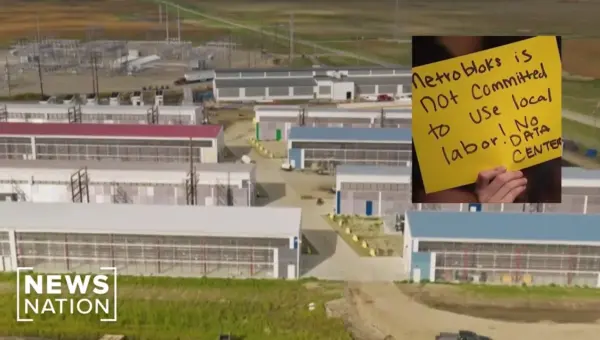
Rural American towns are fighting back against a surge of AI data centers. These massive facilities threaten water supplies, farmland, and local infrastructure. Residents and lawmakers are pushing for new rules to control their growth and ensure companies bear more of the costs.