Meta’s $600B AI Gamble: Is Zuckerberg Building Superintelligence or a Data Center Mirage?
Meta Platforms is planning to spend an unprecedented $600 billion on AI data centers, a move that deviates from its peers who leverage such infrastructure for cloud services. The company's strategy hinges on developing in-house AI products, including its open-source Llama models, with a long-term vision for 'superintelligence.' However, this massive expenditure faces scrutiny, particularly from AI pioneer Yann LeCun, who questions the efficacy of scaling LLMs through computation alone for achieving true superintelligence.

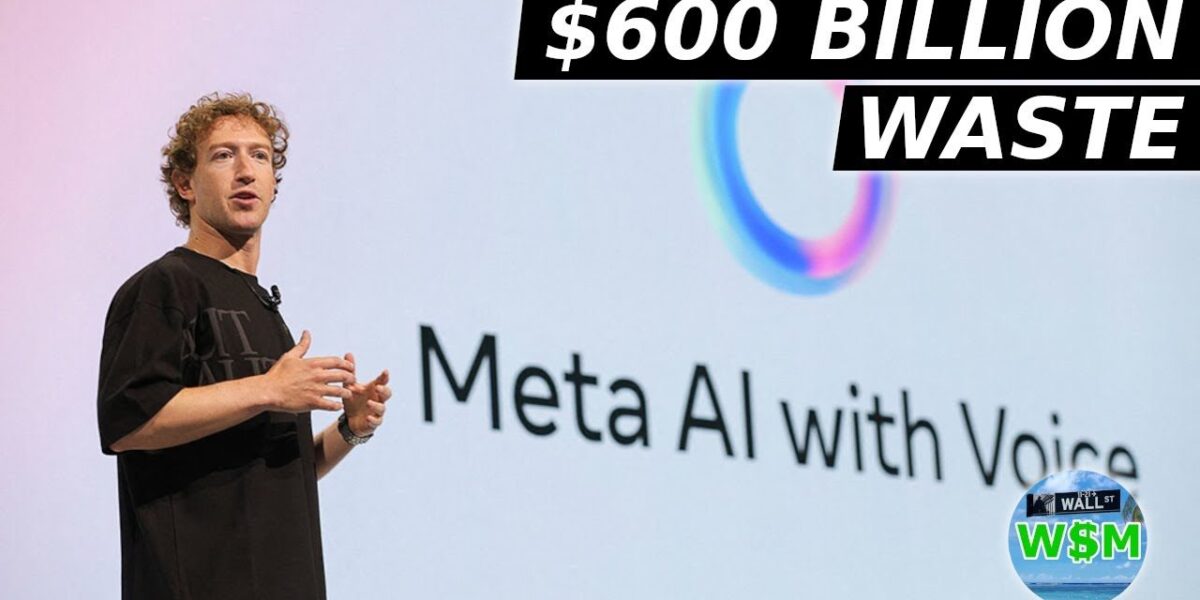
Meta’s $600 Billion AI Ambition Faces Scrutiny
In the relentless pursuit of artificial intelligence, Big Tech has collectively poured hundreds of billions of dollars into AI data centers and supporting infrastructure over the past three years. For giants like Microsoft, Google, and Amazon, this significant investment is intrinsically linked to their cloud computing businesses, where they sell processing power to AI developers. However, Meta Platforms (META) stands out with an unprecedented AI spending spree that is raising eyebrows across the financial world.
A Massive Bet on In-House AI Development
Meta has committed tens of billions of dollars to its AI infrastructure. In 2021, the company reported $19 billion in capital expenditures, and in the first nine months of 2025, this figure surged to $48 billion.
The vast majority of this increase is attributed to the construction of new data centers and the acquisition of high-priced NVIDIA GPUs. The scale of this investment is set to balloon further, with CEO Mark Zuckerberg recently announcing plans to spend an astonishing $600 billion on AI data centers over the next several years.
This $600 billion figure represents nearly all of Meta’s projected operating cash flow, which hovers around $100 billion annually. Unlike its cloud-providing peers, Meta is not in the business of selling computing capacity to external clients. Instead, its colossal data center build-out is solely dedicated to developing Meta’s proprietary AI products, including consumer-facing chatbots and other AI features that are currently offered free of charge, generating no direct revenue.
From AI Research to Llama’s Open Source Leap
Meta’s journey into advanced AI began years ago with its Facebook Artificial Intelligence Research (FAIR) group, rebranded as Meta AI in 2021. Initially focused on integrating AI into existing products like image recognition for photo tagging, content moderation, and ad targeting, FAIR’s work did not require the massive computational power associated with today’s large language models (LLMs). The landscape shifted dramatically in 2022 with the public release of OpenAI’s ChatGPT.
Spurred by the rapid success of ChatGPT, Zuckerberg directed Meta AI to develop its own LLM. This led to the creation of Llama (Large Language Model Meta AI) in 2023.
Meta’s approach with Llama was distinct: instead of restricting access through proprietary APIs, the company made the model weights available to researchers and developers. This open-source strategy, while not directly generating revenue, has fostered a vibrant ecosystem of third-party applications leveraging Llama, such as the Brave browser’s AI assistant, LEO.
Within Meta’s own products, Llama powers free AI chatbots and features, including generative AI tools within Instagram that can create custom avatars or even AI-generated videos. While Meta’s augmented reality glasses incorporate AI features, their performance has been inconsistent, as demonstrated by a problematic demonstration of receiving a WhatsApp video call. These glasses fall under Meta’s Reality Labs segment, which has incurred substantial operating losses, totaling $36 billion over two years against $4.5 billion in revenue.
The Vision of Superintelligence and Leadership Shake-ups
Zuckerberg’s broad vision extends beyond current AI capabilities; he is pursuing what he terms “personal superintelligence.” This ambition, outlined in a July 2025 Instagram post, involves creating AI systems that can self-improve and eventually surpass human intelligence. Meta’s massive infrastructure investment is intended to provide the foundation for these future AI models.
The company’s pursuit of AI leadership has also seen significant personnel changes. Meta has reportedly offered top AI researchers substantial signing bonuses, including upwards of $100 million for individuals from OpenAI. A particularly noteworthy and controversial appointment was that of 28-year-old Alexander Wong as Chief AI Officer in June 2025.
Wong co-founded Scale AI, a company specializing in data annotation – the process of labeling data to train AI models. Meta acquired a 49% stake in Scale AI for $14.3 billion, a move widely seen as a strategic maneuver to bring Wong, who reports directly to Zuckerberg, into the fold.
However, Wong’s appointment and Meta’s AI strategy have drawn criticism, notably from Yann LeCun, a pioneer in AI research and former Chief AI Scientist at Meta. LeCun has expressed skepticism that scaling up LLMs through brute force computation and data alone will lead to true artificial general intelligence (AGI) or superintelligence.
He argues that current LLMs, while capable of retrieving vast amounts of information, lack genuine understanding and problem-solving abilities akin to human intelligence. LeCun believes that companies promising superintelligence solely through increased computing power and data are misguided.
This fundamental disagreement highlights a potential rift in Meta’s AI direction. While Zuckerberg appears convinced that massive investment in data centers and compute power will unlock superintelligence, LeCun posits that this approach is a “dead end” for achieving human-level or superhuman AI.
LeCun’s departure from Meta in early 2026, shortly after Wong’s appointment, highlights these diverging philosophies. In a Financial Times interview, LeCun candidly stated his belief that LLMs are not the path to superintelligence and expressed reservations about Wong’s lack of research experience, despite acknowledging his quick learning ability.
Market Impact and Investor Considerations
- Massive Capital Outlay: Meta’s $600 billion commitment to AI data centers is an unprecedented expenditure that will significantly impact its financial statements for years to come. Investors will need to closely monitor the return on this investment, especially given the lack of direct revenue generation from its current AI products.
- Open Source vs. Proprietary Debate: Meta’s open-sourcing of Llama contrasts with the proprietary models of competitors like OpenAI and Google. While this strategy fosters innovation and broad adoption, it limits Meta’s ability to directly monetize its LLMs.
- The Superintelligence Question: The core of Meta’s strategy hinges on achieving superintelligence. The debate between scaling LLMs through computation versus other, yet-to-be-defined approaches, as highlighted by Yann LeCun’s views, introduces significant uncertainty. Investors should consider whether Meta’s chosen path is scientifically viable for achieving its ambitious goals.
- Leadership and Strategy Alignment: The hiring of Alexander Wong and the departure of Yann LeCun raise questions about the strategic direction and leadership within Meta’s AI division. The company’s ability to execute its vision will depend on its leadership’s alignment and effectiveness.
- Long-Term Outlook: While Meta’s core advertising business remains robust, the massive investment in AI is a long-term play. The success or failure of this strategy could significantly influence Meta’s future valuation and its position in the evolving AI landscape.
Meta’s aggressive AI investment strategy is a high-stakes gamble. While the company possesses the financial resources to pursue its vision, the scientific and economic viability of achieving superintelligence through its chosen methods remains a significant question mark for investors and industry observers alike.
Source: Meta Wasting $600 Billion On AI (YouTube)

Related Articles

AI Jesus Offers Paid Spiritual Guidance for $1.99/Minute
A US tech startup now offers AI Jesus, a paid service providing spiritual guidance for $1.99 per minute. Trained on the Bible and sermons, the AI aims to offer comfort and mentorship. This service taps into a booming $2 billion market for AI-driven spiritual wellness tools, but raises concerns about data privacy and misinformation.

AI Spending Frenzy Faces Reality Check: Anthropic Leads
AI's massive spending boom faces scrutiny as Anthropic CEO Dario Amodei highlights concerns about overestimated demand. Many companies are burning through AI budgets faster than expected, with some even encouraging token usage over actual productivity. Anthropic is shifting to per-token billing, moving away from unsustainable flat-rate plans.


AI Fuels Delusions: New Series Explores Troubling Mind Scapes
A new docuseries, "Suspicious Minds: AI and Psychosis," explores the disturbing link between artificial intelligence and delusions. Host Sean King O'Grady shares stories of people experiencing psychosis after interacting with AI, with Selena Gomez also involved. The series highlights the unknown long-term effects of AI on mental health, urging awareness as technology advances.