Virginia Voters Decide Redistricting Referendum Fate
Virginia voters decided on a critical referendum that could reshape the state's congressional map. The vote, driven by Democrats, aimed to create a significant advantage in the state's congressional delegation. Early turnout data and key county results provided initial clues to the referendum's fate.


Virginia Voters Weigh Critical Redistricting Vote
Virginia voters headed to the polls Tuesday to decide a key referendum that could significantly alter the state’s congressional map. The vote centers on a proposal to change how the state’s legislative districts are drawn, a process that has become a major point of contention in recent years. At stake is the potential for a dramatic shift in the state’s representation in Congress, with implications for national politics.
Democrats Push for Map Overhaul
The referendum, initiated by Democrats, proposes a significant overhaul of Virginia’s congressional districts. Current projections suggested that if approved, the map could transform a narrow 6-5 Democratic majority in the state’s congressional delegation into a near-unanimous 10-1 advantage for the party. This aggressive redrawing of districts aims to consolidate Democratic power ahead of the 2026 midterm elections.
This move mirrors a similar effort by Democrats in California, where voters approved an aggressive redraw of the state’s congressional map in November. That success appears to have inspired similar tactics in Virginia, leveraging the party’s recent electoral gains in the state. Democrats secured strong victories in the 2023 gubernatorial election, with Abigail Spanberger winning by a significant margin, and have used this momentum to push for structural changes.
Turnout Data Offers Early Clues
As polls prepared to close, early data on voter turnout provided some initial insights. Reports indicated that overall voter turnout was tracking around 90% of the levels seen in the 2025 elections.
However, there was a notable imbalance in Election Day turnout. Traditionally Democratic-leaning areas were at about 87% of their 2025 levels, while Republican-supporting jurisdictions saw turnout at approximately 96% of their 2025 figures.
While higher turnout in Republican areas might seem encouraging for the opposition, analysts noted that Republicans are starting from a disadvantage. In the 2025 elections, turnout was lower in traditionally Republican strongholds like rural Southwest Virginia compared to more densely populated, Democratic-leaning areas such as Northern Virginia and the Richmond suburbs. Therefore, even with increased turnout in these areas, a significantly stronger performance than in 2025 would be necessary for the opposition to succeed.
Key Counties to Watch
Analysts highlighted several key counties and cities that would be crucial in determining the referendum’s outcome. Loudoun County, a large, exurban county outside Washington D.C., was expected to report early results.
This area has become increasingly Democratic, and it was anticipated that the referendum would pass there. The speed and margin of victory in Loudoun County were seen as an early indicator.
Virginia Beach and Chesapeake were also identified as critical bellwethers. These cities have shown a tendency to swing between parties in recent gubernatorial elections. For the referendum to fail, the “no” side would likely need to secure comfortable margins in both these populous areas.
Chesterfield County, a large suburban area near Richmond, was considered one of the closest indicators of statewide sentiment. While it has become more Democratic, its voting patterns have historically mirrored broader state trends.
Understanding the Stakes
The referendum’s potential impact extends beyond Virginia’s borders, influencing the national balance of power. If the redistricting plan succeeds, it could create four new seats that would have voted for Donald Trump in the presidential election, shifting them to the Democratic column. This would represent a significant gain for Democrats, potentially altering the composition of the House of Representatives for years to come.
The process of redrawing legislative maps mid-decade, often referred to as mid-decade gerrymandering, is a complex and often contentious issue. The success of similar efforts in states like California has emboldened Democrats to pursue such strategies in Virginia. The outcome of this vote will reveal the extent to which voters are willing to support such significant alterations to their electoral maps.
Early Results and Analysis
As results began to trickle in after polls closed, analysts focused on specific counties to gauge the referendum’s trajectory. Early, incomplete results from Matthews County, a small and very Republican area, showed the “no” side at 70%, slightly below its benchmark of 75%. However, analysts cautioned that the remaining vote was primarily from Election Day, which typically favors Republicans, suggesting the final percentage could improve for the “no” side.
In Fairfax City, early in-person votes showed the “no” side at 33%, below its benchmark of 37. This was attributed to the early vote being more Democratic-leaning.
As more data became available from areas like Loudoun County, which reported a mix of early and Election Day votes, and Prince George County, analysts continued to compare results against pre-set benchmarks. The process involved analyzing different types of votes—mail-in, early in-person, and Election Day—each with distinct partisan leanings, to provide a clearer picture of the overall outcome.
Source: LIVE: Kornacki Cam: Watch Steve analyze Virginia redistricting election results | NBC News (YouTube)

Related Articles
Virginia Voters Decide on Redistricting Power Tuesday
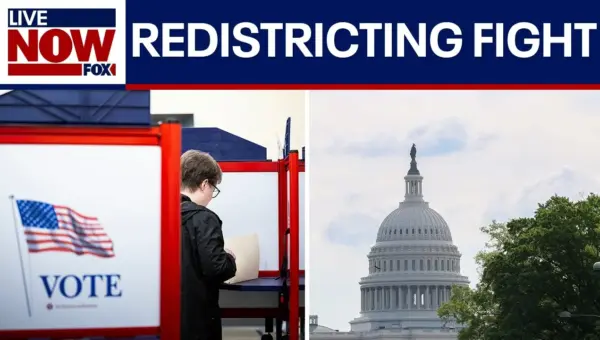
Virginia voters are deciding Tuesday on a constitutional amendment that would grant the state legislature the power to redraw electoral maps. Republicans are raising alarms about a potential partisan power grab and unconstitutional actions. The vote could significantly alter the state's political landscape and national representation.


Trump’s Cryptic Posts Signal Deep Personal Struggles
Donald Trump's recent surge in cryptic and repetitive social media posts, including a video of Frank Sinatra singing "My Way," has sparked widespread concern. Analysts suggest these actions signal a struggle with mortality and a disconnect from reality, raising questions about his fitness for office.


Rogan’s White House Visit Sparks Debate on Trump’s Political Standing
Joe Rogan's appearance at a White House event signing an executive order with Donald Trump sparks debate. Despite Rogan's past criticisms of Trump's administration, his presence suggests a complex political maneuver. The analysis explores Trump's declining poll numbers, his perceived cognitive state, and the broader implications for the Republican party.