Frozen Frontlines: Ukraine’s Soldiers Battle Deadly Cold and Evolving Drone Warfare
Amidst Ukraine's brutal winter, soldiers face deadly sub-zero temperatures and sophisticated Russian drone warfare, transforming daily combat into a desperate struggle for survival. International volunteers Bane and Bruin reveal how extreme cold cripples logistics and equipment, while evolving FPV drone tactics, including coordinated ambushes and thermobaric payloads, demand unprecedented adaptability and ingenuity from frontline forces.


Frozen Frontlines: Ukraine’s Soldiers Battle Deadly Cold and Evolving Drone Warfare
As winter grips the battlefields of Ukraine, soldiers confront an enemy as relentless and deadly as any conventional weapon: extreme cold. With night temperatures plummeting far below freezing, often reaching -20 degrees Fahrenheit (-29 degrees Celsius), the fight for survival against the elements has become an integral and exhausting part of daily combat. This brutal reality, compounded by the rapidly evolving threat of Russian drone warfare, is transforming the nature of conflict on the Eastern Front, demanding unprecedented levels of improvisation, resilience, and technological adaptation from Ukrainian forces and international volunteers alike.
Two such volunteers, Bane, an Australian sniper with Omega Company of the International Legion of Ukrainian Defense Intelligence (GUR), and Bruin, a U.S. Army veteran serving on a drone team since 2023, offered a stark glimpse into the daily struggles. Their experiences highlight the complex challenges faced by those on the frontlines, from critically impacted logistics to the psychological toll of constant vigilance against an unseen, buzzing adversary.
The Unseen Enemy: Extreme Cold and Its Crippling Impact
The severity of the Ukrainian winter is significant. Temperatures consistently below freezing present immediate life-threatening risks such as hypothermia and frostbite. But beyond direct physiological threats, the cold permeates every aspect of military operations, creating a cascading series of logistical and tactical nightmares.
Logistical Lifelines Under Strain
“Batteries are running shorter than most times,” Bane explained, detailing how the frigid air can reduce battery life by a staggering 40 to 60 percent. This reduction cripples the operational range and endurance of vital equipment, especially drones, which have become indispensable for reconnaissance, resupply, and strike missions. In conditions of heavy fog, snow, or sleet, drone operations can be completely grounded for days, leaving frontline units isolated and vulnerable.
The impact extends to basic necessities. Water freezes solid, and food supplies are difficult to keep unfrozen.
When drone resupply is impossible, soldiers are forced to scavenge, moving from house to house in abandoned areas, searching for any canned food they can find. “It feels like you’re playing a game of PUBG, running around every house that you can find… looking for any canned food,” Bane grimly likened the situation to a popular survival video game.
Vehicles, too, bear the brunt of the extreme weather. Bruin, who has witnessed multiple seasons of conflict, noted that this winter’s active fighting is “just destroying the vehicles.” Frozen roads, often riddled with potholes that Bane described as feeling “like open mines,” make transportation hazardous, particularly when driving through dense fog in the early hours of the morning.
Keeping generators running for power generation is another constant battle, demanding extra fuel and succumbing to breakdowns in the harsh conditions. Power outages in rear areas further exacerbate the challenges, forcing support personnel to dedicate significant time to vehicle maintenance and generator repair.
The Human Cost of Cold
Beyond equipment, the human toll is immense. Many soldiers lack adequate cold weather gear, resorting to improvising with whatever they can find in abandoned buildings – from luxurious fur coats to using socks as makeshift gloves.
The persistent threat of frostbite is a stark reality at -20 degrees Fahrenheit. Troop movements become perilous, as footprints in the snow easily betray positions to enemy reconnaissance.
The mental burden is equally significant. Soldiers must constantly balance the need to stay warm with the imperative of remaining undetected. Fires are out of the question due to thermal signatures.
Instead, they rely on ingenious, often uncomfortable, methods: rotating through hot seat bags, sleeping in full gear (which prevents wet clothing from freezing but can lead to sweat accumulation), drying dirty socks around their necks to wick moisture, and sleeping with water bottles to prevent them from freezing. Heaters, even with generators, are largely impractical due to the massive power drain and the undeniable thermal signature they create, making them a beacon for enemy drones.
“You have to choose between staying warm and getting hit by an FPV drone,” Bane articulated, highlighting a brutal trade-off. Carrying heavy packs – often 45-50 kilos for a sniper, or up to 75-80 kilos with full combat load – makes quick evasion of drones nearly impossible. This forces soldiers to make agonizing decisions about what gear to prioritize: warmth or agility.
Often, they opt for lighter loads, accepting the risk of extreme cold for the chance to survive a drone attack. This means sharing sleeping bags, rationing water, and minimizing non-essential items, even for missions expected to last only a few days.
The Drone Dominance: A New Era of Warfare
If the cold is the unseen enemy, drones are the omnipresent, buzzing threat that has fundamentally reshaped the battlefield. The evolution of drone warfare in Ukraine has been rapid and devastating, moving far beyond simple surveillance to complex, coordinated strike and ambush tactics.
Thermal Vision and Air Superiority
At night, the skies over the frontlines are dominated by drones equipped with thermal cameras. Bane estimated that 80% of night-flying drones possess this capability, with Russian drones accounting for an overwhelming 85% of air traffic in his operational area. This gives Russian forces a significant, albeit localized, air superiority, allowing them to detect human heat signatures even in complete darkness or through heavy camouflage.
The proliferation of inexpensive, yet high-quality thermal cameras – even those from consumer markets – provides Russian operators with clear 1080p feeds, enabling them to identify targets from drones flying at 50-60 km/h. When combined with fiber optic control systems, which offer superior signal stability and range compared to traditional radio links, these drones become incredibly precise and difficult to jam.
The Terrifying Evolution of FPVs and Ambush Tactics
Bruin, reflecting on his multiple tours, noted the dramatic increase in drone intensity and sophistication. “Every single time I’ve come back it’s been more… and not just more but they’ve been more complex and they understand them better and they have better tactics with them.” The shift towards FPV (First-Person View) drones is particularly pronounced, with their speed, maneuverability, and devastating payloads.
What was once considered an anti-personnel weapon has evolved into a versatile and potent anti-tank and anti-structure munition. Bane recounted a harrowing ambush where a Ukrainian 113 armored personnel carrier was first hit by a drone carrying a TM62 anti-tank mine, stripping away its FPV cage, then immediately followed by eight FPVs armed with double-stacked RPG warheads. This level of coordinated, multi-drone attack demonstrates a sophisticated understanding of target vulnerabilities and drone capabilities.
Russian forces are now deploying larger 10-inch drones capable of carrying heavier payloads, including thermobaric grenades and bombs. These are used to strike buildings, detonating on floors above entrenched positions, causing massive structural damage and concussive blasts.
More disturbingly, they are employing “ambush drones,” which are landed and positioned near Ukrainian doorways or known choke points, sometimes equipped with motion sensors, to detonate automatically as soldiers emerge. Bruin witnessed the aftermath of such an ambush, where an entire Ukrainian position was burned out and surrounded by three fiber-optic FPVs, parked and waiting.
The sheer volume of drones is also a major factor. Telegram feeds, Bane noted, sometimes show “7-800 drones sitting there ready to go.” This overwhelming numerical advantage, coupled with advanced tactics, creates a constant state of anxiety for soldiers, who liken the sound of an approaching FPV to an “angry bee” – a sound that makes the heart drop and forces immediate, desperate evasion.
Surviving on the Front Lines: Adaptability and Ingenuity
In this dual battle against cold and drones, Ukrainian forces and their international allies are forced to improvise, adapt, and overcome with remarkable ingenuity.
The Imperative of Shelter: From ‘Hole in the Ground’ to ‘Marriott’
“Blendages,” or dug-in bunkers, are critical for survival. These shelters, typically one-room structures buried underground with log overhead cover and a layer of dirt, vary wildly in quality.
As Bruin described, they range from “a hole in the ground where the cold air all settles” with no door, to “the hotel Marriott” – insulated, with a door, generator, and even Starlink internet access. Ideally, blendages are reinforced with defensive trenches and camouflage netting.
Soldiers constantly work to improve their blendages, bringing waterproofing, nails, ponchos, and even spray foam insulation (air-dropped by drone) to seal entryways and holes. However, a significant vulnerability remains: most blendages have only one entrance/exit. Bane, drawing on his Australian military background where bunkers are designed with multiple escape routes, highlighted the danger: “If your position gets attacked… you’re pretty much just stuck inside.” This creates a deadly pinch point, where attackers can simply wait at the sole doorway or use thermobaric grenades to clear the interior.
In areas without proper trenches, such as collapsed apartment buildings where Bane’s unit operates, cover is even scarcer. Soldiers must sprint through rubble, diving under any available debris when a drone approaches, hoping they haven’t been spotted.
The psychological pressure is immense, as the threat of mines is often overshadowed by the immediate danger of an FPV drone. Bane humorously, if grimly, recalled a moment of near-death, dangling upside down from a window after getting his gear caught while trying to evade a drone, fearing a viral video of his demise on Russian channels.
Countering the Drone Threat
Ukrainian forces are developing countermeasures to the pervasive drone threat. One effective tactic involves layering defenses with fish netting and camouflage netting.
A large bubble of fish netting, 3 to 5 meters out from a position, can act as a first line of defense, often causing FPV pilots to abandon their attack if they perceive too many layers to penetrate. Closer to the actual position, camo nets provide additional insulation.
Shotguns have also found a renewed purpose. Within 50 meters, a shotgun can effectively disable an FPV drone. Beyond that range, however, the pellets lose too much energy to be reliably effective, as Bruin embarrassingly discovered.
Another strategy is simply to “wait them out.” Drone batteries, even those on ambush drones, eventually run out. While some motion-sensor drones can self-detonate, many will simply sit there, inert, until their power is depleted.
However, the challenge is compounded by Russian artillery coordination. Enemy spotter drones, often Mavics, are used to direct mortar fire onto main access roads, open fields, and tree lines. Bane described a situation where Russian forces had artillery dialed in with a 7-second flight time and a 10-second response.
As soon as soldiers moved out of a doorway, they would face immediate bombardment, with 122mm and 152mm artillery pounding pre-zeroed choke points. This integrated approach – drones for spotting, FPVs for direct strikes and ambushes, and artillery for area denial – represents a highly sophisticated and lethal threat matrix.
The Broader Implications and Outlook
The testimonies of Bane and Bruin underscore a critical phase in the Ukraine conflict. The winter months, traditionally a period of reduced activity in some historical conflicts, are now defined by relentless, technologically advanced warfare.
The extreme cold amplifies every logistical and tactical challenge, making mere survival an act of profound courage and ingenuity. Meanwhile, the rapid evolution of drone technology, particularly FPVs and their integration with other assets, signals a new chapter in modern combat, where inexpensive, disposable systems can inflict catastrophic damage on multi-million dollar equipment and personnel.
The reliance on international volunteers and fundraising efforts, such as the one mentioned for vehicles and power generation through Ukraine Frontline and Protective Volunteer, highlights the ongoing need for external support to meet the overwhelming demands of this conflict. Providing cold weather gear, robust power solutions, and counter-drone technologies remains paramount.
As the war continues into its next phase, the lessons learned from the frozen frontlines of Ukraine will undoubtedly shape military doctrines and technological development worldwide. The conflict is a brutal crucible, forging new methods of warfare and demanding extraordinary resilience from those caught in its unforgiving grip. The daily struggle against the deadly cold and the ever-present threat of a buzzing drone is not just about holding ground; it is about redefining what it means to fight and survive in the 21st century.
Source: Frozen Front: The Brutal Reality of Winter Combat (YouTube)

Related Articles


Ukraine Jails Ex-Official for Aiding Russian Forces
Former Ukrainian emergency service worker Nelya Chychota has been jailed for collaborating with Russian forces. Accused of spreading pro-Russian information and aiding the enemy, she denied the charges. The conviction highlights Ukraine's efforts to prosecute collaborators.


Ukraine Unveils New Weapons, Forges Global Military Ties
Ukraine has unveiled 56 new domestically produced weapons, showcasing its enhanced military strength and innovation. This development is attracting international attention, with several European nations seeking military cooperation and discussions underway for new alliances that could include Ukraine.
UK Pledges 120,000 Drones to Ukraine in Major Aid Package
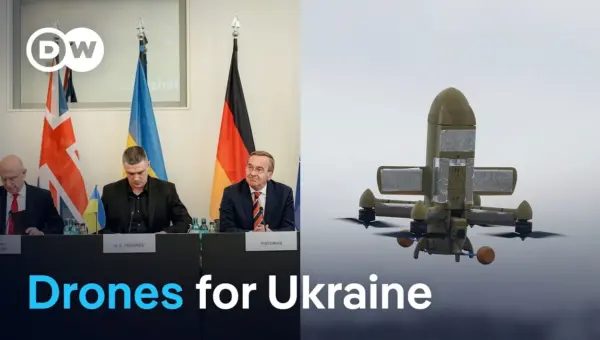
Britain has pledged 120,000 drones to Ukraine, marking its largest aid package of its kind, during a meeting of the Ukraine Defense Contact Group in Berlin. The meeting highlighted both strong international solidarity and ongoing challenges in aid delivery, as Germany also boosts its own defense capabilities.