Quantum Mystery: Fields or Potentials?
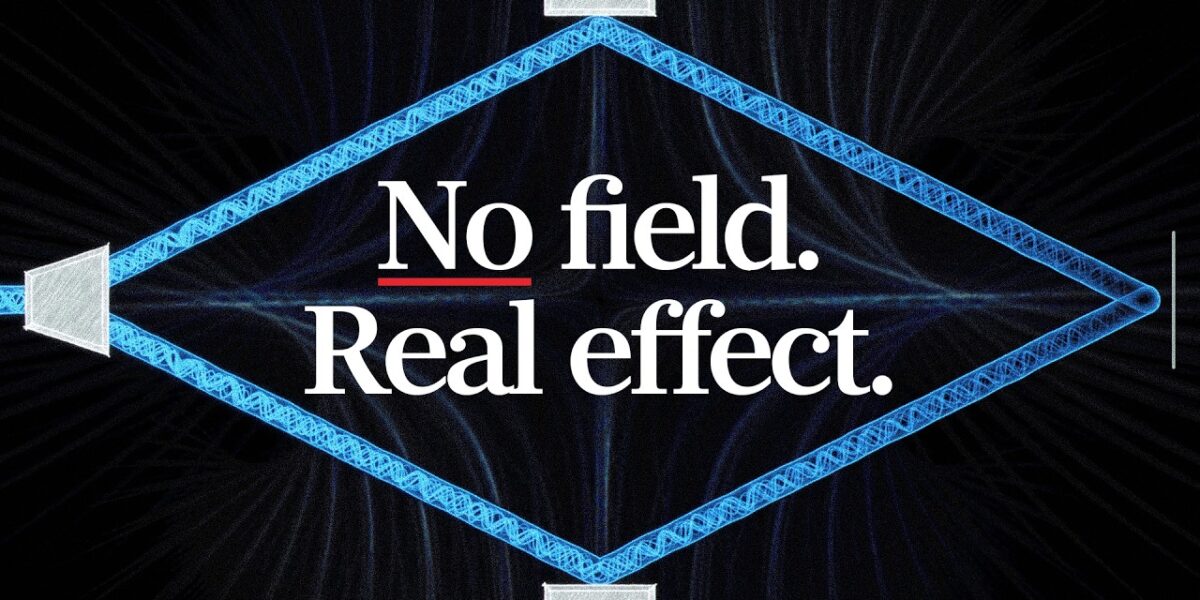
The Bohm-Aharonov effect, demonstrated experimentally, suggests quantum particles are influenced by magnetic potentials even when magnetic fields are absent. This challenges classical physics' view of potentials as mere mathematical tools.

Quantum Mystery: Fields or Potentials?
For centuries, physicists have grappled with the fundamental nature of forces in the universe. While we readily understand how gravity and electromagnetism work through familiar concepts like fields and forces, a deeper, more perplexing question has emerged from the quantum realm: are these forces truly governed by fields, or do more abstract mathematical constructs, known as potentials, hold the key to reality?
The Elusive Three-Body Problem
The quest to understand potentials has a long and winding history, beginning with one of physics’ most enduring challenges: the three-body problem. While Isaac Newton elegantly solved the two-body problem, describing the predictable orbits of, say, the Earth around the Sun, adding just one more celestial body introduced an almost insurmountable complexity.
The gravitational forces become dynamically chaotic, making precise long-term prediction impossible. Generations of brilliant minds, including mathematicians and astronomers, dedicated themselves to finding a solution, but the problem remained stubbornly unsolved.
Lagrange’s Elegant Solution: The Potential
It wasn’t until the 1770s that Joseph-Louis Lagrange offered a revolutionary approach. Instead of wrestling with the complexities of three-dimensional vectors representing forces, Lagrange introduced the concept of gravitational potential (V). This scalar quantity, possessing magnitude but no direction, assigned a value to each point in space around a mass.
Imagine it as an altitude map: the star creates a ‘well,’ and the steepness of the slope at any point indicates the direction and strength of the gravitational force. Mathematically, the gravitational field (G) is the negative gradient of this potential (G = -∇V). This scalar approach simplified calculations immensely; the potentials of multiple bodies could simply be added together, making the system far more tractable.
Lagrange’s work also led to the discovery of the five Lagrange points in a two-body system, locations where a third, smaller object could maintain a stable orbit. While these points didn’t solve the three-body problem, Lagrange’s development of potential theory laid the groundwork for a new way of understanding mechanics. He recognized that the Lagrangian, defined as the difference between kinetic and potential energy, could be plugged into the Euler-Lagrange equations to derive the equations of motion, a method often simpler than direct force calculations, particularly for complex systems like a double pendulum.
From Gravity to Electromagnetism and Magnetism
The success of gravitational potential inspired physicists to explore similar concepts for other forces. Simeon Denis Poisson, a student of Lagrange, noted the striking similarity between the laws of gravity and electrostatics in the 1810s.
He proposed an electric potential (φ) analogous to the gravitational potential. However, a key difference emerged: while masses only attract, charges can attract or repel, meaning electric potentials could create ‘hills’ as well as ‘wells’.
Magnetism, however, proved more recalcitrant. Unlike gravity and electric fields, magnetic field lines form closed loops, without a distinct origin or endpoint. This fundamental difference meant a direct analogy to gravitational or electric potentials was not immediately apparent.
The breakthrough came in the 1840s with William Thomson (later Lord Kelvin). He introduced the concept of the ‘curl’ and proposed that the magnetic field (B) could be described as the curl of a magnetic vector potential (A) (B = ∇ × A). While both B and A are vector fields, A proved to be a more convenient tool for calculations, much like scalar potentials simplified problems in gravity and electrostatics.
The Bohm-Aharonov Effect: A Quantum Challenge
For decades, potentials were largely viewed as convenient mathematical tools, not as physically real entities. The reason was simple: potentials are not unique. For any given field, an infinite number of potentials could be defined by simply adding a constant.
Since adding a constant to a potential doesn’t change the resulting field or the forces experienced by an object, potentials seemed to lack direct physical significance. This perspective held sway until the mid-20th century and the advent of quantum mechanics.
In 1959, physicists David Bohm and Yakir Aharonov proposed a groundbreaking experiment that challenged this classical view. They focused on the Schrödinger equation, the fundamental equation governing quantum systems.
The equation’s solutions, the wave functions, describe the behavior of particles. Crucially, the equation incorporates potentials (A and φ) directly, not the fields themselves.
Bohm and Aharonov hypothesized that potentials, not fields, might be the fundamental entities influencing quantum particles. They devised a theoretical experiment involving a beam of electrons split into two paths. These paths would flank a solenoid—a coil of wire.
When current flows through the solenoid, it generates a strong magnetic field inside but, ideally, no magnetic field outside. However, a magnetic vector potential (A) would still permeate the region outside the solenoid, even though the magnetic field (B) was zero there.
According to their hypothesis, if the phase of the electron’s wave function—a key determinant of its quantum behavior—was influenced by the vector potential A even in the absence of a magnetic field B, it would prove that potentials have a direct physical effect. This phase shift would cause a measurable change in the interference pattern formed when the two electron beams recombined.
Experimental Confirmation and Ongoing Debate
The proposed Bohm-Aharonov effect was initially met with skepticism. Many physicists, accustomed to the classical understanding of fields as the primary actors, found it difficult to accept that a potential could exert influence without a corresponding field. Early experimental attempts, such as Robert Chambers’ experiment in 1960 using a magnetized iron whisker, showed promising results but were criticized for potential stray magnetic fields.
The definitive proof came in 1986 with Akira Tonomura’s experiment. Using a toroidal (donut-shaped) magnet, Tonomura’s team created a situation where the magnetic field outside the torus was precisely zero, while a magnetic potential still existed.
By firing electron beams around this torus and observing the resulting interference patterns, they found a clear shift, precisely as predicted by Bohm and Aharonov. This experiment provided compelling evidence that potentials, not just fields, have a tangible influence on charged particles at the quantum level.
The Enduring Mystery
Despite the experimental validation, the debate about the true nature of potentials continues. One camp argues that potentials are more fundamental than fields, as they appear directly in the Schrödinger equation. Others maintain that while the Bohm-Aharonov effect is real, the arbitrariness of potential values (the ability to add any constant) still suggests they are not the ultimate reality.
The observable effect, they argue, arises from line integrals of the potential, not the potential itself. This ongoing discussion highlights that even in our most advanced theories, fundamental mysteries about the universe persist, pushing the boundaries of our understanding.
Source: We still don't understand magnetism (YouTube)

Related Articles


Wind-Powered Car Defies Limits, Exceeds Wind Speed
A new cart design demonstrates how an object can travel faster than the wind pushing it, using a clever wheel and spool system. This principle, similar to the Blackbird land yacht, challenges our understanding of motion and energy transfer.


Cosmic Blueprint: Science Meets Faith in Universe’s Origins
Astrophysicist Michio Kaku draws parallels between the Big Bang theory and biblical creation accounts. He also discusses the potential for future technology to preserve human consciousness and shares his personal belief in a "God of creation."

Astronaut Spots Cosmic Flip: The Tennis Racket Mystery
A Soviet cosmonaut's accidental discovery of a spinning wing nut revealed the bizarre Janabbeckov effect. This phenomenon, also known as the tennis racket theorem, explains why some spinning objects inexplicably flip, a quirk now understood through physics.