Counting Cosmic Islands: A 62,000-Year Endeavor
Our current estimates place the number of galaxies in the observable universe at a staggering two trillion. Counting them individually, even at one per second, would take an immense 62,000 years, highlighting the vastness of space.

The Staggering Scale of the Cosmos: Two Trillion Galaxies and Counting
Imagine standing on a beach, tasked with counting every grain of sand. Now, magnify that task to an unimaginable scale. That’s the challenge we face when contemplating the sheer number of galaxies in our universe.
As of February 2026, our most ambitious estimates suggest there are at least two trillion galaxies, each a vast island of stars, gas, and dust, much like our own Milky Way. This mind-boggling figure prompts a fundamental question: how long would it truly take to count them all?
A Galactic Tally: From Seconds to Millennia
To grasp the immensity of two trillion, let’s engage in a thought experiment. If we possessed the ability to count one galaxy every second – a feat far beyond human capability, let alone technological prowess – the numbers quickly become astronomical themselves.
Relatable Milestones:
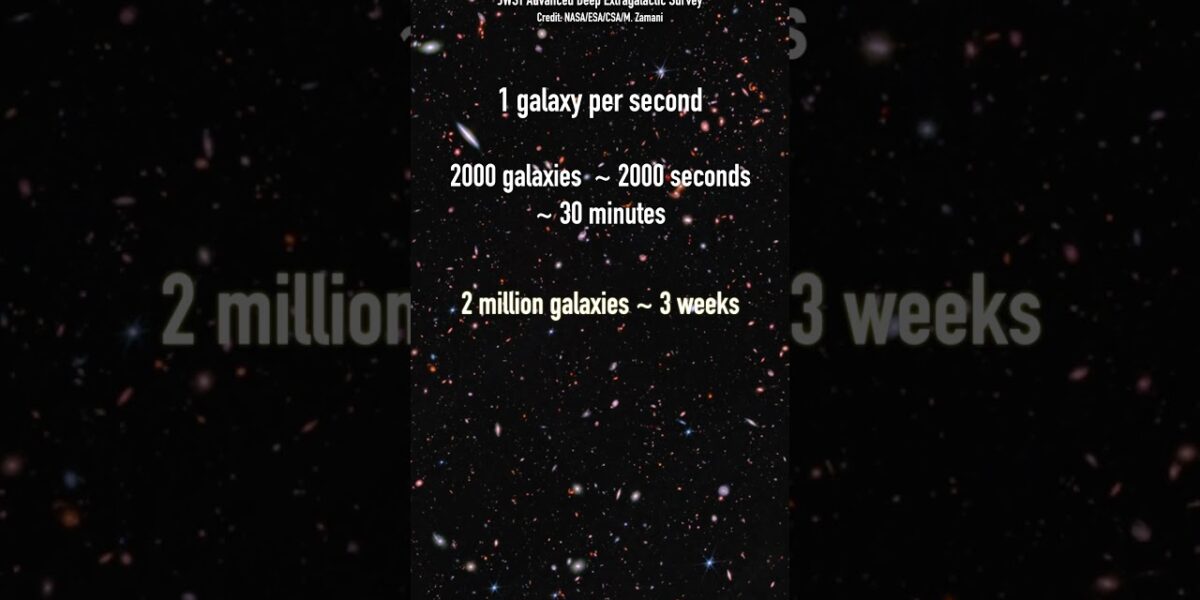
- Counting 2,000 galaxies would take approximately 2,000 seconds, a manageable 33 minutes.
- Reaching 2 million galaxies would extend the tally to 2 million seconds, roughly three weeks of continuous counting.
- A milestone of 2 billion galaxies would demand a staggering 62 years of unwavering dedication.
But our current best estimate is not 2 billion, but two trillion. To count this many galaxies, at one per second, would require an astonishing 62,000 years.
This is a duration that dwarfs human history, spanning from the late Paleolithic era to our current age. It underscores that even with hypothetical perfect counting abilities, the sheer number of galaxies is proof of the universe’s unfathomable vastness.
Beyond the Observable Horizon: The Unseen Universe
The figure of two trillion galaxies represents our current understanding of the observable universe – the portion of the cosmos from which light has had time to reach us since the Big Bang. This is the limit of our telescopic reach, defined by the age of the universe and the speed of light. However, scientists widely believe that the universe extends far beyond what we can currently observe.
The Limits of Perception:
- Technological Limitations: Our current instruments, even the most advanced telescopes like the James Webb Space Telescope, have limits to their sensitivity and resolution. Dimmer, more distant, or smaller galaxies may simply be too faint or too small to detect with present technology.
- The Cosmic Horizon: The observable universe is a sphere centered on us, with a radius determined by the age of the universe (approximately 13.8 billion years) and the expansion of space. Light from objects beyond this horizon has not yet had enough time to reach us. The accelerating expansion of the universe means that some regions of space are receding from us faster than the speed of light, rendering them permanently unobservable.
Therefore, the two trillion galaxies we estimate are likely just a fraction of the total number of galaxies that exist. The true cosmic population could be orders of magnitude larger, a humbling thought that pushes the boundaries of our imagination.
Why Does This Matter? The Quest for Understanding
The endeavor to count and understand galaxies is not merely an exercise in numerical magnitude; it is central to our quest to comprehend our place in the cosmos. Each galaxy is a laboratory for astrophysics, offering insights into star formation, galaxy evolution, the nature of dark matter and dark energy, and the fundamental laws of physics.
Historical Context:
For centuries, humanity has gazed at the stars, initially perceiving a relatively small, contained universe. The discovery of nebulae in the early 20th century, and Edwin Hubble’s groundbreaking work in the 1920s, revolutionized this view.
Hubble’s observations of Cepheid variable stars in the Andromeda Nebula definitively proved that it was a separate galaxy, far beyond the confines of our own Milky Way. This discovery expanded our cosmic neighborhood exponentially and paved the way for the modern understanding of a universe filled with countless galaxies.
The Future of Cosmic Census:
Future generations of telescopes and observational techniques will undoubtedly push the boundaries of our cosmic census. Projects like the Vera C.
Rubin Observatory and planned space missions aim to map even larger portions of the sky with unprecedented depth and detail, potentially revealing previously unseen galaxies. These advancements will refine our estimates, help us understand the distribution of galaxies across cosmic time, and clarify the processes that shaped the universe we inhabit.
The sheer number of galaxies is a constant reminder of the universe’s grand scale and the profound mysteries that still await discovery. While a personal count of two trillion galaxies remains an impossible dream, the ongoing scientific effort to map and understand these cosmic islands continues to expand our knowledge and inspire awe at the boundless nature of existence.
Source: How long would it take to count all 2 TRILLION galaxies in the Universe? (YouTube)

Related Articles

Gravitational Waves Reveal Universe’s Deepest Secrets
Humanity's ability to detect gravitational waves has advanced dramatically, with observatories now capturing nearly one black hole merger daily. These cosmic events are not only spectacular but also crucial for testing Einstein's theories and understanding the universe's fundamental nature. Future upgrades promise even greater insights.


Alien Life Could Travel Between Stars, Scientists Say
Scientists are exploring the scientific concept of panspermia, where life could travel between star systems on asteroids or comets. Evidence shows life's resilience and the movement of material between planets, making this a credible hypothesis. The search for extraterrestrial life is now focusing on when and where we might find it.
Cosmic Hum Hints at Gigantic Black Hole Mergers
Astronomers are using networks of rapidly spinning pulsars, nature's precise cosmic clocks, to detect the faint hum of merging supermassive black holes. New research is now focusing on pinpointing individual merger events, moving beyond the general background noise to understand these colossal cosmic collisions.