Higgs Boson Unlocks Door to Dark Universe
The Higgs boson, discovered at the LHC in 2012, is now theorized to be a 'portal' to a hidden 'dark sector' of particles. Upgrades to the Large Hadron Collider aim to detect these invisible particles, potentially solving the mystery of dark matter.

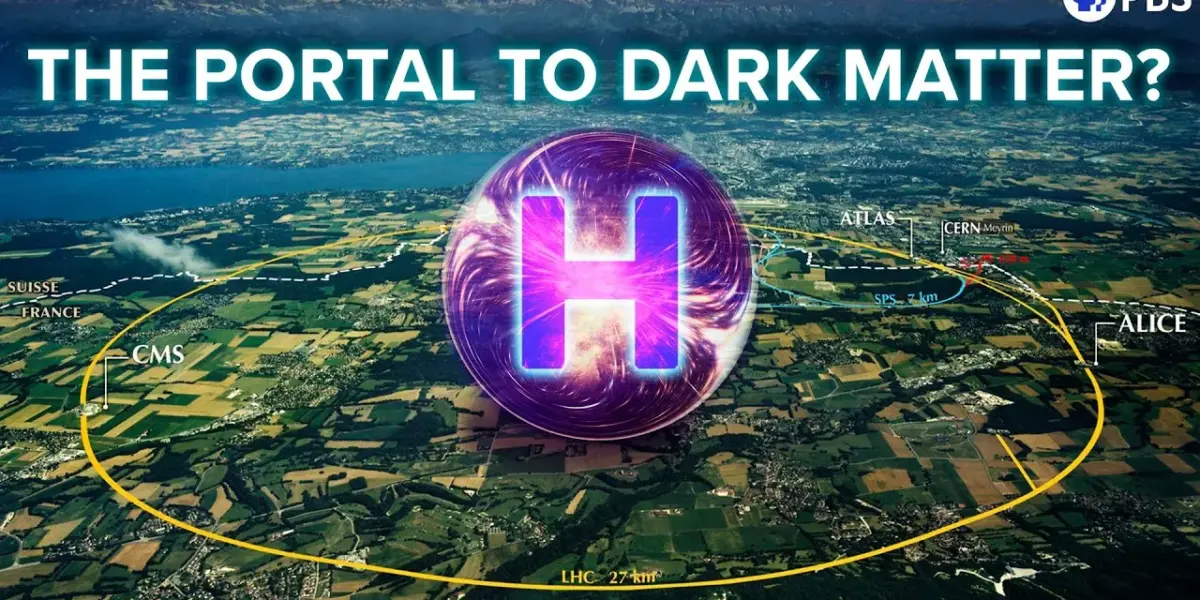
Higgs Boson May Be Key to Unveiling Dark Matter
For years, scientists have speculated about the existence of a hidden realm of particles, a ‘dark sector’ that operates parallel to our familiar universe but remains invisible to our current detection methods. Now, the Higgs boson, the elusive particle discovered at the Large Hadron Collider (LHC) in 2012, is emerging as a potential ‘portal’ to this mysterious dark universe, offering a tantalizing new avenue in the quest to understand dark matter.
The Enigma of Dark Matter
The universe is composed of approximately 27% dark matter, a substance that interacts gravitationally but does not emit, absorb, or reflect light. Its presence is inferred from its gravitational effects on visible matter, such as the rotation of galaxies and the bending of light.
Despite decades of research, the fundamental nature of dark matter remains one of the most profound unsolved mysteries in physics. Many theories have proposed specific dark matter candidates, such as sterile neutrinos or supersymmetric particles, but experimental evidence has been elusive, and the parameter space for these single-particle solutions is rapidly narrowing.
Introducing the Dark Sector Hypothesis
The ‘dark sector’ hypothesis offers a more expansive solution. Instead of a single particle, it posits an entire family of elementary particles that interact with each other but have minimal or no interaction with the fundamental forces governing our visible, or ‘Standard Model,’ universe – electromagnetism, the strong nuclear force, and the weak nuclear force.
These dark sector particles would not possess Standard Model charges (like electric charge or color charge), rendering them invisible to our detectors. However, they could still possess their own internal charges and interactions, potentially mirroring aspects of the Standard Model with ‘dark quarks,’ ‘dark leptons,’ and ‘dark bosons.’
The Higgs Boson: A Universal Connector
The challenge lies in detecting these invisible particles. Direct detection is impossible if they do not interact with our forces. However, physics dictates that certain ‘portals’ might exist, allowing for indirect interaction.
These portals are typically Standard Model particles or fields that can couple to the dark sector. Among the leading candidates for such a portal is the Higgs boson. Discovered at the LHC in 2012, the Higgs boson is unique because it is a scalar field – the simplest type of quantum field.
This simplicity allows it to couple extensively with other fields, a property that gives other fundamental particles their mass. Physicists theorize that this same coupling capability could extend to the dark sector, making the Higgs boson a prime candidate for facilitating energy transfer between the visible and dark universes.
The Large Hadron Collider’s Evolving Role
The LHC, the world’s most powerful particle accelerator, was initially built to discover the Higgs boson. While it succeeded spectacularly in 2012, subsequent searches for other predicted new particles, such as those from supersymmetry, at near the LHC’s maximum energy (currently around 6.8 TeV per beam, with a design goal of 7 TeV), have yielded no definitive results. This has led some to believe that new particles might be too massive to be produced with current energy levels.
However, the focus is now shifting. The LHC’s continued operation, particularly with upgrades, could allow it to probe the Higgs portal more effectively.
The High-Luminosity LHC and Data Analysis
The next phase of the LHC’s life, the High-Luminosity LHC (HL-LHC), is poised to revolutionize dark sector research. Scheduled to begin operations in 2030, the HL-LHC will increase the number of collisions per second by a factor of ten.
This boost in ‘luminosity’ is expected to produce approximately 380 million Higgs bosons over its operational decade, a tenfold increase over all previous datasets. This sheer volume of Higgs bosons is crucial for increasing the chances of observing rare decay events.
However, simply producing more Higgs bosons is not enough. A critical challenge has been the sheer volume of data generated by proton-proton collisions at near the speed of light (99.99999905%).
With hundreds of millions of collisions per second, detectors generate petabytes of data per second, making it impossible to store and analyze everything. Experiments rely on sophisticated ‘trigger’ systems to sift through this data in real-time, discarding the vast majority of ‘boring’ events and keeping only those that show promise for interesting physics.
The problem is that these triggers are designed based on known Standard Model physics. If the Higgs boson decays into dark sector particles, these particles might not interact with Standard Model detectors in predictable ways.
For instance, a Higgs boson could decay into dark sector particles, which then interact within the dark sector before eventually decaying back into detectable Standard Model particles, such as muons. If these final particles originate from a point displaced from the main proton collision vertex, they might be mistakenly discarded by current trigger systems designed to identify particles originating directly from the collision point.
A New Strategy for Detecting the Invisible
The HL-LHC upgrade will include an updated trigger algorithm designed to address this limitation. By incorporating ‘data scouting,’ the system will record minimal details about events, especially those involving ‘displaced muons’ – muons whose trajectories trace back to a point away from the primary collision. If these displaced muons appear in significant numbers, the system will flag the event for more detailed analysis.
The detection of such displaced particles would be a strong indicator of Higgs boson decays into intermediate dark sector particles. While the exact timeline for discovery is uncertain and depends on the unknown properties of the dark sector, such as the strength of its coupling to the Higgs and its decay rates, scientists are hopeful that significant evidence could emerge within the first year of the HL-LHC’s operation. Further analysis of mass distributions, decay timescales, and other properties would then be required to confirm the dark sector hypothesis.
Looking Ahead: A Glimpse into the Dark Universe
The prospect of peering into the dark sector via the Higgs portal represents a monumental step forward in particle physics and cosmology. It offers a tangible path toward solving the dark matter puzzle, a problem that has long eluded direct observation.
If successful, this research could fundamentally alter our understanding of the universe’s composition and evolution, potentially revealing a hidden cosmos teeming with new particles and interactions. The LHC, once built to find the Higgs, may ultimately serve as our gateway to the universe’s most enigmatic secrets.
Source: The Particle That Could Open a Portal to the Dark Universe (YouTube)

Related Articles


Artemis 2 Carries Astronauts to Lunar Orbit
Artemis 2 has launched four astronauts on a journey around the Moon, marking a significant step in human lunar exploration. Meanwhile, astronomers are studying a comet that reversed its spin and galaxies that seem to lack dark matter. Advances in antimatter transport and satellite refueling also point to future space capabilities.


Matter-Antimatter Mystery: CERN Unlocks Secrets of Universe’s Imbalance
Scientists at CERN are producing and studying antimatter to solve the cosmic mystery of why the universe is dominated by matter. This elusive substance, created in a specialized factory, could reveal the fundamental imbalance that allowed matter to prevail over antimatter in the early universe.


Hubble Tension Solved? New Cosmic Clocks Measure Universe’s Expansion
New 'cosmic clocks' like time-delay cosmography are helping astronomers tackle the Hubble tension, a discrepancy in measuring the universe's expansion rate. Meanwhile, the return to the Moon aims to teach humanity how to live in space, while the threat of weaponized satellites looms.