Psychic’s Visions Hint at Killer in 25-Year Cold Case
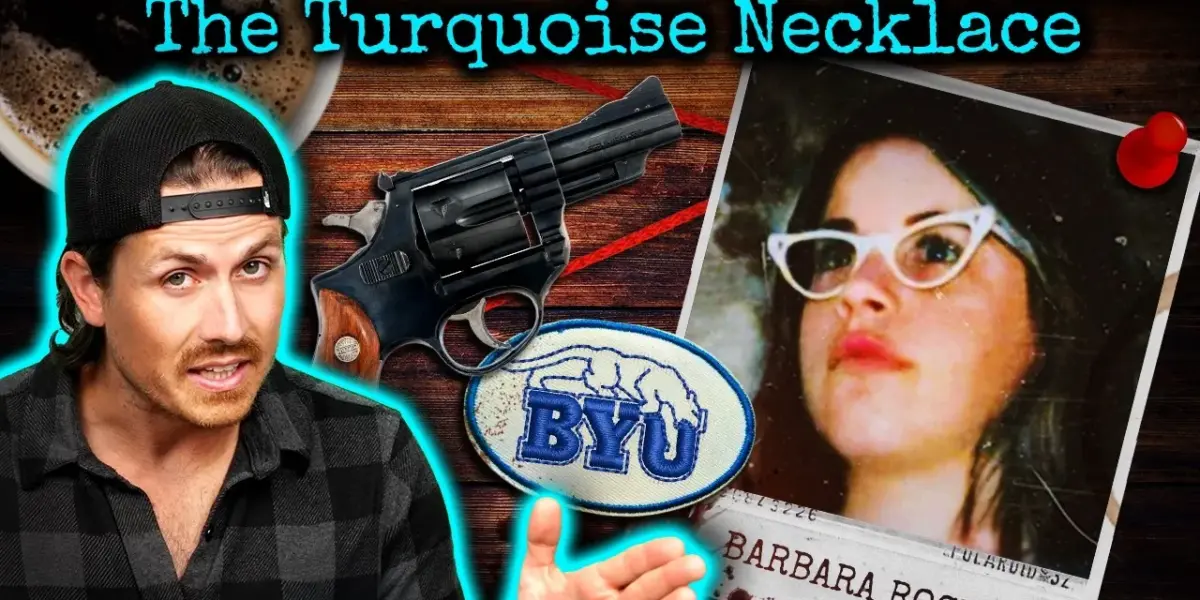
Barbara Rocky, a BYU student seeking escape from campus life, was found murdered in Big Cottonwood Canyon in 1974. A psychic's visions and a pawned necklace initially pointed to a suspect, but the case remained cold for 25 years until DNA technology finally identified her killer.

Psychic’s Visions Hint at Killer in 25-Year Cold Case
March 11th, 1974. The air in Provo, Utah, hummed with the mundane rhythm of a university campus. But for 22-year-old Barbara Rocky, a junior at Brigham Young University, the day held a different, urgent cadence.
She sat at her desk, meticulously crafting a goodbye letter to her seven roommates. The words flowed, each sentence proof of her growing alienation within the deeply religious student body of BYU.
A Californian with a free spirit, Barbara felt like an outsider, her exploration of new ideas and experimentation with different religions a stark contrast to the rigid values of her peers. Her recent move into a shared house had only amplified this disconnect; her roommates viewed her dating habits and spiritual curiosity with alarm, making her feel increasingly unwelcome and even feared.
A Desire for Escape
Barbara’s frustration had festered, leading her to deliberately provoke her roommates, even claiming to pray to the devil, a move that solidified their fear and pushed her further into isolation. The letter was her declaration of independence, a plan to leave campus and seek solace with like-minded individuals. Among them was Richard Finder, a self-proclaimed psychic she’d connected with over the radio.
Despite the age difference, Richard understood her in a way no one else seemed to. Their relationship, though largely conducted over the phone, felt both romantic and spiritual. Barbara envisioned a future where she could be physically closer to him and his circle.
Beyond personal alienation, a growing unease pervaded Barbara’s mind. National news reports of college women being attacked and going missing in their dorm rooms had instilled a deep sense of vulnerability. Physically resembling the victims, Barbara had taken steps to protect herself, enrolling in judo classes and even acquiring a gun, which, ironically, had recently gone missing and been reported to campus police.
With her goodbye letter finished, Barbara checked the clock. Nearly 10:00 a.m., and class awaited. She placed the letter in her purse, alongside a turquoise necklace, her most valuable possession, which she intended to pawn in Salt Lake City for seed money to fund her departure.
As she prepared to leave, the familiar sight of her car pulling into the driveway brought a sense of relief. Her best friend, Jerry Hicker, had borrowed it and was returning it just in time for her planned trip.
A Friend’s Growing Concern
Jerry greeted Barbara with keys in hand, inquiring about their afternoon plans. Barbara, preoccupied with her imminent departure and the logistics of selling her necklace, offered a distracted nod before hopping into her car and driving off. Later that afternoon, Jerry arrived at Barbara’s house, expecting to meet up, only to find she hadn’t shown.
This was highly uncharacteristic. Her car was also absent from the driveway, leading him to consider asking her roommates. However, as he walked back to his own place, a jarring sight stopped him: Barbara’s car, parked in the lot of an apartment complex where he knew she had no acquaintances.
A knot of worry tightened in Jerry’s stomach. He approached the unlocked car and discovered a note. The contents sent his heart racing.
An hour later, Jerry, accompanied by a visibly uneasy group of Barbara’s roommates, burst into the campus police station. The note, a goodbye letter stating Barbara was leaving to be with “her people,” struck Jerry as alarming, potentially a suicide note. While the roommates seemed skeptical of Jerry’s overreaction, they agreed to accompany him to the police.
The responding officer promised to look into it. Initial inquiries with students and Barbara’s family yielded no information; she had vanished.
A Body in the Canyon
The following day, March 12th, a utility worker hiking in the remote Big Cottonwood Canyon, a scenic nature preserve near Salt Lake City, made a horrifying discovery. Expecting solitude, he instead found a woman lying face down, partially or completely nude. Initially mistaking her for a sunbather, the cold March air and her position quickly dispelled that notion.
A gasp escaped him as the grim reality set in. He fled to alert the authorities.
Captain Pete Hayward of the Salt Lake City Sheriff’s Office arrived at the scene, a secluded spot accessible only by a steep, arduous trail. Beneath a bush lay the body of a naked woman. Hayward observed at least three bullet wounds in her back, but no other apparent injuries.
The lack of decomposition suggested she had been there for roughly a day. The scene was eerily neat: her clothes and shoes were folded meticulously nearby, with no signs of a struggle, drag marks, or a discarded weapon. Hayward deduced the woman had likely been killed at the spot where she was found, speculating that she had willingly accompanied her killer, someone she knew and trusted, up the challenging terrain.
Without identification on the body or in her clothing, the victim remained a mystery. Investigators collected bullets and soil samples, hoping for forensic evidence.
The next day, March 13th, Captain Hayward received crucial information: the victim was identified as Barbara Rocky. BYU police had alerted them about a missing student, and classmates had confirmed her identity.
Interrogations and Unraveling Clues
Hayward’s immediate focus turned to Jerry Hicker, the friend who first reported Barbara missing. Jerry, visibly shaken, recounted his last interactions with Barbara on March 11th. He explained borrowing her car, returning it around 10:00 a.m., and their canceled plans for later that day.
His discovery of her car and the unsettling note, which he initially feared was a suicide note, led him to the police. Hayward, aware that the killer was likely someone Barbara trusted, viewed Jerry as a potential suspect but noted his alibi and his proactive reporting of her disappearance made him seem unlikely.
The investigation then shifted to Barbara’s roommates. While they all possessed solid alibis, they confirmed Barbara’s intention to pawn a turquoise necklace in Salt Lake City. This lead prompted a city-wide canvass of pawn shops.
The break came when a pawn shop owner identified Barbara from a photograph and confirmed she had sold a turquoise necklace on March 11th at 12:50 p.m. Crucially, Barbara had mentioned her boyfriend was circling the block, a detail that had previously gone unmentioned by anyone in her life. Further inquiries revealed this boyfriend’s name: Richard.
The timing and circumstances surrounding Barbara’s disappearance coincided with Richard Finder’s presence in Salt Lake City on a ski vacation. Finder, a self-proclaimed psychic, owned a .357 caliber pistol—the same caliber believed to be the murder weapon—and his lodging was conveniently located near Big Cottonwood Canyon.
The Psychic Suspect
Captain Hayward brought Richard Finder in for questioning. Finder, with his glasses and goatee, exuded an air of confidence, which Hayward immediately distrusted. He suspected Finder was attempting to insert himself into the investigation to deflect blame.
Finder claimed a deep spiritual connection with Barbara, initiated after she heard him on the radio. He stated they had never been physical.
When asked about his call to the station, Finder spoke of a psychic vision: the murder weapon had been thrown into water. This information, unknown to the public, further solidified Hayward’s suspicion.
Hayward demanded an account of Finder’s whereabouts on March 11th. Finder appeared genuinely stunned, denying any involvement and claiming to have been with friends all day.
He provided their contact information, and Hayward, though still convinced of Finder’s guilt, knew he needed more concrete evidence. He requested to examine Finder’s .357 pistol for ballistics testing.
A Cold Case Rekindled
Weeks later, the ballistics report arrived, delivering a stunning blow: Richard Finder’s gun was not the murder weapon. Hayward was shocked and profoundly disappointed.
Richard Finder, his prime suspect, had been cleared. His alibi also proved shaky, with friends confirming he was not with them for the entire day.
The investigation, which had seemed on the verge of a breakthrough, once again lost momentum. The initial autopsy revealed five gunshot wounds, not three, and could not confirm sexual assault. Forensics found no usable fingerprints at the scene.
The missing gun, the motive, and the killer remained elusive. The case grew cold, leaving Barbara Rocky’s death unsolved for nearly a quarter of a century.
Justice After Decades
The breakthrough came 25 years later, in 2000, with advancements in DNA technology. Investigators re-examined the evidence, including the bullets recovered from the scene. A DNA profile was generated from trace evidence found on the bullets.
This profile was then run through CODIS, the FBI’s DNA database. The match led investigators to a man named Steven Mark Robins, who had a prior conviction for assault. Robins had been in Salt Lake City at the time of Barbara’s murder.
Under renewed scrutiny and presented with the DNA evidence, Robins confessed to killing Barbara Rocky. He admitted to picking her up after she pawned her necklace, driving her to Big Cottonwood Canyon, and shooting her multiple times before discarding her clothes and fleeing. Robins was subsequently convicted of first-degree murder and sentenced to life in prison.
Barbara Rocky’s case is a clear reminder of the enduring nature of violent crime and the vital role of evolving forensic science in achieving justice. The initial investigation, while thorough for its time, was hampered by the limitations of 1970s technology.
The psychic’s involvement, though ultimately not yielding the killer, provided a tantalizing, albeit misleading, clue. The decades-long wait for justice highlights the pain of unresolved cases for victims’ families and highlights the persistent hope that even the coldest of cases can eventually be brought to light.
Source: BYU coed murder took 25 years to solve… (YouTube)

Related Articles
Shoe Print Unmasks Killer in Brutal Highway Murder
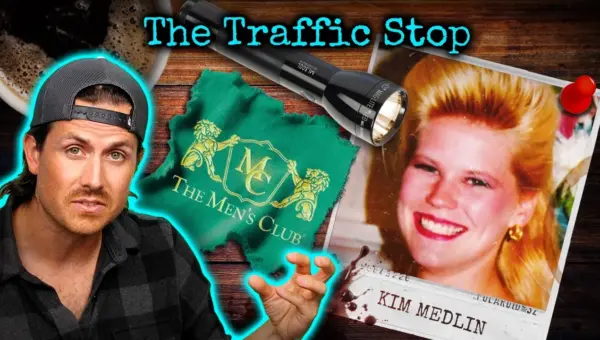
A chilling discovery on a secluded North Carolina road led investigators down a path of obsession and brutal violence. A single shoe print on a victim's sweatshirt became the key to unlocking the truth behind Kim Medlin's murder.

DNA Clues Emerge in Cold Case: Saliva Samples Hold Key
Seventy days into the Nancy Guthrie case, fears of it going cold are rising. A mixed DNA sample is the only lead, but it requires advanced analysis. Expert CeCe Moore believes saliva DNA from the perpetrator, potentially left while holding a flashlight, is a key to solving the mystery. New technologies could help investigators overcome these challenges.

Cold Case Cracked: Arrest Made in 2011 Iowa Realtor Murder
After 15 years, a major breakthrough has occurred in the 2011 murder of Iowa real estate agent Ashley Okland. Kristin Ramsey has been arrested and charged with first-degree murder, with new details emerging about witness accounts and alleged inconsistencies in the suspect's statements.