US Ally Faces Global Outcry Over War Actions
Prominent figures and international leaders are increasingly vocal in their criticism of Israel's wartime actions, drawing parallels to historical atrocities and condemning its policies. The report highlights global backlash, diplomatic clashes, and a growing movement advocating for a shift in US foreign policy and support for progressive political change.


US Ally Faces Global Outcry Over War Actions
A prominent British actress, Miriam Margolyes, voiced deep shame and concern over Israel’s actions in a statement recorded over a year ago. She described the situation as shocking, embarrassing, and wicked, equating it to a scenario where Hitler might have “won.” Margolyes urged Jewish people worldwide to demand a ceasefire and the release of hostages, emphasizing that criticizing Israel’s wartime conduct is not anti-Semitic.
Margolyes drew a clear distinction between being Jewish and supporting Zionism, a political movement. She argued that true Semites are the Palestinians and Lebanese, the very people she believes Israel is targeting. She highlighted an Israeli attack in Lebanon that reportedly killed a family of four, including a critically injured individual, and mentioned reports of Israel being the leading cause of journalist and child deaths globally.
South Korea’s President Condemns Israeli Actions
The issue gained international attention when South Korean President Lee Jae-myung publicly criticized the Israeli Defense Forces (IDF) over a video circulating in 2024. The video appeared to show Israeli soldiers throwing bodies off a rooftop in the occupied West Bank. Israel stated the operation targeted militants and that its actions did not align with IDF values, while President Lee controversially compared the events to the Holocaust and Japan’s wartime sexual slavery of Korean women.
Israel’s Foreign Ministry called President Lee’s remarks unacceptable, particularly for trivializing the massacre of Jews. The incident highlighted international scrutiny of Israel’s military conduct. Under international law, militaries are required to treat bodies with dignity and return them to families, a standard that critics argue Israel has repeatedly failed to meet.
Criticism Mounts Against Israeli Government and US Support
Commentators like Ana Kasparian have spoken out against threats from Israeli officials and supporters towards those who criticize the government’s actions. Kasparian stated she is not afraid of these threats, despite receiving messages from the IDF. She argued that Israel is internationally hated not for being Jewish, but for its actions against innocent people, accusing its leaders of acting like “demons” and engaging in war crimes.
The report also pointed to Apple’s alleged role in assisting Israel by removing names of Lebanese villages from Apple Maps, which was described as a form of ethnic cleansing. This action was seen as a collaboration with what some call the “Israeli war crime machine.” The commentary suggested that figures like Tim Cook are aligning with Israeli interests, which is viewed as a betrayal of humanitarian principles.
Israel’s Nuclear Status and Regional Influence Questioned
Journalist Mehdi Hasan raised critical questions about Israel’s regional standing, particularly concerning nuclear weapons. He noted that Israel possesses nuclear weapons, has not signed the Non-Proliferation Treaty, and defies UN resolutions to allow international inspection of its nuclear facilities. Hasan contrasted this with Iran, arguing that Israel, not Iran, is the rogue nuclear state in the Middle East.
Hasan also suggested that Israeli Prime Minister Benjamin Netanyahu has influenced American presidents to engage in “wars of choice,” citing the Iraq War and potential future conflicts with Iran. Global public opinion, the report claims, increasingly views Israel as a threat to regional and international peace, a sentiment amplified by its actions and its relationship with the United States.
Progressive Candidates and the Call for Change
The discussion shifted towards solutions, highlighting progressive political candidates who are independent of pro-Israel lobbying groups. These candidates advocate for universal healthcare and renewable energy, aiming to reduce involvement in wars driven by fossil fuel interests. The movement encourages voters to support these candidates to change the political landscape and address issues like late-stage capitalism.
The report referenced Mondaire Jones as an example of a progressive politician whose work demonstrates the effectiveness of democratic socialism. It calls for an end to the idea that corporate influence benefits everyone and urges people to become involved in politics to elect representatives who prioritize the well-being of their constituents and the planet. This movement aims to reform Congress by removing entrenched politicians who vote against public interest.
Historical Context and Jewish Voices Against Israeli Policy
The article highlighted the long-standing nature of international criticism against Israel’s actions, suggesting they have gone “unpunished” and received significant financial support for decades. It cited Caitlin Johnstone’s assertion that the world cannot have both peace and Israel, reflecting a growing global sentiment. The report also included a statement from “The Voice of Rabbis” which argued that Judaism is a religion, not a nationality, and that claiming Israel as the sole Jewish homeland is a distortion bordering on anti-Semitism.
This perspective aligns with the idea that Israel is an ethno-state, not a reflection of all Jewish people. The report noted that Israel has been accused of bombing Christian sites and communities, challenging the notion that its actions are solely defensive or religiously motivated. It emphasized that the majority of Israeli citizens support the current government’s policies, contrary to the idea that the conflict is solely driven by Netanyahu.
A Call for Open Minds and Peace
The piece concluded with a plea for open minds and self-education, suggesting that much of what is taught in America is propaganda. It stressed the importance of distinguishing between Judaism and Zionism, asserting that criticism of Israel’s government is not an attack on Jewish people.
The call to action is to educate oneself, understand the real story behind the conflict, and support those working for peace. The final thought emphasizes that true change requires active participation and a willingness to challenge established narratives, with the ultimate hope for a peaceful resolution in the region.
Source: Top U.S. Ally in NIGHTMARE of its OWN MAKING… (YouTube)

Related Articles


Trump Announces Israel-Lebanon Ceasefire Amid Rising Tensions
President Trump announced a new ceasefire agreement between Israel and Hezbollah, set to take effect immediately. The truce aims to de-escalate weeks of heavy fighting. The announcement comes as a US oil deal nears expiration, and global economic concerns, including rising gas prices, persist.
Cuba Denies Political Prisoners Amid Rights Group Claims
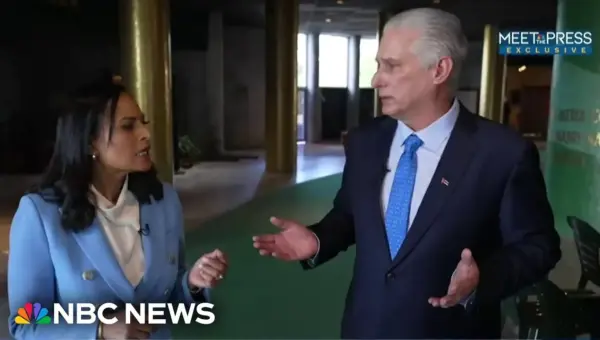
Cuban President Miguel Diaz-Canel has denied holding political prisoners, calling such claims a "big lie." However, human rights groups, including Prisoners Defenders, insist that over 1,200 individuals are unjustly detained for dissent. The dispute highlights ongoing tensions over freedom of expression in Cuba.


Trump Claims Iran Deal: A Leap of Faith or Risky Gamble?
President Trump claims Iran has agreed to surrender its enriched uranium, potentially ending the war. However, skepticism remains high due to Iran's history of deception, and significant military movements suggest conflict is still a strong possibility. The situation is fluid, with verification and trust being key.