Dark Matter Signal Detected in Our Galaxy
A new analysis of Fermi Telescope data reveals a mysterious gamma ray signal originating from the Milky Way's dark matter halo. This pattern matches theoretical predictions for WIMP annihilation, offering the most promising evidence yet for the elusive substance that shapes our universe.

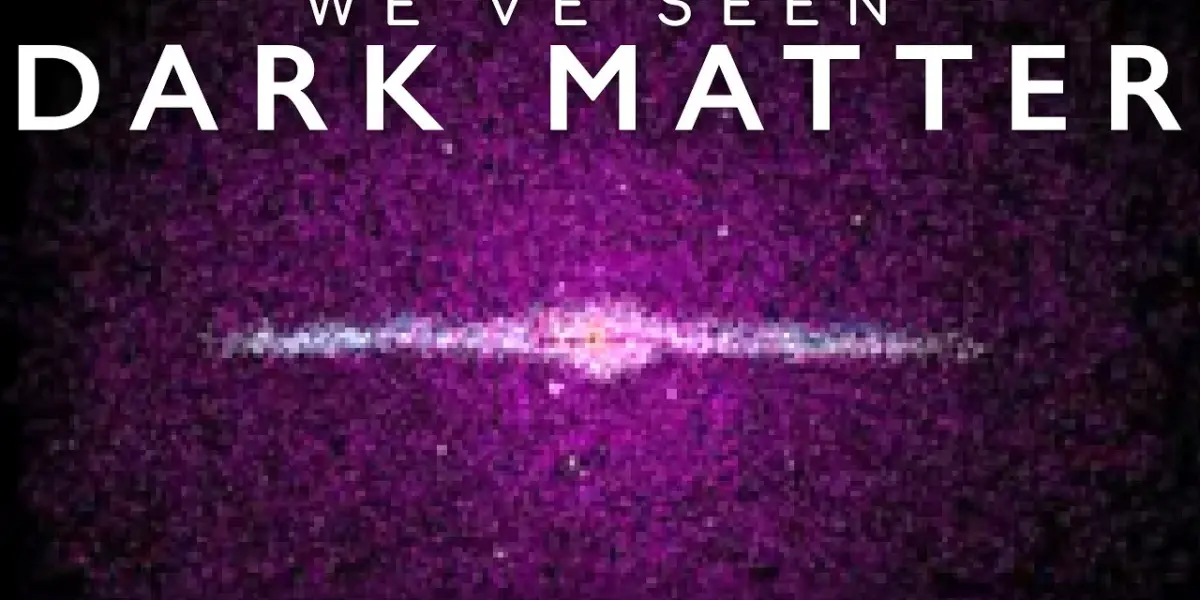
Cosmic Mystery Deepens: New Signal Hints at Dark Matter’s Presence
A faint but persistent signal originating from within our own Milky Way galaxy might be the first direct evidence of dark matter. For nearly a century, scientists have grappled with the invisible substance that makes up most of the universe. Now, a new analysis of data from the Fermi Gamma-ray Space Telescope suggests we may have finally caught a glimpse of this elusive cosmic material.
Dark matter is a fundamental part of our universe, but its true nature remains one of science’s biggest puzzles. It doesn’t give off light, reflect it, or block it, making it invisible to our telescopes. Despite its mysterious nature, we know it plays a key role in how galaxies form and move.
A Century-Long Search for the Invisible
The story of dark matter begins with Fritz Zwicky, a Swiss astronomer working in the United States in the 1930s. While studying the Coma Cluster of galaxies, Zwicky noticed something peculiar. The galaxies within the cluster were moving far too fast to be held together by the gravity of the visible matter alone.
Zwicky calculated that the cluster needed about ten times more mass than could be seen to keep it from flying apart. He proposed that an unseen, ‘dark’ substance must be providing the extra gravitational pull. This groundbreaking observation, made using the same Mount Wilson telescope that helped prove the universe was expanding, laid the foundation for the concept of dark matter.
What is Dark Matter?
Since Zwicky’s initial observations, scientists have been searching for what dark matter could be. The problem is its invisibility; it doesn’t interact with light in any way we can detect. We can only infer its presence through its gravitational effects on visible objects, much like seeing the wind move leaves without seeing the wind itself.
Two leading theories for what dark matter might be are WIMPs (Weakly Interacting Massive Particles) and axions. While many experiments have been set up to find these particles, none have yielded definitive proof until now. The search has involved everything from powerful particle accelerators to sensitive detectors buried deep underground.
A Potential Breakthrough from Old Data
In November 2025, a research paper by Dr. Tomonori Totani from the University of Tokyo presented a compelling new lead. Dr. Totani analyzed vast archives of data collected by the Fermi Telescope over 15 years. This space telescope is designed to detect gamma rays, a high-energy form of light, coming from distant cosmic events.
The key to Dr. Totani’s research was to focus on the gamma rays coming from our own Milky Way galaxy. He meticulously filtered out signals from known sources, such as black holes and dying stars, which also produce gamma rays. What remained was a unique pattern of gamma rays that seemed to match the predicted shape of the Milky Way’s dark matter halo.
The WIMP Connection
The signal’s energy profile was particularly intriguing. It peaked at about 20 giga-electron volts, an energy level consistent with the theoretical mass of WIMPs.
WIMPs are predicted by some extensions to the Standard Model of particle physics, like supersymmetry. They are called ‘weakly interacting’ because they barely interact with normal matter, except through gravity, making them perfect candidates for dark matter.
When a particle meets its antiparticle, they annihilate each other, releasing energy in the form of gamma rays. This process, described by Einstein’s famous equation E=mc², is a fundamental way energy and mass are related. If WIMPs exist and annihilate, they would produce gamma rays with specific energy signatures, which is exactly what Dr. Totani’s analysis might have found.
Challenges and Next Steps
While the discovery is exciting, scientists are proceeding with caution. There are still some uncertainties to address.
The exact mass of a WIMP is not precisely known, leading to a range of possible gamma ray energies. The observed signal’s strength suggests a higher density of WIMPs than some current models of the early universe predict.
Professor Carlos Frenk, a prominent dark matter researcher, has compared the significance of finding dark matter to Charles Darwin’s theory of evolution. This highlights the immense importance of such a discovery and the need for absolute certainty before making a definitive claim.
The Future of Dark Matter Detection
The search for dark matter is far from over, but this new evidence provides a powerful direction. Future observations will look for similar gamma ray signals in neighboring dwarf galaxies. These smaller galaxies are thought to be rich in dark matter and less cluttered with other gamma ray sources.
A major player in this ongoing quest will be the Vera C. Rubin Observatory in Chile, which began operations in June 2025.
Named after a pioneering dark matter researcher, the observatory will survey the southern sky, collecting vast amounts of data. This massive effort aims to uncover new cosmic objects and clarify mysteries like dark matter.
Dark matter is more than just an academic curiosity; it shaped the universe we see today and will influence its future. This potential detection of WIMP annihilation is the most significant development in observational dark matter research in decades. Scientists worldwide are continuing the work, driven by the thrill of unraveling one of the universe’s greatest secrets.
Source: Have We Just Seen Dark Matter For the First Time? (YouTube)

Related Articles

Dark Energy Drives Universe Expansion, Scientists Confirm
Scientists confirm dark energy, a mysterious force, is accelerating the universe's expansion, counteracting gravity. This discovery, rooted in 1999 observations of distant supernovae, suggests dark energy makes up about 68% of the universe's energy density. Future telescopes aim to unravel its true nature and impact on the cosmos's fate.


Artemis 2 Carries Astronauts to Lunar Orbit
Artemis 2 has launched four astronauts on a journey around the Moon, marking a significant step in human lunar exploration. Meanwhile, astronomers are studying a comet that reversed its spin and galaxies that seem to lack dark matter. Advances in antimatter transport and satellite refueling also point to future space capabilities.

Webb Telescope Reveals New Cosmic Secrets
The James Webb Space Telescope has selected its next batch of scientific projects, promising new insights into alien worlds and the early universe. Researchers will use Webb to study exoplanet atmospheres, investigate distant galaxies, and explore objects within our own solar system.