Big Tech’s Land Grab: Small Towns Face Existential Crisis
Big Tech's aggressive acquisition of land is transforming rural America, displacing farmers and straining resources. Data centers consume vast amounts of water and energy, while offering minimal local employment and demanding significant tax breaks, leaving communities questioning the true cost of technological progress.


Big Tech’s Land Grab: Small Towns Face Existential Crisis
In the heartland of America, a profound crisis is unfolding. As 2025 and 2026 mark a period of significant economic strain for agricultural communities, exacerbated by past trade disputes that crippled farmers, a new and more insidious threat is emerging: the relentless expansion of Big Tech. Silicon Valley giants, armed with vast financial resources, are descending upon rural America, acquiring generational family farms and transforming the landscape, impacting not just livelihoods but also the very fabric of these communities.
The Unveiling of a Crisis: A Farmer’s Stand
The stark reality of this burgeoning crisis came into sharp focus recently when a video capturing a farmer’s defiant refusal of a $15 million offer for his land from a prominent tech company went viral. The farmer, presented with an offer of $60,000 per acre, totaling over $15 million for his properties, unequivocally rejected the deal. His reasoning was not purely economic but deeply rooted in a desire to preserve his farms and the agricultural heritage they represent. “I said no. I was not interested in uh uh destroying my farms. That was the bottom line,” he stated, expressing his heartbreak at the prospect of seeing “every square inch” of his land developed. This act of resistance highlights a growing sentiment among many in rural America who feel their way of life is under siege.
The True Cost of Technological Advancement
While artificial intelligence is frequently lauded as the pinnacle of human achievement, promising a new era of progress, the physical infrastructure required to support it is coming at a devastating cost to the land that sustains us. The United States is permanently losing an estimated 2,000 acres of farmland every single day, according to the American Farmland Trust. This loss is not for the construction of affordable housing or essential services like hospitals, which are often being closed. Instead, the land is being consumed by massive, windowless data centers, described by critics as “concrete air fryers for tech billionaires.” This trend is particularly acute in areas like Ohio, which is becoming ground zero for this phenomenon.
Economic Disruption and Community Erosion
Tech giants are entering small agricultural towns with seemingly bottomless pockets, offering exorbitant prices for land that local families have owned for generations. These aggressive acquisitions destabilize local real estate markets, making it virtually impossible for residents to afford homes in the towns where they were raised. The narrative presented to these communities is one of gratitude for the “privilege” of living next to these massive technological installations. This influx of capital is often accompanied by demands for significant tax abatements, with companies securing decades-long breaks that leave local services like fire departments and schools underfunded. This is seen as a continuation of a long-standing pattern of wealth transfer, where the capital of the working class is systematically harvested.
“These buildings are parasites. A single hyperscale data center can guzzle up to 5 million gallons of water a day just to cool down its towers. They drain the local aquifer. It requires massive overhauls. the electrical grid and they have to usually put high voltage transmission lines over private property putting the owners in a position where they either have to take a deal from the tech company or the government’s going to use eminent domain and they they put this choice in front of the American people also they can keep the servers from melting down and if you’re asking the question who actually pays for these billion dollar utility upgrades you do.”
The Data Center Dilemma: Resource Drain and Utility Spikes
The operational demands of data centers are immense, placing a significant strain on local resources. A single hyperscale data center can consume up to 5 million gallons of water daily for cooling, severely depleting local aquifers. Furthermore, these facilities necessitate substantial upgrades to the electrical grid, often requiring high-voltage transmission lines to be built over private property. Residents are often faced with the difficult choice of accepting a deal from the tech company or facing government-imposed eminent domain. The cost of these multi-billion dollar utility upgrades is ultimately borne by local residents through increased delivery fees and utility bills, a burden that disproportionately affects rural communities with less political leverage. These utility costs can double or triple during harsh winter months, pushing already struggling families to the brink.
The Illusion of Economic Revitalization
Local politicians often champion the arrival of data centers, touting them as catalysts for economic revitalization. However, the reality is far less rosy. While construction phases may create temporary jobs, once a data center is operational, the need for human labor plummets to around 30 individuals, primarily security personnel. This starkly contrasts with the economic ecosystem fostered by traditional farms, which support local dealerships, hardware stores, and a broader network of employment. Data centers, in contrast, are described as “closed-loop vacuums” that extract resources like water and cheap power, funneling profits to coastal executives while leaving the heartland depleted and land prices inflated, consequently driving up property taxes for residents.
Environmental and Health Impacts: Noise and Water Scarcity
Beyond the economic ramifications, the proliferation of data centers introduces significant environmental and health concerns. The constant, low hum of machinery, replacing the natural sounds of rural life, has been linked to adverse health effects such as headaches and nausea in nearby residents. More critically, the competition for water resources between data centers and agriculture is intensifying. In regions like Mexico, data centers have already depleted water sources to the point where local farmers cannot irrigate their crops, forcing them into water rationing. This competition highlights a broader trend of creating “sacrifice zones,” areas where the exploitation of land and resources takes precedence over the well-being of the people who inhabit them.
A Battle for Sacred Ground: Prince William County Example
The conflict between technological expansion and the preservation of heritage is starkly illustrated by a proposed development in Prince William County, Virginia. Developers are seeking to rezone 2,100 acres for a “digital gateway” that would include 37 data centers, some as tall as eight stories. This project is slated for construction adjacent to Manassus National Battlefield Park, a site of immense historical and personal significance. For the narrator, this battlefield is a sanctuary, a place of peace and reflection, where generations of his family have walked and where his ancestors fought. The prospect of this hallowed ground being overshadowed by the perpetual hum of data centers represents a profound loss, a “corporate sanitization of our physical reality” that prioritizes speculative digital ventures over historical memory and natural tranquility.
The Unfair Trade: A Future Forged in Sacrifice
The article concludes with a somber reflection on the choices America is making. The trade-off between preserving invaluable farmland and historical sites for the sake of technological advancement is deemed fundamentally unfair and unwise. As the nation transitions towards an AI-centric future, the critical need for balance between humanity and technology is emphasized. The narrative warns that without careful consideration, the very foundations of our society could be built upon the erosion of our physical reality and historical memory, leaving behind a landscape of abandoned data centers and desecrated sacred grounds.
What’s Next?
As the expansion of data centers continues, the focus will likely shift towards legislative and community-led efforts to regulate their development and mitigate their impact. The long-term consequences for agricultural sustainability, water resources, and the preservation of historical and natural landscapes remain critical areas to monitor. The ongoing debate over tax incentives and the true economic benefits versus the societal costs will undoubtedly intensify, potentially shaping the future of rural communities across the nation.
Source: WARNING: Big Tech is Bulldozing Small Town America (YouTube)

Related Articles

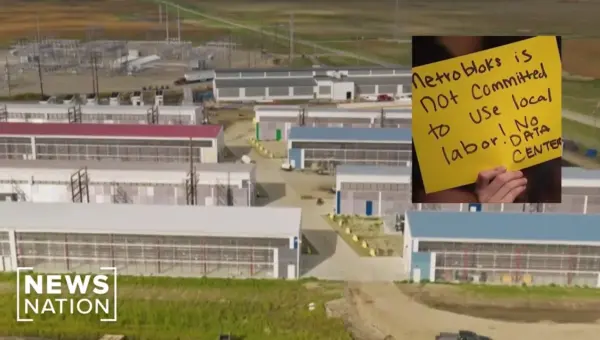
AI Data Centers Spark Rural Uprising
Rural American towns are fighting back against a surge of AI data centers. These massive facilities threaten water supplies, farmland, and local infrastructure. Residents and lawmakers are pushing for new rules to control their growth and ensure companies bear more of the costs.

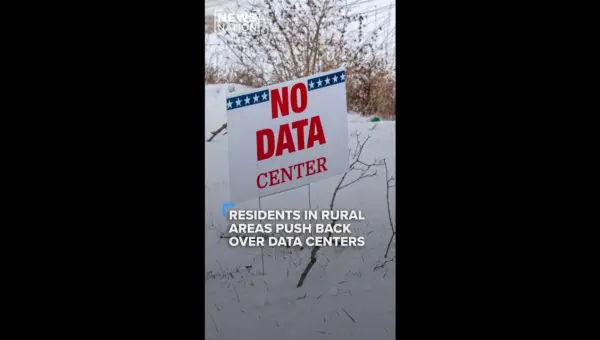
Data Centers Spark Rural Uprising Over Land and Power
Rural communities are fighting back against the rapid expansion of data centers, citing concerns over massive energy consumption and changes to their land. These facilities, vital for AI technology, are straining local power grids and raising questions about the balance between digital progress and community well-being.
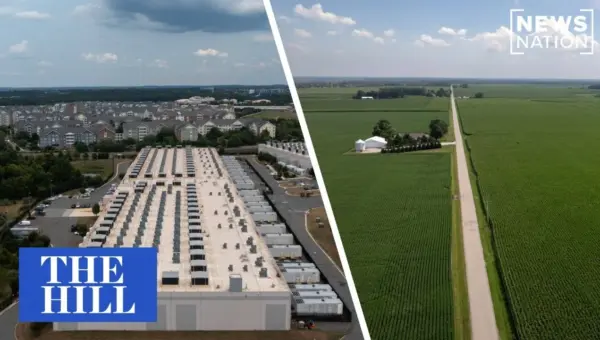
Farmers Fight Data Centers For Land, Power
The rapid expansion of data centers in rural America is creating significant challenges for farmers. These facilities consume vast amounts of land and electricity, driving up costs and threatening food production. Texas officials are proposing solutions to guide development towards less productive areas.