Galaxy S26 Ultra’s Privacy Display: A Game Changer?
Samsung's upcoming Galaxy S26 Ultra may feature an innovative privacy display, allowing users to control viewing angles on demand. A recent demo showcased its ability to obscure the screen from side glances, enhancing mobile privacy.

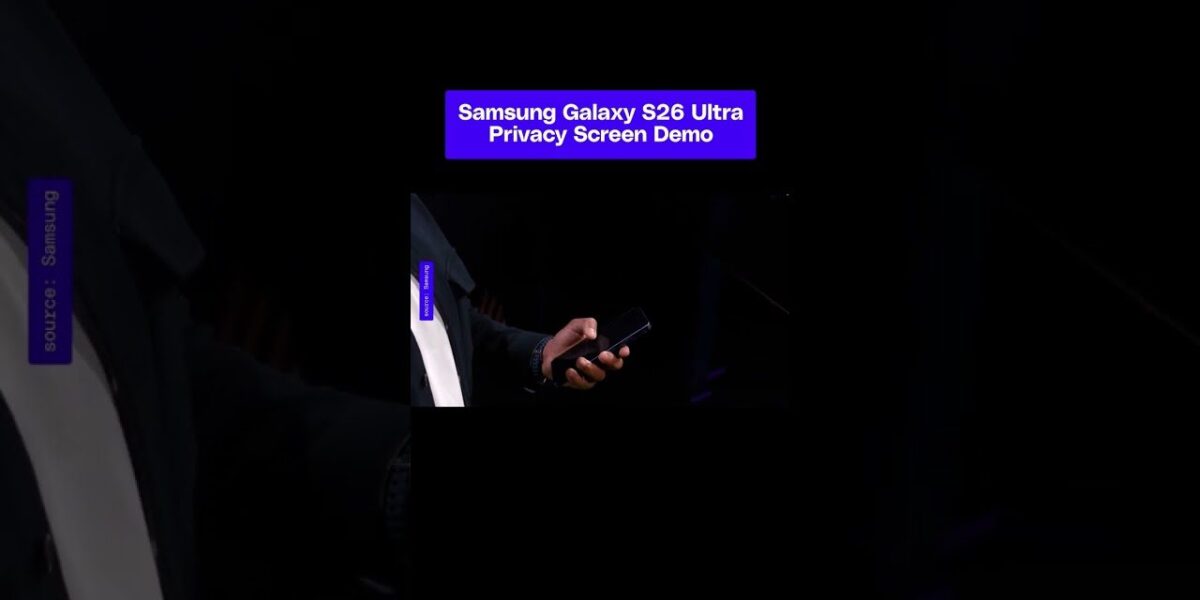
Samsung’s Galaxy S26 Ultra Promises Enhanced Privacy with New Display Tech
In a move that could redefine mobile privacy, Samsung is reportedly gearing up to integrate an advanced privacy display feature into its upcoming Galaxy S26 Ultra. While official details remain scarce, a recent demonstration by tech influencer MilesAboveTech has offered a tantalizing glimpse into a technology that could put an end to unwanted screen peeking.
The Live Demo: Seeing is Believing
During a live demonstration, MilesAboveTech showcased the capabilities of what is believed to be the Galaxy S26 Ultra’s new privacy display. The presenter highlighted how the screen, when the privacy feature is activated, becomes virtually invisible from side angles. This means that while the user can see their content clearly, anyone attempting to look over their shoulder would see a black or heavily obscured screen.
“Right now, I have the privacy display on,” MilesAboveTech explained during the demo. “You can see my screen clearly, but you can’t see it from the sides.
See?” The presenter then demonstrated the effect, showing how the screen was perfectly legible from the front but completely unreadable from oblique angles. This feature is designed to protect sensitive information, such as banking details, private messages, or confidential work documents, from prying eyes in public spaces.
Seamless Transition: Privacy on Demand
Crucially, the demonstration also revealed the ease with which this privacy mode can be toggled on and off. “But if I want, I could just go ahead and turn it off like this,” the presenter stated, presumably activating a setting or gesture to disable the privacy filter.
This suggests that users won’t be permanently locked into a restricted viewing angle. They can switch back to a normal display mode instantly, allowing for easy screen sharing with friends or colleagues when desired.
The ability to quickly switch between a wide viewing angle and a narrow, private one is a significant usability improvement over previous privacy screen solutions, which often involved physical screen protectors that could diminish screen clarity or touch sensitivity. “This way, I can keep whatever’s on my screen private, but also share my screen with my friends,” MilesAboveTech concluded, highlighting the feature’s dual utility.
What This Means for Mobile Privacy
The integration of such a sophisticated privacy display directly into the hardware of a flagship device like the Galaxy S26 Ultra would be a major step forward. Current solutions often rely on third-party screen protectors, which can be cumbersome, affect screen quality, and are not always perfectly integrated. A built-in solution offers a seamless experience, likely optimized for the device’s display technology and potentially offering superior clarity and responsiveness.
This feature directly addresses a growing concern among smartphone users: digital privacy. At a time when personal data is constantly being accessed and displayed on our devices, the risk of sensitive information being compromised in public is ever-present. From checking bank balances on a crowded train to reading private messages in a cafe, the need for on-demand privacy is clear.
Potential Impact and Competitor Landscape
If the Galaxy S26 Ultra indeed launches with this feature, it could set a new standard for smartphone privacy. Competitors like Apple, Google, and other Android manufacturers may be compelled to develop similar technologies for their own devices. While some laptops and tablets offer digital privacy filters, their implementation on the smaller, more portable smartphone screen presents unique engineering challenges.
The technology behind such a display likely involves advanced liquid crystal technology or electrochromic layers that can dynamically alter the screen’s light-polarizing properties. The challenge lies in achieving this without sacrificing brightness, color accuracy, or battery life – factors that are critical for user satisfaction.
Who Should Care?
This privacy display technology is particularly relevant for several user groups:
- Business Professionals: Those who handle sensitive company data or financial information on their mobile devices will find this invaluable for maintaining confidentiality in public workspaces.
- Privacy-Conscious Individuals: Anyone concerned about their digital footprint and the security of their personal communications and online activities.
- Frequent Travelers: Commuters and frequent flyers who often use their phones in crowded public transport or airports.
- Social Media Users: Individuals who prefer to keep their personal conversations and browsing habits private, even when in the presence of others.
Looking Ahead: Availability and Expectations
While the MilesAboveTech demonstration provides strong evidence, Samsung has yet to officially announce the Galaxy S26 Ultra or confirm the inclusion of this privacy display feature. Typically, Samsung unveils its flagship Galaxy S series in the first quarter of the year. Therefore, we can anticipate more concrete details and official specifications to emerge closer to a potential launch in early 2025.
The success of this feature will hinge on its real-world performance, its impact on battery life, and its integration into the user interface. If Samsung can deliver a privacy display that is both effective and unobtrusive, the Galaxy S26 Ultra could be a significant contender, not just for its performance and camera prowess, but for its commitment to user privacy.
Specs & Key Features (Anticipated)
- Privacy Display: Dynamically adjustable viewing angle to prevent side-viewing.
- Seamless Switching: User-friendly toggle between privacy mode and standard viewing.
- Display Technology: Likely an advanced iteration of Samsung’s Dynamic AMOLED, with integrated privacy filter technology.
- Device: Samsung Galaxy S26 Ultra (expected).
The prospect of a built-in, on-demand privacy screen on a flagship smartphone is exciting. It addresses a genuine user need and, if executed well, could make the Galaxy S26 Ultra a standout device in a competitive market.
Source: MilesAboveTech comes on stage to do a live demo of the Galaxy S26 Ultra’s privacy display. (YouTube)

Related Articles


Apple’s iBook Return? It Would Fail Today
Apple's iconic iBook, with its unique design and handle, likely wouldn't succeed in today's market. Experts explain that consumers are accustomed to familiar device shapes, making truly innovative designs a tough sell. This challenge extends to smartphones, where the standard rectangular form factor dominates.


AI Agents Surge: Why Future Tech Matters More Than Fame
Fame is less important than contributing to future-shaping fields like AI, especially in the development of autonomous AI agents. Expertise in these areas attracts significant attention, even from influential figures, highlighting the value of substantive work over popularity.


Samsung’s TriFold: A Rare Gem, Hard to Get
Samsung's elusive Galaxy Z TriFold, a phone with two hinges that unfolds into a tablet, proved incredibly hard to obtain. After a difficult purchase and software modifications, it offers a unique glimpse into foldable tech, but remains a niche product for enthusiasts.