Starmer Faces “Corrosive Complacency” Amid Mandelson Affair
Journalist Jason Cowley criticizes Prime Minister Keir Starmer's leadership as marked by "corrosive complacency," particularly in light of the Peter Mandelson appointment controversy. Questions are being raised about vetting processes and information transparency within the government. The situation draws parallels to past criticisms leveled against Boris Johnson, while internal Labour Party dynamics and discussions on English identity add further layers to the political commentary.

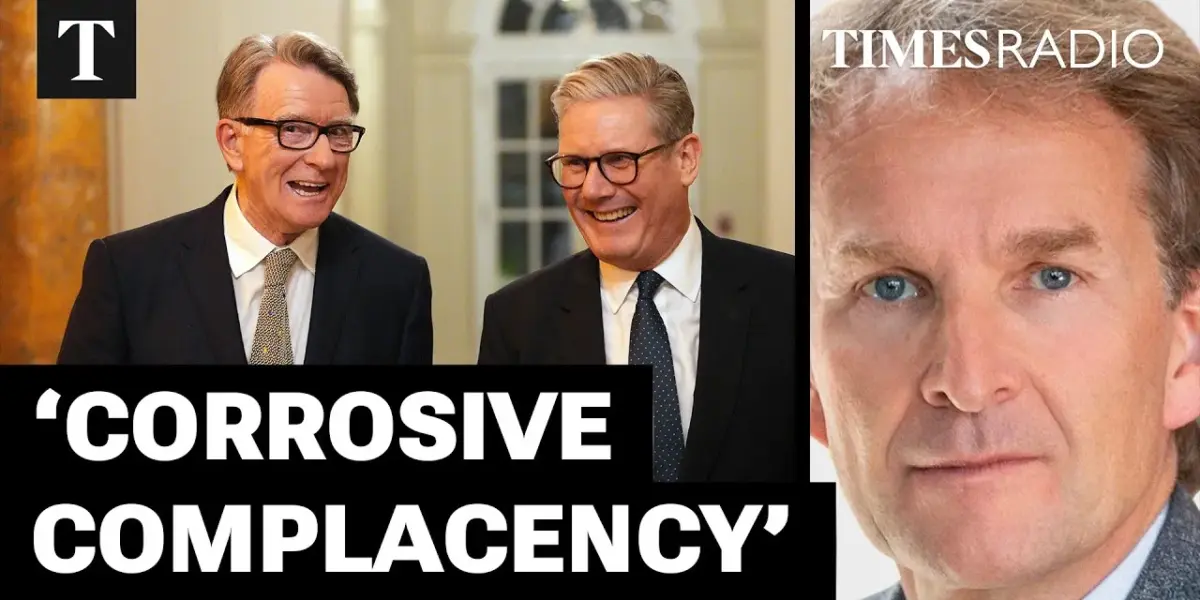
Starmer’s Premiership Defined by “Corrosive Complacency,” Says Analyst
The leadership of Prime Minister Keir Starmer is being criticized for a “corrosive complacency,” a phrase used by journalist Jason Cowley in The Sunday Times. This criticism comes amid fallout from the appointment of Lord Peter Mandelson and questions surrounding the Prime Minister’s approach to governance. Cowley suggests that a lack of curiosity and a tendency to react late to events have become hallmarks of Starmer’s time in office.
Mandelson Appointment Sparks Vetting Controversy
Concerns have surfaced regarding Lord Mandelson’s vetting process for a government role, with reports suggesting foreign links may have been a factor in the UK security vetting’s decision not to approve him. The exact process leading to his appointment remains unclear, raising questions about who was aware of the vetting issues.
David Lammy, the current Deputy Prime Minister and former Foreign Secretary, stated he would have blocked Mandelson’s appointment if he had known about the vetting failure. He expressed shock at the decisions made by Sir Oliver Robbins, formerly a key figure in the vetting process, indicating that he and his advisors were unaware of the vetting’s conclusions.
Current Foreign Secretary, Emily Thornberry, has ordered a full review of information provided by her department to the Foreign Affairs Select Committee. This situation is building towards a significant moment as the Prime Minister is expected to address Parliament. Sir Oliver Robbins is also scheduled to provide his account of events to the Foreign Affairs Committee.
Prime Minister’s Defense and “Honest Mistakes”
The Prime Minister’s central argument appears to be that he was not provided with the necessary information about Peter Mandelson’s vetting at any point. This suggests a potential failure in the information flow, even after Mandelson’s initial appointment and subsequent dismissal. Critics, however, question why the Prime Minister did not proactively seek this information rather than waiting for it to be disclosed.
Jason Cowley draws a parallel between Starmer’s current situation and the criticism he leveled against former Prime Minister Boris Johnson. Starmer, who positioned himself as an “anti-Johnson” figure, a lawyer focused on rules and honesty, now faces similar questions about accountability. Cowley highlights Starmer’s past questioning of Johnson in Parliament: “Why does the Prime Minister think everybody else’s actions have consequences except his own?” This question is now being echoed by some of Starmer’s own MPs.
While acknowledging that Starmer is willing to admit mistakes, Cowley notes that these are often framed as “honest mistakes.” This contrasts with Johnson, who was found to have misled Parliament about COVID-19 lockdown parties. The key difference, Cowley suggests, is Starmer’s readiness to acknowledge error, even if the circumstances surrounding the mistakes are under scrutiny.
Delegation Strategy Under Fire
Cowley argues that Starmer’s approach to leadership, characterized by a desire to delegate and grant autonomy to ministers and cabinet secretaries, has not been effective. This strategy, evident from the early days of his premiership, has led to a lack of a unifying political vision. The Prime Minister’s reliance on trusting department heads without close questioning is seen as a potential weakness.
This style of leadership is contrasted with that of Gordon Brown, who was known for his hands-on, micromanaging approach. Starmer’s preference for delegation, while perhaps intended to empower his team, has resulted in a perceived lack of rigorous oversight, particularly in sensitive matters like the Mandelson appointment.
Internal Labour Party Dynamics and Future Leadership
Behind the scenes, political maneuvering within the Labour Party is ongoing. Reports of clandestine meetings, such as one involving Andy Burnham and Angela Rayner, suggest that potential leadership challenges are being discussed. While ambition and plotting are inherent in politics, many within the party are waiting for the opportune moment to make a move.
Figures like Andy Burnham, currently outside the Westminster bubble, and Angela Rayner are subjects of speculation regarding their future ambitions. Although Rayner has not definitively expressed a desire for the top job, she may be called upon to make a decision if circumstances shift. These internal discussions and rivalries indicate a level of discontent building within the party.
The Debate on English Identity
The conversation also touched upon the concept of Englishness, prompted by the launch of Billy Bragg’s campaign, “A Very English Chat,” aimed at fostering positive discussions about national identity. Cowley, who has written about modern English identity, believes that Englishness has been lost within a broader Britishness, making it less assertive than, for example, Scottish identity.
Historically, the English flag has been associated with far-right movements, creating reluctance to embrace symbols of English identity. Cowley points to Gareth Southgate, the England football manager, as someone who successfully navigated modern English identity by unifying a diverse team and country. The discussion explored potential symbols of Englishness, with suggestions ranging from Marmite and marmalade to the English countryside and the traditional pub.
The article concludes by highlighting the upcoming parliamentary address by the Prime Minister and Sir Oliver Robbins’s testimony, events that will likely shed further light on the Mandelson affair and its implications for Starmer’s leadership.
Source: Peter Mandelson: ‘Corrosive Complacency Has Come To Define The Starmer Premiership’ | Jason Cowley (YouTube)

Related Articles


Mandelson Appointment Scandal Rocks UK Government
The decision to appoint Peter Mandelson to a diplomatic post has been labeled 'unconscionable' by a former aide to Tony Blair. John McTernan believes the controversy stems from this initial choice. Meanwhile, former Foreign Office head Ollie Robbins is preparing to defend his role amidst accusations of scapegoating.
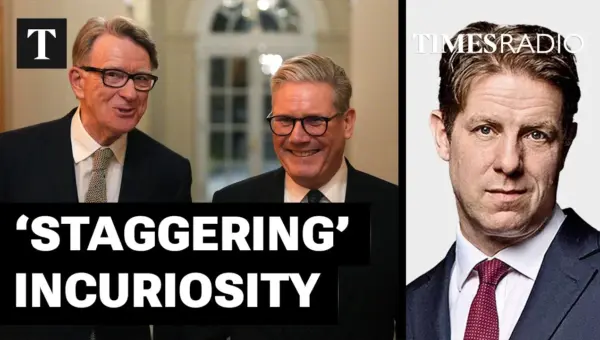
Starmer Criticized: “Spectator In His Own Governmental Machine”
Prime Minister Keir Starmer is being criticized as a "spectator" in his own government amidst the Peter Mandelson scandal. Analysis suggests a pattern of "plausible deniability" and a lack of deep engagement with unfolding events, drawing parallels to the sitcom "Yes Minister."

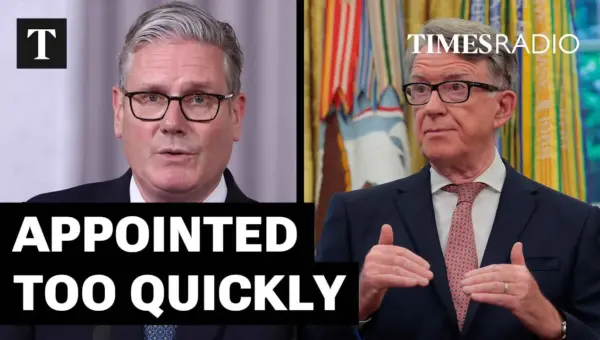
PM Faces Fury Over Ambassador Vetting Scandal
Prime Minister Keir Starmer faces calls for resignation over the appointment of Peter Mandelson as UK ambassador to the US, who allegedly failed security vetting. Starmer expressed fury at not being informed, while Number 10 points fingers at the Foreign Office. The controversy highlights deep issues with government communication and security protocols.