Crypto Security Flaws Cost Millions; New Methods Emerge
Millions in Bitcoin have been lost not to hackers, but to physical theft and human error, exposing the vulnerabilities of traditional hardware wallet security. Experts are now advocating for multi-signature and social recovery solutions to mitigate these risks and enable broader crypto adoption.

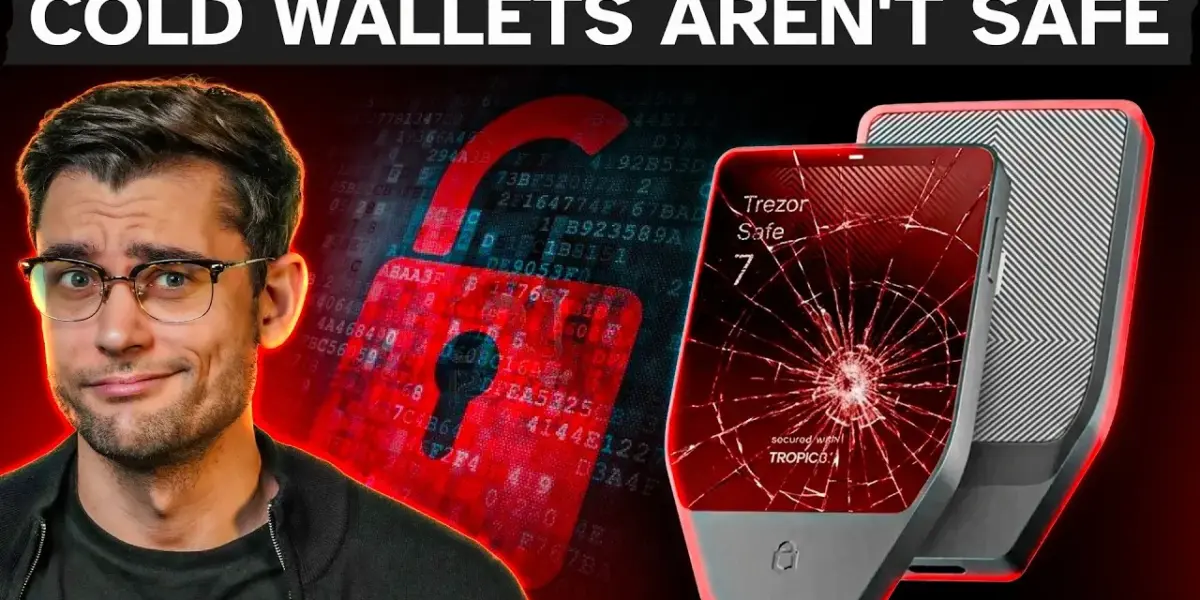
Crypto Security Flaws Exposed, Millions Lost
A man in the United Kingdom reportedly lost $176 million in Bitcoin, not to a complex cyberattack, but because someone watched him type his recovery phrase. This incident highlights a growing concern: the primary threats to digital assets may not be distant hackers but physical proximity and simple human error. While hardware wallets are often promoted as the ultimate security solution, real-world data reveals significant vulnerabilities.
As of March 23, 2026, Bitcoin and Ethereum together hold a market capitalization of approximately $1.65 trillion. Bitcoin alone accounts for nearly $1.4 trillion, with prices fluctuating significantly over the past year. This immense value makes robust security measures absolutely crucial for all holders.
The Promise vs. The Reality of Self-Custody
The core idea behind cryptocurrencies is financial freedom, often described as becoming your own bank. This typically involves buying a hardware wallet, writing down a 24-word recovery phrase, and storing it securely. This method is seen as the best way to protect digital assets from exchange failures or government interference.
However, data from Chainalysis in 2025 suggests that between 2.3 million and 3.7 million Bitcoin have been permanently lost due to poor management of private keys. These losses stem from human mistakes, natural disasters, and the basic fragility of relying on a single piece of paper. This silent epidemic of lost recovery phrases is causing more financial damage than sophisticated hacker attacks.
Physical Threats Bypass Digital Defenses
The case of the UK man and his $176 million Bitcoin fortune illustrates how easily digital security can be compromised physically. The alleged thief did not need to break any encryption; they simply watched the recovery phrase being entered. This type of physical vulnerability is not uncommon in the crypto space.
Security expert Joe Grand has demonstrated how to extract recovery seeds directly from hardware wallets by manipulating the device’s internal circuitry. These methods bypass the wallet’s security features entirely. Hardware wallets, while advanced, are still physical devices vulnerable to physical attacks.
Physical Attacks on Crypto Holders Surge
Data compiled by Bitcoin security expert Jameson Lopp shows a significant increase in physical attacks. In the first six months of 2025, physical attacks on crypto holders rose by 169%. This includes a 75% jump in ‘wrench attacks,’ where individuals are physically threatened into giving up access to their devices.
Even if your location is secret and your device is hidden, other threats exist. Supply chain compromises and manipulated user interfaces pose serious risks.
The Lazarus Group’s $1.5 billion heist from Bybit in February 2025 involved injecting malicious code into a developer’s workstation. This altered the transaction interface, causing users to unknowingly approve transfers to hackers.
The Weakness of the Single Seed Phrase Model
The fundamental issue with the traditional method is the heavy burden placed on the user. Ethereum co-founder Vitalik Buterin has long criticized the single 24-word seed phrase model. He argues that relying on one piece of paper creates a single point of failure, which is unsuitable for widespread adoption.
If a house fire, flood, or simple misplacement destroys the recovery phrase, the funds are permanently lost. Buterin points out that ordinary users are expected to meet an impossibly high standard of security perfection, unlike in traditional banking. This model requires zero room for error.
Social Recovery and Multi-Signature Wallets Offer Solutions
To address these issues, Buterin advocates for social recovery wallets, powered by the ERC 4337 account abstraction standard. By May 2025, about 23 million of these smart accounts were deployed on Ethereum. These accounts let users designate trusted guardians, like family members or other devices.
If primary access is lost, these guardians can collectively authorize a reset after a waiting period, eliminating the risk of a lost seed phrase. The industry is moving beyond the ‘lone wolf’ security model toward solutions that enable mass adoption.
Multi-Signature Security Explained
Multi-signature (multi-sig) technology requires multiple private keys to authorize any transaction, eliminating the single point of failure. A common setup for individuals is a 2-of-3 multi-sig, needing two out of three keys to move funds. This typically involves keeping one hardware wallet at home, another in a secure location like a bank vault, and a third key managed by a trusted service.
This distributed approach creates a resilient system. If one device is lost or stolen, the funds remain secure as long as the other keys are safe. This also offers protection against physical threats, as a user can truthfully state they don’t have all the necessary keys to authorize a transaction on the spot.
Collaborative Custody and Institutional Security
Companies like Casa and Unchained Capital offer collaborative custody models for retail users, securing billions in Bitcoin. While some purists argue this violates crypto’s ethos, users still maintain control by holding two of the three keys. The service provider cannot move funds without the user’s explicit agreement, and users can recover assets if the provider fails.
Large financial institutions secure their massive crypto portfolios using Multi-Party Computation (MPC). Firms like Fireblocks and BitGo use MPC to split a private key into multiple parts stored on different servers. The signature is created collectively without the full key ever being in one place, preventing theft from rogue employees or compromised servers.
Data Shows Multi-Sig and MPC Superiority
Industry data from 2025 indicates that firms using custodians with multi-sig or MPC architectures experienced 70% fewer security breaches than those using standard setups. This demonstrates the clear advantage of distributed security models.
Hardware manufacturers are also improving backup standards. Trezor’s Safe 5N model T now uses Shamir’s Secret Sharing. This allows users to split their recovery seed into multiple parts, where an incomplete set reveals no information about the original seed, unlike simply cutting paper.
The Future of Crypto Security
The crypto industry’s initial focus on absolute independence has inadvertently created significant vulnerabilities. The $176 million CCTV theft and millions in lost Bitcoin show that extreme isolation can be a weakness. Becoming your own bank also means becoming your own security guard and potentially your own worst enemy.
The core principle of eliminating centralized points of failure has been undermined by concentrating risk in our own homes. The future of digital asset protection lies in cryptographic resilience, geographic distribution, and intelligent redundancy, not extreme isolation.
Conclusion: Evolving Security for Mass Adoption
While hardware wallets are essential for moving assets off exchanges, securing significant wealth with a single device and paper backup is highly risky. The shift towards multi-signature and collaborative custody represents a natural evolution of self-sovereignty. Holders must adapt to these new security standards to protect their assets effectively.
The transition from single-signature to multi-signature and collaborative custody is a necessary step for the maturation of the self-sovereign philosophy. Those who adapt will be better positioned to safeguard their digital wealth in the evolving crypto space.
Source: Upgrade Your Crypto Security (YouTube)

Related Articles


Bitcoin RSI Signals Bull Run: Accumulators Buy Heavily
Bitcoin's monthly RSI has flashed a historical buy signal that has preceded every major bull run. Accumulator addresses are buying heavily, while exchange inflows hit record lows, indicating weak hands have sold. These factors suggest a potential for significant price appreciation.


Bitcoin RSI Signals Potential Bottom: History Suggests Upside
Bitcoin's one-week RSI has broken its trend line, a signal that has preceded major bottoms seven out of eight times historically. Additionally, a bullish cross on another key indicator has appeared, which has led to explosive price rallies in the past. These technical signs suggest a potential end to the bear market.


Bitcoin Drops Below Key Trend; Stocks Brace for Fall
Bitcoin has broken a key mid-term trend line, signaling potential drops to the $50,000s, while the stock market braces for a 10-15% decline. Analysts suggest preparing for a relief rally, highlighting significant opportunities in altcoins and airdrop farming as crucial strategies for navigating current volatility.