Capturing Fleeting Moments: From Strobes to Trillions of Frames
Explore the evolution of high-speed imaging, from Harold Edgerton's pioneering strobe photography in the 1930s to modern techniques capturing trillions of frames per second and observing electron dynamics at the attosecond scale.

From Flickering Lights to Unimaginable Speeds: The Quest to Freeze Time
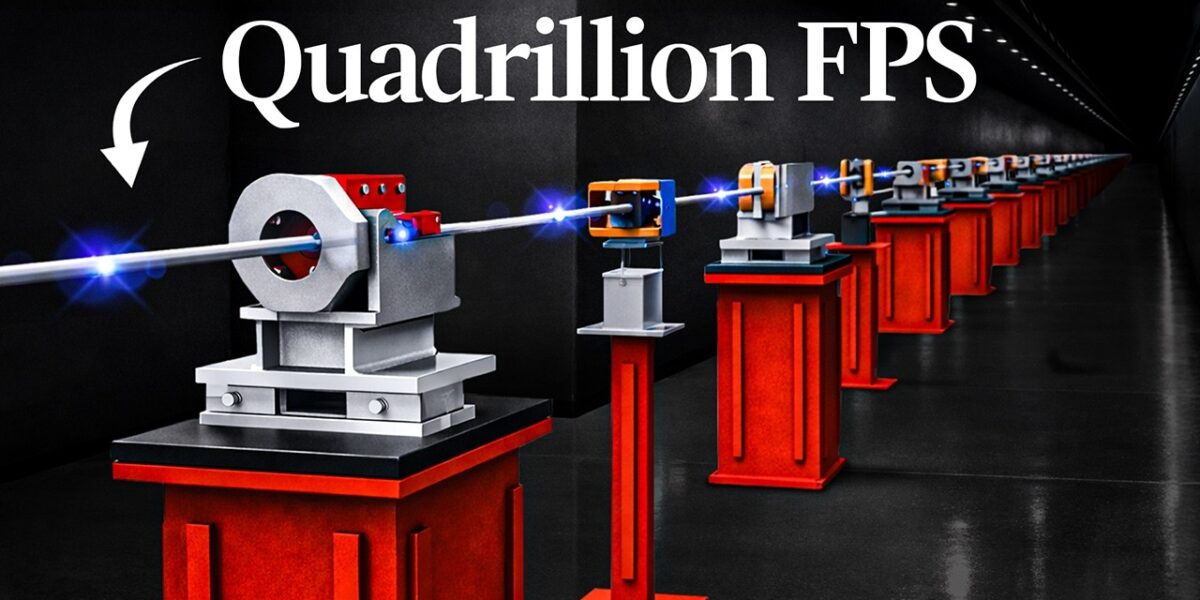
The universe, at its most fundamental level, operates on timescales so minuscule they are almost incomprehensible. For centuries, humanity has strived to peer into these fleeting moments, developing technologies that push the boundaries of perception. From the ingenious strobe photography of the 1930s to cutting-edge facilities capable of capturing quadrillions of frames per second, our ability to slow down time has revolutionized our understanding of everything from mechanical engineering to the behavior of electrons.
The Accidental Genius of Harold Edgerton
The story of capturing incredibly fast events often begins with a problem that couldn’t be solved with existing tools. In the 1920s, engineers struggled to diagnose issues with rapidly spinning electric motors. Standard cameras of the era, with their slow exposure times, produced only blurry images, rendering the intricate workings of these machines invisible to the naked eye and conventional photography.
Enter Harold “Doc” Edgerton, an MIT engineer. He observed that his experimental equipment, when subjected to power surges, emitted a bright, brief flash of light.
This flash, he realized, could momentarily illuminate a fast-moving object, making it appear stationary. This insight led to the development of the strobe light, a device that could produce an intensely bright flash lasting mere microseconds – a duration so short it effectively froze motion.
Edgerton’s strobe worked by storing electrical charge in a capacitor. When triggered, this charge surged through a gas-filled tube, ionizing the gas and creating a flash of light reaching temperatures of around 10,000 Kelvin, nearly twice the surface temperature of the Sun.
The flash was incredibly brief, lasting only about 10 microseconds. By synchronizing these flashes with a camera whose shutter remained open, Edgerton could capture incredibly sharp images of objects in motion.
More Than Just Science: The Art of Strobe Photography
Edgerton’s innovation wasn’t just about technical prowess; it was also about vision. Initially, he used his strobe to photograph industrial machinery, helping engineers solve problems.
But his artistic eye soon transformed his invention into a tool for scientific and popular communication. He captured iconic images of hummingbirds frozen mid-flight, tennis balls being struck by rackets, and milk droplets forming intricate splashes.
These images, published in magazines like “Life” and “National Geographic,” brought the invisible world of rapid motion into public view. The challenge, however, was timing the strobe precisely. Edgerton ingeniously used sound to trigger his flashes.
For instance, when photographing a balloon pop, a microphone would detect the sharp sound of the pop, and after a slight delay, trigger the strobe, perfectly capturing the moment of rupture. This same principle, using the sonic boom of a supersonic bullet, allowed him to precisely time shots of bullets passing through objects.
From Military Reconnaissance to Bullet Trails
Edgerton’s strobe technology quickly found applications beyond industrial and artistic pursuits. In 1939, Major George Goddard of the Army’s photographic lab recognized its potential for nighttime aerial reconnaissance. He envisioned a strobe powerful enough to illuminate the ground from high altitudes, enabling safer and more effective nighttime photography than the existing method of dropping flares.
Edgerton confirmed this was possible, and the resulting strobe, capable of releasing 60,000 joules in a millisecond (a peak power of roughly 60 megawatts), was instrumental during World War II. It allowed Allied forces to photograph Normandy the night before D-Day, confirming German troop positions. The clarity of these images, even by today’s standards, is remarkable.
Comparing Edgerton’s technique to a modern 20,000 frames per second (FPS) slow-motion camera when shooting a bullet through a playing card reveals the enduring power of his method. While the modern camera captured a good sequence, Edgerton’s strobe photography produced an image with exceptional sharpness and detail, demonstrating that high spatial resolution combined with a precise temporal snapshot can sometimes outperform high frame rates with lower resolution.
Pushing the Limits: Trillions of Frames Per Second
The quest for ever-slower motion has led to astonishing advancements. While Edgerton’s strobe offered a single, incredibly sharp snapshot, modern technology aims for sequences of these snapshots at unimaginable speeds. Today, researchers are developing cameras capable of capturing trillions of frames per second.
One such technique, often referred to as “single-pixel cameras,” works by capturing a single point of data at an extremely high rate. These cameras can record photon counts around a trillion times per second, with each frame lasting only about a picosecond.
While this sounds like a single pixel, by systematically moving the camera or steering a laser beam across a scene and repeating the measurement hundreds or thousands of times, a full, high-resolution image can be constructed. This allows for the visualization of light itself traveling through a scene, creating videos that appear to show light moving at a speed that, relative to the camera’s movement, can seem faster than light.
These “speed of light” videos, generated from data captured at the University of Toronto and MIT, and even replicated in garages, offer a mind-bending glimpse into the propagation of light. They can create complex visualizations, akin to the “bullet time” effect in “The Matrix,” showing light interacting with objects, reflecting off mirrors, and diffracting through gratings.
Unveiling the Electron: The SLAC Facility
The ultimate frontier in high-speed imaging lies in observing the behavior of subatomic particles, particularly electrons, which govern chemical reactions and the very nature of matter. To achieve this, scientists utilize massive facilities like the SLAC National Accelerator Laboratory.
SLAC houses a 3.2-kilometer-long linear accelerator that propels electron pulses to over 99.9999992% the speed of light. These relativistic electrons are passed through a series of precisely spaced magnets (undulators).
The wiggling motion of the charged electrons in these magnetic fields generates electromagnetic radiation. Due to relativistic effects and blueshifting as observed from the end of the accelerator, this radiation is compressed into extremely high-energy X-rays, with wavelengths as small as 50 picometers.
These X-rays are then further manipulated to create coherent laser-like pulses, incredibly short – down to a few hundred attoseconds (10^-18 seconds). This attosecond timescale is so brief that an attosecond is to a second what a second is to the age of the universe.
Attosecond Strobe: Watching Molecular Dynamics
These attosecond X-ray pulses act as the ultimate strobe, allowing scientists to probe the electron clouds within molecules. By tuning the X-ray energy, specific core-level electrons in different atoms can be ejected. Measuring the kinetic energy of these ejected electrons provides information about the electron density around those atoms, revealing how electrons interact and influence molecular bonds.
By initiating a molecular process with a laser pulse and then probing it with a sequence of attosecond X-ray pulses at slightly varying time delays, researchers can build up a “molecular movie.” This technique, validated by experiments at SLAC, allows for the observation of charge distribution changes within molecules on timescales of femtoseconds (10^-15 seconds) and even attoseconds. While the movies are often based on validated simulations, they represent the closest we can get to directly observing electron dynamics, offering unprecedented insights into chemical reactions and material science.
The Future of Slowing Time
The journey from Edgerton’s flickering strobe to attosecond X-ray pulses is proof of human ingenuity. Each advancement in slowing down time has unlocked new scientific frontiers.
The ability to capture events at quadrillions of frames per second promises to deepen our understanding of fundamental physics, chemistry, and biology. As technology continues to evolve, we can anticipate even more astonishing ways to freeze, observe, and comprehend the universe’s most elusive moments, potentially leading to breakthroughs in fields ranging from medicine to energy and materials science.
Source: What Happens If You Keep Slowing Down? (YouTube)

Related Articles


Alien Life Could Travel Between Stars, Scientists Say
Scientists are exploring the scientific concept of panspermia, where life could travel between star systems on asteroids or comets. Evidence shows life's resilience and the movement of material between planets, making this a credible hypothesis. The search for extraterrestrial life is now focusing on when and where we might find it.


Cosmic Hum Hints at Gigantic Black Hole Mergers
Astronomers are using networks of rapidly spinning pulsars, nature's precise cosmic clocks, to detect the faint hum of merging supermassive black holes. New research is now focusing on pinpointing individual merger events, moving beyond the general background noise to understand these colossal cosmic collisions.


Artemis II Astronauts Set New Human Distance Record
The Artemis II mission set a new human distance record, reaching 413,145 km from Earth. The mission also established a record for the greatest distance between two groups of humans, with astronauts on China's Tiangong space station being 419,656 km away from the Artemis II crew.