2025 Market Review: Unexpected Returns and Investor Lessons
The year 2025 defied market expectations with strong returns in Canadian equities, a surge in gold prices, and a correction in real estate. Investors learned valuable lessons about diversification, the stock market versus the economy, and the importance of sticking to long-term plans.

2025 Market Review: Unexpected Returns and Investor Lessons
The year 2025 delivered a series of market performances that defied widespread expectations, challenging conventional wisdom and reinforcing long-held investment principles. From a surprising surge in Canadian equities to significant shifts in real estate and digital assets, the year offered crucial insights for investors navigating an increasingly complex financial landscape.
Canadian Equities Outshine Expectations Amid Economic Concerns
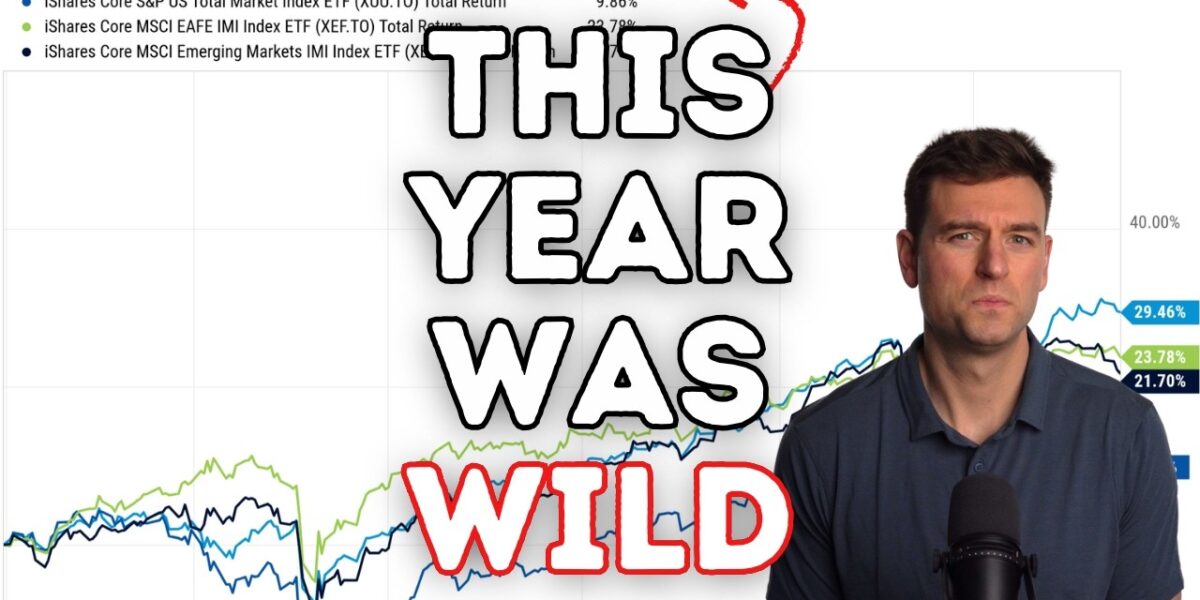
Despite a prevailing narrative of economic headwinds and concerns such as a productivity crisis, a proposed hike to the capital gains inclusion rate, and the potential impact of international trade policies, the Canadian stock market experienced a remarkable turnaround. As of December 17, 2025, a Canadian stock market index fund had returned a robust 29.46% year-to-date.
This performance not only surpassed international developed and emerging markets but also more than tripled the Canadian dollar return of a US total market index fund during the same period. This starkly contrasts with the preceding five years, where the US market had outperformed Canadian equities by nearly 5 percentage points annualized, and even more significantly against international markets.
This divergence highlights a critical lesson for investors: the stock market is not a direct mirror of the economy. Market prices reflect forward-looking expectations of future cash flows, whereas economic data is backward-looking.
By the time economic news becomes widely reported, its impact on market valuations may have already been priced in by investors. Unexpected economic data that is merely less negative than anticipated can sometimes lead to stock price increases, highlighting the difficulty of making investment decisions based solely on economic indicators.
US Market Volatility and the Enduring Value of Diversification
The US stock market, which had enjoyed years of strong performance leading into 2025, experienced significant intra-year volatility. The market was down more than 16% in Canadian dollar terms by April 2025. This downturn served as a potent reminder that even dominant markets can experience substantial drawdowns.
Historical data suggests that negative intra-year returns do not necessarily predict negative annual returns, a phenomenon that played out in 2025. This highlights the importance of adhering to a long-term investment plan rather than attempting to time the market based on short-term fluctuations.
The performance of Canadian equities also reinforced the ongoing importance of international diversification. While the perception that the US market is the only one worth investing in has grown, periods of underperformance in any single country’s market, including the US, can be mitigated through global diversification. The strong showing of Canadian stocks in 2025, particularly when compared to the US market’s intra-year dip, exemplifies this principle.
Value and Small-Cap Segments Shine
Beyond the broad market indices, specific segments of the Canadian equity market delivered exceptional returns. Canadian value and small-cap stocks, which had lagged the broader market over the preceding decade, experienced a significant upswing. The iShares S&P TSX Small Cap Index ETF returned 47.94% and the iShares Canadian Value Index ETF returned 33.63% from January 1st to December 17th, 2025.
This resurgence has narrowed the performance gap, with Canadian value stocks now outperforming over an almost 11-year period. This trend emphasizes the importance of patience and conviction in investment strategies, as returns can often materialize in concentrated bursts after periods of dormancy.
Gold’s Surge and Bitcoin’s Decline
Gold experienced an extraordinary year, with the iShares Gold Bullion ETF returning 57.53% in Canadian dollar terms year-to-date. Despite this impressive performance, the long-term outlook for gold remains a point of caution for many analysts. Gold is generally considered a non-productive asset with historically low expected real returns, often fluctuating around inflation.
While its short-term price movements can be significant, its efficacy as a consistent hedge against market downturns or inflation is debated. Investors drawn to gold due to its recent gains are advised to consider its low expected long-term return and the historical tendency for assets that have experienced sharp price increases to deliver lower future returns.
In contrast, Bitcoin saw a decline, with the Purpose Bitcoin ETF dropping 13.09% in Canadian dollar terms year-to-date. This performance, especially during a period of geopolitical uncertainty where cryptocurrencies were expected by some to perform well, highlighted a divergence from gold and raised questions about their respective roles in investor portfolios.
Canadian Real Estate Correction Continues
The Canadian real estate market, particularly in major urban centers like Toronto, continued its downward trend. Composite real estate prices in Toronto had fallen nearly 26% from their 2022 peak through November 2025, with a 6.5 percentage point decline occurring within 2025 alone.
This correction, driven by factors such as changes in immigration policy and rising interest rates, has impacted both apartments and single-family homes. The narrative that the decline was solely due to an oversupply of small apartments has been challenged, as single-family homes have seen larger percentage drops.
An analysis comparing the wealth accumulation of hypothetical renters and homeowners across 12 Canadian cities revealed that, as of November 2025, renting had outperformed owning on average. The renter-to-owner wealth ratio stood at 1.14, indicating renters held more wealth.
This contrasts with the period from 2005-2024, where owning held a marginal advantage or the outcomes were roughly tied. This highlights the financial viability of renting, provided renters consistently save and invest their savings in well-diversified portfolios.
Market Concentration, Valuations, and the Rise of Complex ETFs
As 2025 drew to a close, concerns regarding high valuations and market concentration in the US stock market surfaced. The top seven US stocks accounted for 32% of the market’s total value, a level not seen since 1927. However, historical data suggests that market concentration alone is not a reliable predictor of poor future returns.
While high valuations have historically correlated with lower future returns across developed markets, this relationship is not always statistically reliable and does not preclude periods of strong performance. Investors are cautioned against using valuations as a market-timing signal, but rather as an input for setting more moderate expected return assumptions.
A notable trend observed towards the end of 2025 was the proliferation of complex and often risky Exchange Traded Funds (ETFs) marketed aggressively to retail investors. Products such as buffer ETFs, single-stock covered call ETFs, and leveraged ETFs are often designed to generate fees for issuers rather than to serve the long-term financial goals of most investors. This influx of what is termed ‘ETF slop’ highlights the need for investors to exercise due diligence and focus on low-cost, broadly diversified investment solutions.
The introduction of Avantis Investors’ suite of Canadian-listed ETFs, in partnership with CIBC, presents a potentially significant development for Canadian retail investors. These ETFs are designed to offer low costs, broad diversification, and tax efficiency, while also incorporating tilts towards small-cap value and highly profitable companies, based on financial economic theory and evidence. This approach, similar to that offered by Dimensional Fund Advisors through financial advisors, aims to enhance expected long-term returns and will be available directly to retail investors, offering an evidence-based alternative to traditional total market index funds.
Source: 2025 Was Nut(s): A Canadian CIO's Review (YouTube)

Related Articles


Median Home Price Now Out of Reach for Median Income
The median home price in the U.S. has now surpassed what the median household income can afford, creating a significant barrier to homeownership. Analysis shows a required salary of over $112,000 for the median home price, far exceeding the median income of $84,000. This affordability gap challenges the traditional dream of owning a home for many Americans.


Wall Street Landlords Slash Rents Amid Oversupply
Wall Street landlords are cutting rents by up to 10% in cities like Atlanta due to a surge in accidental landlords and market oversupply. This trend is leading to significant discounts on homes, impacting both renters and sellers.


Ceasefire Sparks 100% Gains; Institutions Bet on Bullish Turn
A recent ceasefire has fueled a market rally, with some tech calls doubling in value and institutions like Bank of America signaling a bullish outlook. While inflation concerns ease, elevated oil prices and shifting hedge fund exposure in software present mixed signals for investors. Opportunities may lie in undervalued sectors as institutions rebalance portfolios.