IT’s 4th Quarter Reign: Thomas Owned the End of Games
Isaiah Thomas, a 5'9" guard, defied the odds to become the NBA's fourth-quarter king in the 2016-17 season. Despite injuries and personal tragedy, he delivered historic performances, leaving an indelible mark on the league and the Boston Celtics.

IT’s 4th Quarter Reign: Thomas Owned the End of Games
In a league dominated by towering giants, Isaiah Thomas, standing at a mere 5’9″, defied all expectations to become the undisputed king of the fourth quarter. In the 2016-17 NBA season, Thomas didn’t just play in the final frame; he owned it, delivering performances that etched his name in the history books and captivated fans. This remarkable feat is even more astounding considering the rarity of players under six feet tall making a significant impact in the NBA, let alone reaching elite scoring milestones.
A Statistical Anomaly
The transcript highlights the sheer improbability of Thomas’s success. Only 145 players under 6 feet have ever scored in the NBA, with most debuting before the turn of the century.
Of this exclusive club, only one player has ever reached the 2,000-point mark in a single season: Isaiah Thomas in 2016-17. This season saw the diminutive guard transform into the most clutch player in the league during the crucial final minutes of games.
While Wilt Chamberlain’s 100-point game includes a 31-point fourth quarter, comprehensive quarter-by-quarter tracking only dates back to 1996-97. Within this modern era, Thomas’s exploits stand tall.
Dirk Nowitzki, a seven-footer, once scored 29 points in a fourth quarter on November 3rd, 2009, shooting an incredible 7 of 8 from the field and a perfect 14 of 14 from the free-throw line. While Hall of Famers achieving such feats isn’t surprising, the last pick of the 2011 draft, Isaiah Thomas, achieving comparable, and in many ways superior, fourth-quarter dominance was nothing short of astonishing.
Stealing the Spotlight
Thomas’s fourth-quarter heroics were so pronounced that he even seemed to usurp Damian Lillard’s signature “Dame Time” celebration. Fans and analysts alike acknowledged his right to do so, as evidenced by commentary like: “Isaiah right hand dribble pulls UP FOLLOW AT 17. GOT IT AGAIN.” The sentiment was clear: nobody had owned fourth quarters quite like Thomas, before or since.
Even Russell Westbrook, known for his clutch performances in 2017, couldn’t match Thomas’s scoring efficiency in the final frames, though his overall impact was undeniable. The only player in the last 30 seasons to outscore Thomas in fourth quarters was Kobe Bryant in 2005-06.
However, Kobe’s 715 fourth-quarter points came over five additional quarters and required 124 more field goal attempts. The fact that Thomas, at 5’9″, achieved such scoring prowess is proof of his skill and determination.
Early Signs of Greatness
Despite slipping in the draft, Thomas’s ability to will his team to victory was evident early in his career. As a rookie with the struggling Sacramento Kings, he recorded two 20-point quarters against the eventual Finals teams, the Miami Heat and the Oklahoma City Thunder. In the 2013 calendar year, he replicated this feat against the same teams, scoring 21 points in a quarter against each, though all four instances came in losing efforts.
Even as the third point guard in Phoenix, he managed 17-point quarters. His teams held a respectable 4-2 record in games where he scored 15-plus points in a quarter during his early career stops.
Upon his arrival in Boston, this trend continued, with the Celtics going 3-4 in games featuring one of his high-scoring quarters within his first 100 games. It seemed he was still calibrating his dominance, as six of those seven outbursts occurred in the third quarter.
A Landmark Season in Boston
Thomas’s first full season with the Celtics in 2016-17 was a landmark year. He played all 82 games, earned an All-Star selection, and transformed from a perceived “microwave” bench scorer into a beloved figure in Boston, drawing comparisons to Celtics legend Larry Bird. Like Bird, Thomas played through injuries, a trait that, for better or worse, defined a significant part of his career.
The Celtics’ offensive rating plummeted by 14 points per 100 possessions when Thomas sat during the 2016-17 season, underscoring his indispensable value. His 28.9 points per game that season trailed only LeBron James among top scorers in terms of impact when off the court and was just shy of Bird’s franchise record of 29.9 points per game nearly three decades prior.
Fourth Quarter Fury
Thomas’s scoring was crucial for a Celtics team that won the Eastern Conference by just two games. He recorded 16 games with 15-plus point quarters, leading the team to a 12-4 record in those contests.
Thirteen of these explosive quarters came in the fourth quarter. He achieved a single-season record with four 20-point fourth quarters, each coming in a single-digit victory.
One such game, on November 16th against the Mavericks, saw the Celtics staring at a 5-6 start. Thomas’s ability to change speed and direction was instrumental in creating scoring opportunities, whether finishing at the rim or drawing fouls, where he shot an elite 91% from the line. His 38% three-point shooting on 8-12 attempts per game also made him a threat from beyond the arc, making him incredibly difficult to defend.
Overcoming Adversity
Despite an injury scare early in the season, Thomas went on an unprecedented scoring tear. In a 22-game stretch from December 20th to February 1st, he recorded five 40-point games, something he hadn’t achieved in his first 388 career games. His pick-and-roll chemistry with Al Horford was particularly effective, but his ability to hit transition pull-up threes and “parking lot threes” was equally devastating.
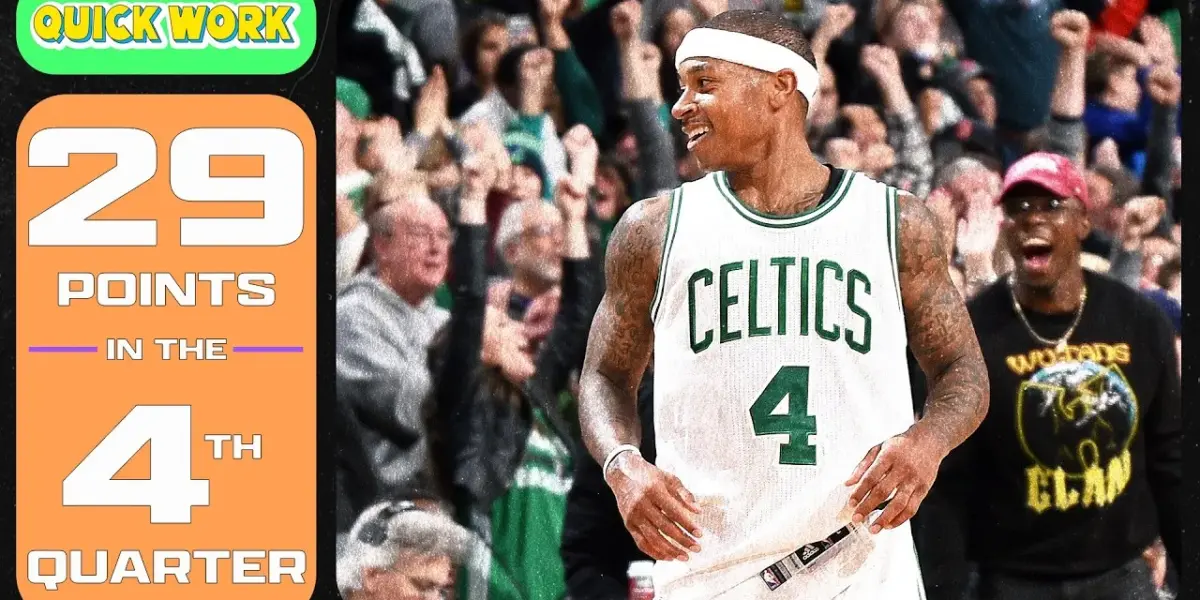
On December 30th, he dropped 52 points against the Miami Heat, the most by a Celtic in 27 years, with 29 of those coming in the fourth quarter. In January, he continued his scoring onslaught against Washington and Detroit, pouring in 20 and 24 points in the fourth quarter respectively, leaving commentators in awe: “I see it. THOMAS IS A FLAMETHROWER.” and “I’m sorry, but he’s just he is such a treat to watch, especially up close.”
His consistency was remarkable, scoring 20 or more points in 43 consecutive games from November through February, breaking John Havlicek’s franchise record set in 1972. Thomas’s journey was fraught with challenges, including playing through significant hip injuries. He finished fifth in MVP voting despite these physical setbacks.
Personal Tragedy and Unwavering Spirit
The eve of the playoffs brought immense personal tragedy with the death of his younger sister, China, in a car accident. Despite his grief, Thomas led the Celtics to a Game 6 victory over the Bulls.
In Game 1 of the second round, the day after his sister’s funeral, he had a tooth knocked out while attempting a steal but continued to play. He underwent six hours of dental surgery the next day.
Just one day later, on what would have been his sister’s 23rd birthday, Thomas poured his grief into a career-best 53 points, including 29 in the fourth quarter and overtime, against the Wizards. The Wizards as a team only scored 30 points in that same span. “Isaiah, where is this coming from, man?
Where is this coming from? It’s my sister. It’s her birthday today.
Happy birthday. She would have been 23 today.
So, everything I do is for her and she’s watching over me. So, that’s all her,” he emotionally stated.
A Legacy Beyond the Stats
While the Celtics eventually fell to the Cavaliers in the Conference Finals after Thomas re-aggravated his hip injury, his legacy was cemented. His career with the Celtics ended with an unceremonious trade to Cleveland. He never again played more than 40 games in a season, a fate tragically shared with fellow Washington Husky and clutch performer Brandon Roy, whose careers were cut short by injuries.
Despite the abrupt end to his playing career, Isaiah Thomas remains a beloved Celtic. His influence extended beyond his playing days as a mentor to Jaylen Brown and Jayson Tatum, contributing to the championship core that followed. His mantra of the “slow grind” inspired many, embodying a lifetime of patience and persistence that allowed him to perform at his best when it mattered most, for a brilliant, albeit brief, period.
Source: Nobody owned fourth quarters like Isaiah Thomas, before or since | Quick Work (YouTube)

Related Articles

Wemby’s Playoff Debut Stuns League: Spurs Win Game 1
Victor Wembanyama delivered a historic 35-point performance in his playoff debut, leading the San Antonio Spurs to a Game 1 victory over the Portland Trail Blazers. The rookie sensation set multiple records, signaling a powerful arrival in the postseason. Meanwhile, the Boston Celtics and Oklahoma City Thunder also secured dominant Game 1 wins, showcasing strong defensive performances.

Tatum’s Playoff Return: Celtics Dominate 76ers in Game 1
Jayson Tatum made a triumphant return to the NBA playoffs, leading the Boston Celtics to a commanding Game 1 victory over the Philadelphia 76ers. Tatum, who faced uncertainty about playing this season, delivered a performance filled with gratitude and excitement. His stellar play, combined with an outstanding performance from Jaylen Brown, sets a strong tone for the Celtics' championship aspirations.


Deni Avdija: NBA’s Ultimate Foodie on the Road?
Washington Wizards forward Deni Avdija revealed his unique habit of dining out almost every night on the road. Describing himself as a passionate foodie, Avdija meticulously researches restaurants in every city. Despite his dedication to culinary exploration, he humorously admits he rarely gets invited by his teammates on these nightly outings.