California’s Blue Wall Cracks: GOP Leads Governor Race
California's Democratic stronghold is facing a surprising challenge, with Republicans leading the polls for governor. The state's unique "jungle primary" system and a fragmented Democratic field are key factors. The upcoming debate is crucial as voters remain largely undecided.

California’s Blue Wall Cracks: GOP Leads Governor Race
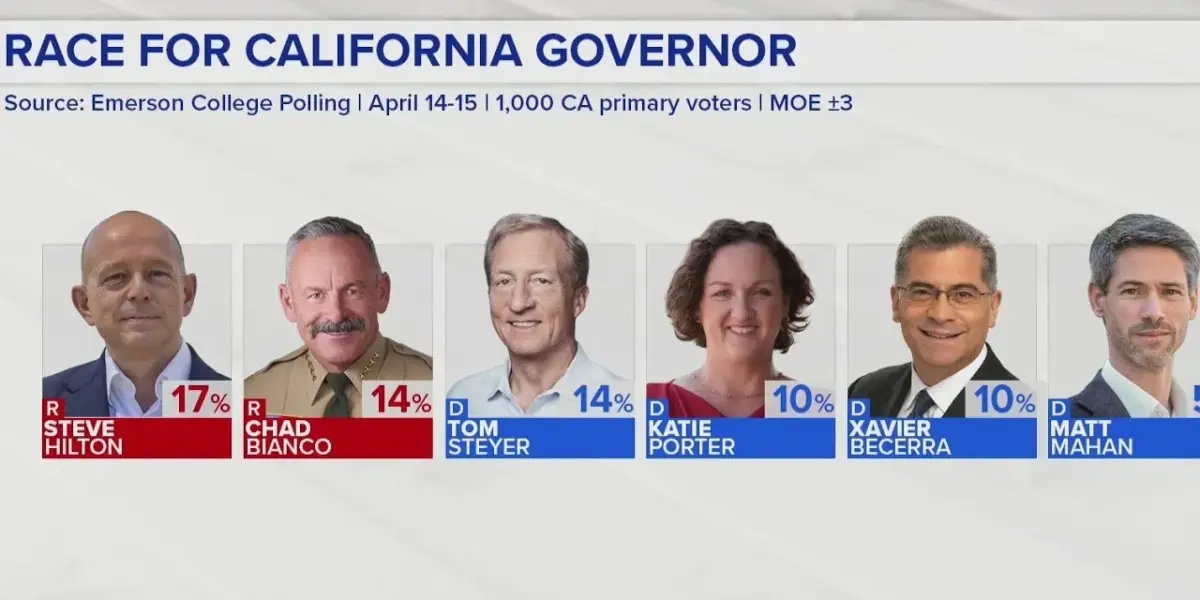
San Francisco, a city often seen as a liberal beacon, is experiencing a political shift. Two days before a major gubernatorial debate, the leading candidates for California governor are both Republicans.
This is a striking development in a state that has consistently voted Democratic, with Kamala Harris winning by a significant 20-point margin in past elections. Headlines in The Atlantic have even pondered a “Blue Armageddon” for California, questioning why one of the nation’s most liberal states is struggling to field a strong Democratic contender.
The financial aspect of this race is astounding. One prominent Democrat, Tom Steyer, is running what is reportedly the most expensive campaign in America, having spent $130 million.
This figure is notable, especially considering he spent over $200 million of his own fortune in 2020 for a presidential bid that did not gain traction. Even with such immense spending, Steyer currently sits at a mere 14% in the polls, highlighting a disconnect between financial power and voter support.
The Jungle Primary Explained
To understand the current situation, it’s important to explain California’s unique “jungle primary” system. In this system, the top two vote-getters, regardless of their political party, advance to the general election.
Currently, the top two spots are held by Republicans, Steve Hilton and Chad Bianco. This scenario became more probable after Eric Swalwell withdrew from the race, and the polls have since shown some stabilization, though more movement is expected.
However, a less expected Democratic candidate is making a move. Former Health and Human Services Secretary Xavier Becerra has recently climbed in the polls, now holding the third position.
This surge could complicate the Republican frontrunners’ path and potentially prevent an all-Republican general election. The cost per poll point is staggering, with Steyer’s $130 million translating to roughly $10 million per point, a sum even former presidential candidate Dean Phillips noted was more than he spent in New Hampshire.
A Democratic Party in Disarray?
The sheer number of Democrats still in the race, around seven after one dropped out recently, creates a fragmented field. This division makes it more likely that two Republicans could indeed face off in the general election.
This is a remarkable situation for a state with a strong Democratic registration advantage, where a significant portion of the electorate is expected to turn out for a consequential election. The Democratic Party’s current standing is particularly surprising given the state’s ongoing challenges.
Some are looking to a new generation of potential leaders. San Jose Mayor Matt Mahan is mentioned as a business-minded candidate with a background as a former teacher, who has performed well as mayor. Daniel Lurie in San Francisco is another name being discussed.
There’s a sense that Californians might have an opportunity to elect a next-generation governor. This includes figures like Josh Frydenberg for Lieutenant Governor, presenting a pair of impressive young Democrats who could potentially move the needle, though endorsements and media attention don’t always translate to widespread support.
Why This Matters
The current political climate in California raises questions about the Democratic Party’s grip on the state. Despite controlling California with an “iron grip” for years, the party appears to be losing control of its own voters.
This phenomenon is complex, with a significant portion of the electorate still undecided. Given that Democrats outnumber Republicans in California by a two-to-one ratio, a scenario where one Republican and one Democrat advance to the general election would likely lead to a Democratic victory, simply due to voter numbers.
The leading Republican candidate, Steve Hilton, has a unique background, having only become a U.S. citizen in 2021 and previously serving as an aide to Arnold Schwarzenegger. His strong polling performance, despite this background, is noteworthy.
The energy in the race seems to have waned since last November’s vote on a gerrymandered map, leaving many voters feeling exhausted by politics. There is a lack of widespread excitement about any particular Democratic candidate, and some negative attention has focused on figures like former Congresswoman Katie Porter.
Historical Context and Future Outlook
Historically, political parties held more sway, and the old Democratic Party would likely not have seen so many candidates vying for a single spot. California, unlike other urban centers like Minneapolis or New York City, doesn’t seem to exhibit the same dynamic of far-left versus moderate Democrats. The current race is characterized by what one observer calls “the far left versus the farther left” within the Democratic primary.
The upcoming debate is a crucial event. With only about a third of the electorate still undecided, the remaining campaign days are vital.
The low approval ratings of the current president among two-thirds of California voters likely play a role in the Republican candidates’ strong showing. The path forward for the Democratic Party in California will depend on its ability to energize its base and present compelling candidates who can connect with a broader electorate, moving beyond internal ideological divides.
The gubernatorial debate is scheduled for Wednesday night. Coverage will begin at 10:00 PM Eastern. The race for California governor is set to heat up.
Source: Which candidate has edge going into California governor’s debate? | On Balance (YouTube)

Related Articles


Democrats Attack Trump’s Picks Amidst Global Turmoil
Democratic lawmakers are voicing strong concerns about President Trump's appointments, particularly Cash Patel, questioning his fitness and raising national security implications. Republicans largely defend the appointees, focusing on their own legislative work. The exchanges reveal a deep partisan divide on leadership and accountability.


Walz Blasts Trump, Pledges Fight for Rural America
Minnesota Governor Tim Walz launched a new PAC to support Democrats in rural areas, criticizing Donald Trump's policies and foreign policy decisions. He emphasized the need for tangible policy solutions that improve daily lives, particularly for those in small towns often feeling left behind. Walz aims to build the political infrastructure necessary to connect with these communities and enact meaningful change.

California Democrats’ Crisis: Can a Republican Seize Governorship?
California, a staunchly Democratic state, faces a political earthquake as Republicans lead the race for governor. With a crowded Democratic field and voter apathy, the state's political future hangs in the balance. A key debate looms, with potentially two Republican candidates advancing to the general election.