Artemis II Mission Soars: Updates on Crew, Systems, and Lunar Flyby
NASA's Artemis II mission is making significant progress, with the Orion spacecraft's systems performing nominally. Officials provided updates on the crew's well-being, ongoing system checks, and preparation for the upcoming lunar flyby. The mission continues to gather valuable data for future lunar exploration.


Artemis II Mission Soars: Updates on Crew, Systems, and Lunar Flyby
NASA’s Artemis II mission is progressing smoothly, with the Orion spacecraft and its systems performing as expected, and even better in some areas. The crew is reportedly in good spirits and actively engaged in the mission’s objectives. Key updates reveal successful maneuvers, ongoing system checks, and anticipation for the upcoming lunar flyby.
Subsystems Show Strong Performance
Officials reported that the Orion spacecraft’s subsystems are continuing to perform very well, with all systems operating nominally and as anticipated. A significant achievement was the recent trans-lunar injection maneuver, which saw propellant usage within 5% of predicted limits. This critical burn, lasting nearly six minutes, was described as outstanding by mission control.
Other vital systems are also functioning effectively. Solar array power generation is meeting expectations, and the air revitalization system is maintaining healthy levels for carbon dioxide scrubbing and humidity control. The crew has been seen enjoying their time in the cabin, indicating a comfortable environment.
Addressing a Service Module Propellant Issue
While overall system performance is strong, engineers are addressing a minor issue with the Service Module’s (SM) propellant pressurization. One of the redundant helium branches used to push oxidizer and fuel for major engine burns had to be isolated. This isolation has no impact on the mission’s objectives, as the second branch is fully operational.
The system is designed with such redundancy to handle such situations. Even without regulating pressure from the helium tanks, there is enough residual helium pressure to perform the remaining burns. This capability ensures the mission can continue without interruption, showcasing the robustness of the spacecraft’s design.
Crew Well-being and Performance
The crew’s comfort and performance are also key focus areas. Initial cabin temperatures were adjusted after the crew expressed discomfort at a lower setting.
By turning on shell heaters and adjusting fan speeds, temperatures were raised to a more comfortable range in the low to mid-70s Fahrenheit. Humidity levels are also being maintained, which aids the effectiveness of the CO2 scrubbers.
Crew members have been able to exercise, and their performance on guidance, navigation, and control systems has been closely monitored. Initial assessments indicate no negative implications from these activities, with the spacecraft’s systems performing as designed.
Looking Ahead to the Lunar Flyby
A major milestone approaching is the lunar flyby, which mission officials emphasized is crucial for the broader goal of returning humans to the Moon. Seeing the lunar surface with human eyes is a significant step, demonstrating the capability to reach the Moon and setting the stage for future sustained presence.
This mission is a vital test flight for the transportation system being developed. While Artemis I demonstrated uncrewed capabilities, Artemis II adds the critical element of human spaceflight, allowing engineers to understand how systems operate with a crew onboard and make necessary adjustments.
Capturing Imagination and Scientific Insight
Beyond the technical achievements, the mission aims to capture the public’s imagination. The engagement seen so far has exceeded expectations, and officials hope this will grow as the mission progresses. The visual aspect, including stunning images of Earth taken from space, plays a significant role in connecting people to the mission.
Scientists are also keenly interested in the visual observations of the lunar surface. While satellites provide extensive data, human eyes can resolve details with a granularity important for scientific research, even from a distance. This human element is considered a key differentiator.
Navigating Minor Anomalies and Learning
The mission is providing valuable learning opportunities through minor anomalies and system checks. For instance, the lack of need for minor correction burns, which was initially anticipated due to venting from systems like CO2 scrubbers, indicates exceptional navigation performance. This suggests the disturbances from these vents are less significant than predicted.
The mission is also testing the caution and warning system, which was not active during the uncrewed Artemis I. This system alerts the crew to potential issues, and its performance, along with real-time adjustments made by the flight control team, is a critical part of understanding the spacecraft’s behavior with humans inside.
Future Steps and Continued Exploration
As Artemis II continues its journey, the focus remains on safely transporting humans to the Moon and gaining crucial experience for future exploration. The mission is building a reliable transportation system, step by step, with a new generation learning how to operate in deep space after a 53-year hiatus.
The upcoming lunar flyby and subsequent activities will provide further data and insights, enabling more ambitious missions. The mission is scheduled to continue with planned test objectives, including manual piloting tests and image capture, as it progresses towards its return to Earth.
Source: LIVE SOON: Artemis II updated on moon mission (YouTube)

Related Articles
NASA’s Orion Spaceship Heads to Moon After Engine Burn
NASA's Orion spacecraft is now en route to the Moon after a successful trans-lunar injection burn. The four astronauts aboard are undertaking a 4-day journey, covering 234,000 miles at high speed. This follows a widely celebrated Artemis launch, though a minor water storage precaution was issued for the crew.


Aspiring Astronaut Shares Awe of Artemis II Launch Moment
Aspiring astronaut Adrian described the Artemis II launch as an incredible sight, emphasizing the human emotion witnessed. The mission represents a significant step in NASA's program to return humans to the Moon and inspire future generations of explorers.

Artemis Rocket Achieves Space, Crew Begins Journey to Moon
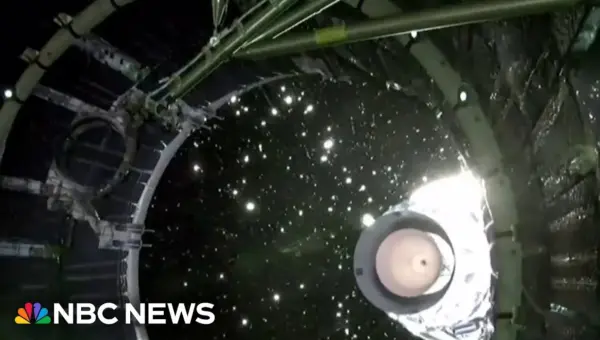
NASA's Artemis mission has successfully launched, sending the Orion capsule and its crew toward the Moon after a clean separation of the rocket's core stage. The mission marks a significant step in humanity's return to deep space exploration. The Orion capsule will now orbit Earth to test its systems before heading to lunar orbit.