Putin Trapped: War Goals Failed, Russia Faces Grim Outlook
Russian President Vladimir Putin's war aims in Ukraine have "clearly not been achieved," with Ukraine emerging as Europe's strongest military, according to British journalist Peter Dickinson. He states Putin is "trapped" with no clear path to victory, relying on controversial recruitment tactics and facing strategic vulnerabilities due to Russia's vast size. A peace settlement remains unlikely in the short term.

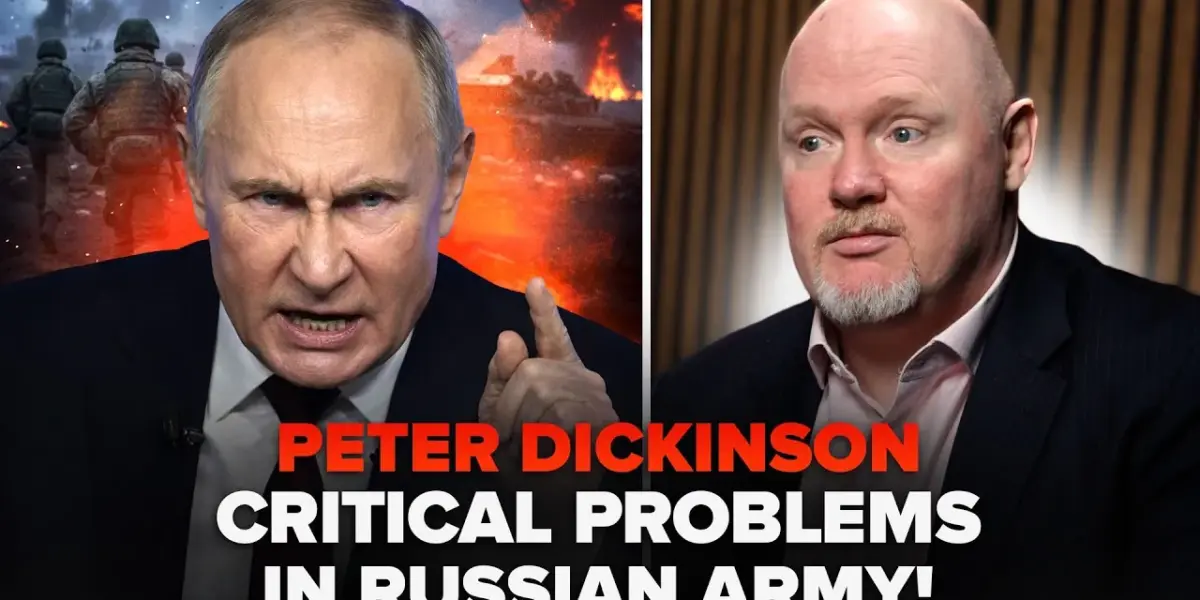
Putin’s Ukraine War Goals Unmet, Analyst Says
In a stark assessment of Russia’s full-scale invasion of Ukraine, British journalist Peter Dickinson has declared that President Vladimir Putin’s initial war aims have “clearly not been achieved.” Dickinson, an editor at the Atlantic Council and publisher of Business Ukraine magazine, speaking on the first anniversary of the full-scale invasion, outlined how Russia has failed in its stated objectives of demilitarizing and “denazifying” Ukraine, a term he interprets as an attempt to eradicate Ukrainian national identity.
Ukraine’s Military Resurgence and Identity Strengthened
Contrary to Putin’s goals, Ukraine has emerged as “the biggest and the strongest military in Europe.” Dickinson elaborated, “if we look at de denazification, which essentially is is Kremlin code for um the eradication of Ukrainian national identity as a separate identity, it’s also been a major failure because Ukraine has never been more Ukrainian.” He added that the nation has “never been more separate from Russia either.” This outcome represents a significant strategic defeat for Russia, undermining Putin’s legacy and leaving him “trapped in a war now that he doesn’t seem to have a way to win.”
Putin’s Unwavering Ambitions and Limited Options
Despite the evident failures, Dickinson believes Putin has not modified his long-term goals and is “way past the point of no return.” The Russian president, having committed his legacy to the invasion, is compelled to continue pushing forward, hoping that Western support for Ukraine might wane or that Ukrainian resistance could collapse. This strategy, however, leaves Putin in a precarious position with no clear path to victory but an inability to withdraw.
“He’s basically tied his entire legacy to to this war, to this invasion. So, he really is um he’s trapped in in a war now that he doesn’t seem to have a way to win. Doesn’t seem to have an obvious pathway to victory. Um, but he he’s he can’t get out of it really.”
The High Cost of Mobilization and Russia’s Recruitment Tactics
Dickinson highlighted the challenges Russia faces in sustaining its war effort, particularly concerning troop mobilization. He noted that Putin’s attempt at a broad conscription in 2022 was a “disaster,” leading to an estimated million Russians fleeing the country and causing significant damage to Russia’s international prestige. To avoid such destabilization, Russia has resorted to recruiting from “the poorest elements of Russia, from the ethnic minorities,” and crucially, from “the prison populations.” The primary source of new recruits, however, are volunteers lured by substantial financial incentives, reportedly receiving payments of $20,000 to $40,000 to sign up, in addition to high salaries.
This reliance on volunteers, while minimizing public dissent due to the perceived agency of these recruits, places a significant economic strain on Russia. “They’re spending a lot of money on these guys,” Dickinson observed, adding that if the Russian economy continues to struggle, maintaining these payments will become increasingly difficult, potentially creating a downward spiral where resources are diverted from essential services like infrastructure, education, and healthcare.
Vast Territory, Defenseless Borders: Ukraine’s Strategic Advantage
Ukraine’s strategy is increasingly leveraging Russia’s immense size against it. Dickinson explained that while Russia’s vastness has historically been an advantage, Ukraine is now using drone and cruise missile attacks to exploit its enormous airspace, which Russia lacks sufficient air defenses to protect. “Russia is just too big,” he stated, noting that air defenses are concentrated on Moscow, St. Petersburg, and Putin’s palaces, leaving border regions and other areas vulnerable.
Communication Disruptions and Shifting Frontlines
Recent Ukrainian counteroffensive actions, including the reported cut-off of Russian troops from Starlink terminals and Telegram, have further pressured Russian forces. Dickinson described the Russian dependency on American systems like Starlink as “interesting” and a significant vulnerability. While Russia will likely find workarounds, these disruptions leave them temporarily vulnerable.
Regarding territorial gains, Dickinson expressed skepticism about the extent of Russian occupation in some areas, suggesting that Ukraine is pushing back against smaller presence groups rather than fully occupied territories. The current Ukrainian focus, he believes, is on establishing strong defensive positions ahead of anticipated major Russian offensives in the spring, aiming to inflict high casualties and prevent Russian advances.
NATO’s Conditions for Turning the Tide
A recent Times article suggests NATO believes Ukraine could shift the war’s trajectory if two conditions are met: the mobilization of at least 250,000 additional troops and the reception of modern weaponry from Western countries. However, Dickinson questions the realism of the troop mobilization figure, calling it a “big ask” for a nation already heavily engaged in combat and suffering high casualties. While he affirmed that the West “certainly can” provide more weapons, he noted the slow pace of European decision-making.
Skepticism Towards Peace Negotiations and Putin-Zelenskyy Meeting
Dickinson remains highly skeptical about the possibility of a direct meeting between Vladimir Putin and Ukrainian President Volodymyr Zelenskyy. He cited Putin’s fundamental stance that Ukraine is not a legitimate state and Zelenskyy is not a legitimate leader, making a meeting counterproductive to his core objectives. Such a meeting would legitimize Zelenskyy, something Putin is determined to avoid.
The issue of territorial concessions, particularly the Donbas region, remains a significant hurdle. Dickinson argues that the Donbas holds little historical or demographic importance for Russia, suggesting its pursuit is a tactic to stall negotiations and maintain the conflict rather than a genuine necessity. While it offers some strategic military advantages by removing fortified Ukrainian defenses, it is not politically essential for Russia.
“I don’t think there’s any real argument from the Russian side that they must have this this territory. I think Russia wants it for, you know, Russia pushes for it for two reasons. One, it keeps negotiations going because they know Ukraine can’t accept this demand. So, it’s a way of basically playing for time, stalling, you know, making impossible demands knowing that Ukraine will say no in order to push the negotiations on because they don’t want to make a peace deal here. They don’t want to do it.”
Trump’s Deadlines and the Protracted Conflict
Regarding former President Donald Trump’s calls for a swift peace settlement, Dickinson dismissed his deadlines as unreliable, referencing past instances where Trump predicted rapid resolutions that did not materialize. While acknowledging Trump’s desire for a peacemaking triumph, especially with the US celebrating its 250th independence anniversary, Dickinson believes neither Ukraine nor Russia will seriously adhere to such timelines. He anticipates that the conflict will continue, heavily influenced by Russia’s ability to sustain its offensive operations and Ukraine’s capacity to inflict costs within Russia through aerial attacks and other means.
Looking Ahead: A Continued Stalemate?
The path forward, according to Dickinson, likely involves a continued fight. The key factors to watch will be Russia’s capacity for sustained advances and Ukraine’s ability to bring the war to Russia, imposing greater costs on its military and economy. Sanctions and other geopolitical elements will also play a role, but the battlefield dynamics and the pressure exerted within Russia are expected to be the primary determinants of the conflict’s duration and eventual outcome.
Source: ⚡️Kremlin is stunned by mobilization! British journalist exposed Putin. Key factors in end of war (YouTube)

Related Articles

US Actions Abroad Questioned: Rogue State Behavior Alleged
Harvard professor Stephen Walt argues the U.S. is acting like a "rogue state" due to impulsive foreign policy, questionable war planning, and a disregard for international norms. The conflict with Iran highlights limitations in American power, leading allies to question U.S. judgment and seek more stable global partners.
US-Iran Peace Talks Stall; Gap ‘Wider Than Strait of Hormuz’
Peace talks between the U.S. and Iran remain stalled, with a significant gap described as 'wider than the Strait of Hormuz.' Despite White House optimism about ending the conflict and lowering gas prices, public opinion shows weariness and concern over the war's economic toll. International diplomatic efforts continue, but major hurdles persist in resolving key issues.

Greenland’s Leader: Trump’s Threats Make Citizens Unsafe
Greenland's Prime Minister revealed that citizens felt unsafe and angry after then-President Trump's 'threats' to buy the island. The comments highlight the human impact of geopolitical discussions on national sovereignty.