Webb Telescope Probes TRAPPIST-1 for Signs of Life
The James Webb Space Telescope is scrutinizing the TRAPPIST-1 system, a collection of seven Earth-sized planets orbiting a red dwarf star. While some planets show no signs of atmosphere, TRAPPIST-1e remains a promising candidate for habitability, with ongoing research seeking to confirm the presence of a life-supporting atmosphere.

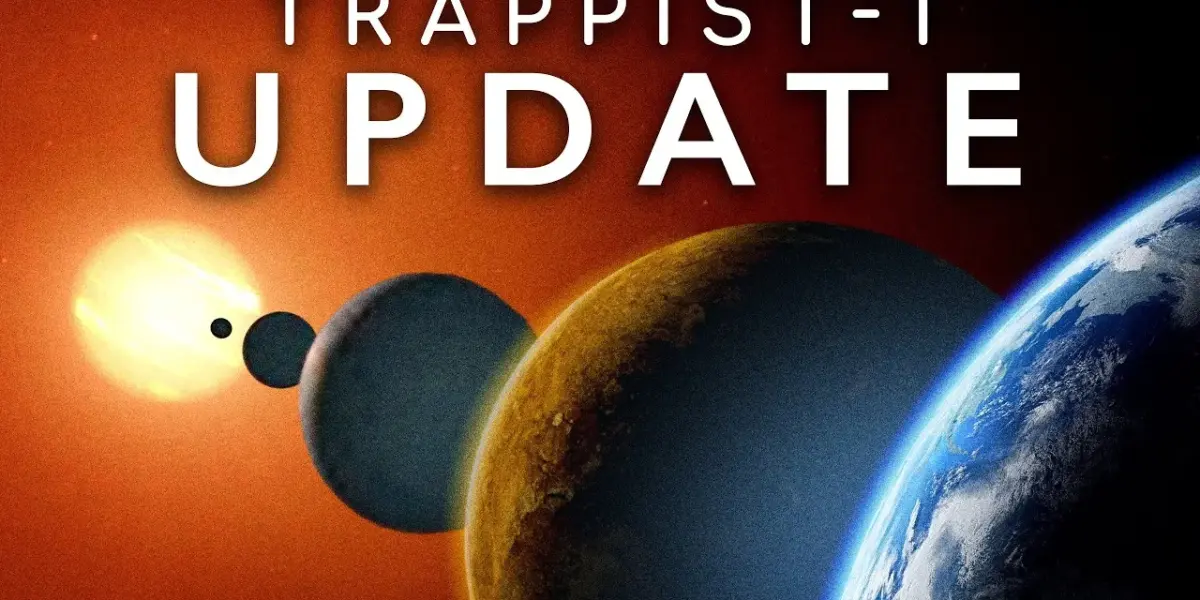
Webb Telescope Probes TRAPPIST-1 for Signs of Life
The question of whether we are alone in the universe is one of humanity’s oldest and most profound. While the idea of alien life is captivating, finding concrete evidence has remained elusive.
However, the TRAPPIST-1 star system, located a relatively close 40 light-years away, is now a prime candidate in this cosmic search. Now, the powerful James Webb Space Telescope (JWST) is turning its gaze towards this intriguing system, analyzing the atmospheres of its seven Earth-sized planets for clues to habitability.
A Star System Unlike Any Other
At the heart of the TRAPPIST-1 system lies a star of the same name, an ultra-cool red dwarf. This star is only slightly larger than Jupiter but significantly more massive.
Red dwarfs are the most common stars in our galaxy, and many nearby stars, including our closest stellar neighbor Proxima Centauri, are of this type. Their cool nature means they are incredibly long-lived, with some models suggesting they can exist for trillions of years, far exceeding the current age of the universe.
Typically, red dwarfs present challenges for habitability. The ‘Goldilocks zone,’ where temperatures are just right for liquid water to exist on a planet’s surface, is very close to these stars. This proximity often leads to planets becoming ‘tidally locked,’ meaning one side perpetually faces the star in eternal daylight, while the other remains in constant darkness.
The dark side could be cold enough for atmospheric gases to freeze. Red dwarfs are often ‘flare stars,’ emitting powerful bursts of radiation that can strip away planetary atmospheres.
The TRAPPIST-1 star, however, is an exception. It flares about 30 times less than a typical red dwarf, increasing the chances that its planets could retain their atmospheres.
The full system of seven planets was discovered in 2017 using the TRAPPIST (Transiting Planets and Planetesimals Small Telescope) robotic telescope, a network of observatories in Chile and Morocco. These telescopes detect planets by observing the slight dimming of a star’s light as a planet passes in front of it, a technique called transit photometry.
Seven Earth-Sized Worlds
Remarkably, all seven planets orbiting TRAPPIST-1 are rocky and roughly the size of Earth. This makes TRAPPIST-1 the most Earth-like planetary system discovered to date. With such a compact system, the planets are packed closely together; the outermost planet orbits at about 9 million kilometers from the star, a distance much closer than Mercury’s orbit around our Sun (58 million kilometers).
Optimistically, six of these seven planets orbit within the star’s Goldilocks zone. The James Webb Space Telescope, launched in December 2021, is humanity’s most powerful space observatory.
Its advanced instruments allow scientists to analyze the light filtering through exoplanet atmospheres as they transit their star. This technique, called transmission spectroscopy, can reveal the chemical composition of these distant atmospheres, detecting specific gases by how they absorb different wavelengths of light.
Webb’s Findings: A Mixed Bag
Initial observations from JWST have provided crucial insights, though not always the ones hoped for. TRAPPIST-1b, the innermost planet, orbits its star in just 36 hours.
While slightly larger than Earth, its surface temperatures are estimated to reach only about 227°C (440°F) on its sun-facing side. This temperature suggests the planet likely lacks a significant atmosphere, making it a barren world.
TRAPPIST-1c, the next planet out, also orbits quickly, with a year lasting 58 hours. It receives twice the starlight Earth gets. JWST data indicates TRAPPIST-1c is surprisingly cool, potentially the coolest rocky exoplanet ever measured.
This suggests it either has no atmosphere or a very thin one, similar to Mars, with no clouds. Scientists do not detect water vapor, implying the planet likely formed with little water.
TRAPPIST-1d, orbiting slightly further out, is smaller than Earth. It receives slightly more starlight than Earth and is within the inner edge of the Goldilocks zone.
JWST has not detected an Earth-like atmosphere, with no signs of water, methane, or carbon dioxide. However, there’s a possibility of a hidden ocean beneath a thick atmosphere that could be masking Webb’s readings, or it could be a world with a thin atmosphere and small ocean, leading to extreme temperature differences between its day and night sides.
TRAPPIST-1f, orbiting at 5.8 million kilometers, has a year of about 9 days. Studies suggest its low density means it could be up to 20% water. At this distance, this would likely create a massive greenhouse effect, turning water into gas and making it a ‘steam world’ with high surface temperatures and pressures, potentially inhospitable.
TRAPPIST-1g, orbiting at 7 million kilometers with a 12-day year, is slightly larger than Earth and is on the outer edge of the habitable zone. Water has been detected on this planet, making it a candidate for habitability, though less is known about its atmosphere.
TRAPPIST-1h, the outermost planet, orbits at 9.3 million kilometers with a 19-day year. It’s the smallest and least dense, with gravity comparable to our Moon. Being so far out, it’s likely icy, though a hydrogen-rich atmosphere could theoretically allow for liquid water.
TRAPPIST-1e: The Most Promising Candidate
The planet generating the most excitement is TRAPPIST-1e. It orbits precisely in the middle of the predicted habitable zone, receiving about two-thirds of the energy Earth receives from the Sun. JWST observations initially suggested this planet might have an atmosphere, unlike planets c and d.
The DREAMS (Deep Reconnaissance of Exoplanet Atmospheres through Multi-instrument Spectroscopy) team, using their allocated JWST observation time, has focused heavily on TRAPPIST-1e. They have ruled out primordial atmospheres rich in light gases like hydrogen and helium, as well as thick carbon dioxide atmospheres like Venus’, or thin ones like Mars’.
This leaves open the possibility of an Earth-like atmosphere, dominated by heavier gases like nitrogen, potentially with a greenhouse effect from water, carbon dioxide, or methane. Such an atmosphere, with a surface pressure around one bar (similar to Earth’s), could help distribute heat to the dark side, potentially allowing for a global surface ocean despite being tidally locked. This would be a monumental discovery.
However, the data also slightly favors a different scenario: TRAPPIST-1e might be a cold planet without a global ocean. High levels of methane could be creating a ‘reverse greenhouse effect,’ absorbing and re-emitting stellar energy into space before it reaches the surface. This would mean liquid water might only exist on the star-facing side, potentially supporting life in a ‘warm little pond’ scenario, as proposed by Charles Darwin.
Another possibility is that TRAPPIST-1e is an icy world with a subsurface ocean, similar to Jupiter’s moon Europa or Saturn’s moon Enceladus. Life on Earth is thought by some to have originated near deep-sea vents, and a similar process could occur on TRAPPIST-1e.
Despite these possibilities, scientists cannot entirely rule out that TRAPPIST-1e is a cold, airless world. The intense activity of the red dwarf star TRAPPIST-1, even though less active than others, poses a significant challenge.
Flares releasing vast amounts of energy could strip away any nascent atmosphere over time. The star’s ‘chaotic teenage years,’ which can last for billions of years, could prevent planets from developing stable, life-supporting atmospheres.
Yet, these flares might also be crucial. UV radiation from flares could have been essential for creating the building blocks of RNA, key molecules for life.
Now that TRAPPIST-1 is in a calmer phase, a stable atmosphere might form, potentially protected by a magnetic field, similar to Earth’s. TRAPPIST-1e’s close and potentially eccentric orbit could generate internal friction, heating its core and helping to maintain a magnetic field, much like the tidal heating that makes Jupiter’s moon Io volcanically active.
The Road Ahead
While the TRAPPIST-1 system presents a tantalizing prospect, definitive answers are still forthcoming. The JWST continues to gather data, with scientists refining their techniques for more precise measurements. The hope is to confirm the presence or absence of key gases like carbon dioxide and to determine if a secondary atmosphere exists, a crucial step in the search for life.
Recent studies tentatively suggest TRAPPIST-1e might have a methane atmosphere, though this could be interference from the star itself. The possibility remains that TRAPPIST-1e and its neighbors could host unique, inhospitable atmospheres, or perhaps one that could theoretically support life. The discovery of formations on Mars, potentially formed by life, fuels the feeling that discovering extraterrestrial life is inevitable.
The next major step in this quest will be the launch of the Habitable Worlds Observatory in 2041, a telescope specifically designed to search for life around stars like TRAPPIST-1. Until then, the ongoing observations from the James Webb Space Telescope offer our best glimpse into the potential habitability of these distant worlds.
Source: Everything We Know About TRAPPIST-1 (YouTube)

Related Articles

Mars Rovers Seek Ancient Life Signs on Red Planet
NASA's Perseverance rover is actively searching for signs of ancient microbial life in Jezero Crater, Mars. Equipped with advanced instruments, it collects rock and soil samples for future return to Earth. This mission builds on decades of Mars exploration, seeking to answer if life ever existed beyond our planet.

Solar Lens Mission: A 20-Year Journey to Cosmic Magnification
A proposed mission to use the Sun as a giant cosmic magnifying glass, known as the Solar Gravitational Lens, could revolutionize astronomy. Reaching this distant vantage point, however, requires overcoming significant propulsion challenges, with a journey expected to take around 20 years after launch, potentially in the 2070s or 2080s.

Artemis II Shatters Distance Records on Lunar Flyby
The Artemis II mission achieved a historic lunar flyby on April 1, 2026, sending four astronauts farther from Earth than ever before. Meanwhile, new images from JWST and Hubble offer deeper insights into Saturn's atmosphere, and the mysterious "super-puff" exoplanet Kepler 51D continues to baffle scientists.