Giant New Moon Crater Stuns Scientists
A massive new crater, 225 meters wide, has been discovered on the Moon, marking a significant impact event. Meanwhile, the Artemis 2 astronauts have safely returned to Earth after a record-breaking journey. New surveys are mapping the universe in 3D, and evidence of merging supermassive black holes has been found.

Giant New Moon Crater Stuns Scientists
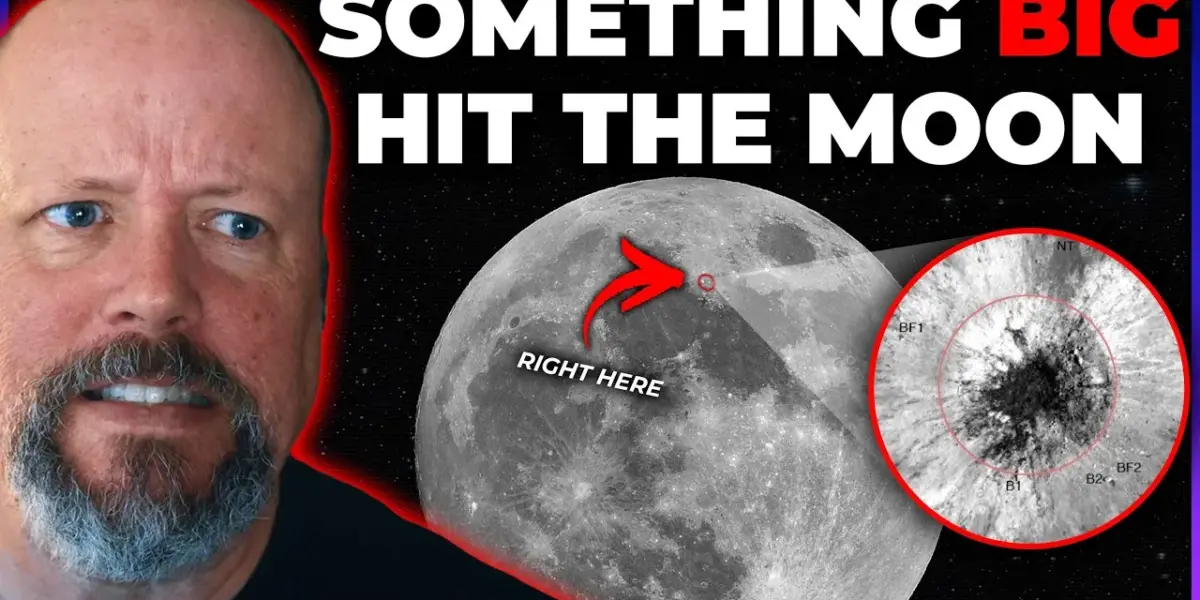
The Moon, a silent witness to billions of years of cosmic history, has revealed a fresh scar. Astronomers using data from the Lunar Reconnaissance Orbiter have discovered a massive new impact crater, a rare and significant event. This colossal new crater measures an impressive 225 meters across and plunges 43 meters deep, dwarfing previous discoveries.
The sheer scale of this impact is remarkable. Its walls are so steep they would make standing on them nearly impossible.
Ejected debris, chunks of lunar rock blasted outwards by the impact, form blocks tens of meters high around the crater’s edge. Researchers also observed a glassy material at the crater’s base, evidence that the intense heat of the impact briefly turned the lunar soil into a molten state before it cooled like glass.
Artemis 2 Astronauts Safely Return to Earth
In a triumphant conclusion to a historic journey, the four-person crew of the Artemis 2 mission has safely returned to Earth. After a 10-day voyage that took them to the Moon and back, the Orion capsule splashed down off the coast of San Diego. This mission pushed the boundaries of human spaceflight, traveling over 1.1 million kilometers round trip.
The astronauts achieved several remarkable feats during their voyage. They set a new record for the farthest distance humans have ever traveled from Earth.
Their journey provided stunning views, including Earthrise and Earthset, a solar eclipse lasting an hour, and the chance to observe micrometeorite impacts on the Moon’s dark side. They also witnessed the Milky Way and planets with unparalleled clarity.
Mapping the Universe: Dark Energy Survey Concludes
A groundbreaking five-year survey, the Dark Energy Spectroscopic Instrument (DESI), has just completed its mission to map a vast portion of the cosmos. DESI used a unique system of robotic fiber optic cables to capture detailed information from millions of galaxies and quasars. This massive undertaking has created an unprecedented 3D map of the universe, spanning 14,000 square degrees of the sky.
This detailed map will allow astronomers to study how galaxies clustered together in the early universe compared to today. The primary goal is to better understand the mysterious force known as dark energy, which is causing the universe to expand at an accelerating rate. Scientists hope this data will clarify whether dark energy’s influence has changed over cosmic time.
Two Supermassive Black Holes Found Merging
Astronomers have detected compelling evidence of two supermassive black holes locked in a cosmic dance, on a collision course. Located in the galaxy Messier 501, approximately 450 million light-years away, these behemoths are generating powerful jets of energy. By analyzing 23 years of radio signals, scientists identified not one, but two distinct jets orbiting each other.
This observation strongly suggests the presence of two supermassive black holes at the galaxy’s core. The smaller black hole appears to orbit the larger one every 121 days, separated by a distance of 250 to 540 astronomical units. While they are spiraling inwards, their merger is predicted to occur in about 100,000 years, a cosmic event that future telescopes like the Laser Interferometer Space Antenna (LISA) may be able to detect.
Blue Origin Advances Lunar Technology
While SpaceX garners much attention, Blue Origin is making significant strides in space exploration. The company recently conducted a successful test flight of its New Glenn rocket, with the first-stage booster returning safely. This booster is being tested for reusability, with plans to use it again for the upcoming Bluebird 7 launch.
Beyond rocketry, Blue Origin is developing innovative technologies for lunar exploration. Their ‘Blue Alchemist’ project aims to create an all-in-one lunar factory.
This system would process lunar soil to produce breathable air, rocket fuel, construction materials, and even components for solar cells. NASA has approved the project’s technical review, with a demonstration planned by the end of 2026.
Oldest Stars and Venusian Haze
In other astronomical news, student astronomers have identified one of the oldest stars in the universe. This discovery highlights the ongoing effort to understand the universe’s earliest moments. Meanwhile, scientists may have finally solved the mystery of a thin haze layer observed just below the clouds of Venus.
Researchers now believe this haze is formed by cosmic dust. Micrometeorites entering Venus’s atmosphere break apart and react with sulfuric acid clouds. These reactions create particles that seed the haze layer, providing a long-sought explanation for this atmospheric phenomenon.
Source: Fresh Huge Lunar Crater // 3D-Map of The Universe // Stardust on Venus (YouTube)

Related Articles


Artemis II Crew Shares Emotional Moon Mission Reflections
The Artemis II astronauts shared emotional reflections on their recent moon mission with Al Roker. They described the profound impact of seeing Earth as a "blue marble" and experiencing the moon's far side up close. The crew also honored Commander Reid Wiseman's late wife by naming a new lunar crater.


Mars Rovers Seek Ancient Life Signs on Red Planet
NASA's Perseverance rover is actively searching for signs of ancient microbial life in Jezero Crater, Mars. Equipped with advanced instruments, it collects rock and soil samples for future return to Earth. This mission builds on decades of Mars exploration, seeking to answer if life ever existed beyond our planet.


Moon Missions Race for Resources, Not Just Science
Humanity's return to the Moon is driven by a new space race focused on political competition and the potential for valuable resource extraction, rather than solely scientific discovery. Programs like NASA's Artemis highlight this shift, preparing for long-term lunar bases and future Mars missions by studying human health in space.