Cosmic Mystery Solved? Direct Collapse Black Holes Found
New simulations suggest that direct collapse black holes, a theorized rapid formation pathway, may explain the existence of supermassive black holes in the early universe. Evidence comes from matching JWST spectral data.

Cosmic Enigma Unraveled: New Evidence Points to Direct Collapse Black Holes
The universe, in its vast and enigmatic expanse, continues to surprise us. For decades, astronomers have grappled with a perplexing cosmic puzzle: how did supermassive black holes, millions or even billions of times the mass of our sun, form so early in the universe’s history?
The conventional understanding of black hole formation—the dramatic death of massive stars—simply doesn’t provide enough time for these behemoths to grow to such colossal sizes so quickly. Now, a groundbreaking simulation by a team led by Pikuchi and collaborators offers compelling evidence for an alternative, more rapid pathway: the direct collapse black hole.
The Stellar Graveyard and the Supermassive Puzzle
Our current understanding of stellar evolution dictates that black holes are born from the ashes of stars. When a star much more massive than our Sun exhausts its nuclear fuel, its core can no longer withstand the inward pull of gravity. This leads to a catastrophic implosion, followed by a spectacular supernova explosion that blasts the star’s outer layers into space.
The remaining core collapses under its own immense gravity, forming a stellar-mass black hole. These black holes typically range from about 5 to 50 times the mass of our Sun.
However, the supermassive black holes that reside at the centers of most galaxies, including our own Milky Way’s Sagittarius A*, are in a different league entirely. They can be millions or even billions of solar masses. The prevailing theory suggests that these giants grow over cosmic time by accreting vast amounts of gas and dust, and by merging with other black holes.
But the early universe, a mere fraction of its current age, presents a temporal challenge. Observations from the James Webb Space Telescope (JWST) have revealed the presence of surprisingly massive black holes in the universe’s infancy, long before they could have theoretically grown to such proportions through conventional accretion and mergers.
The Direct Collapse Shortcut
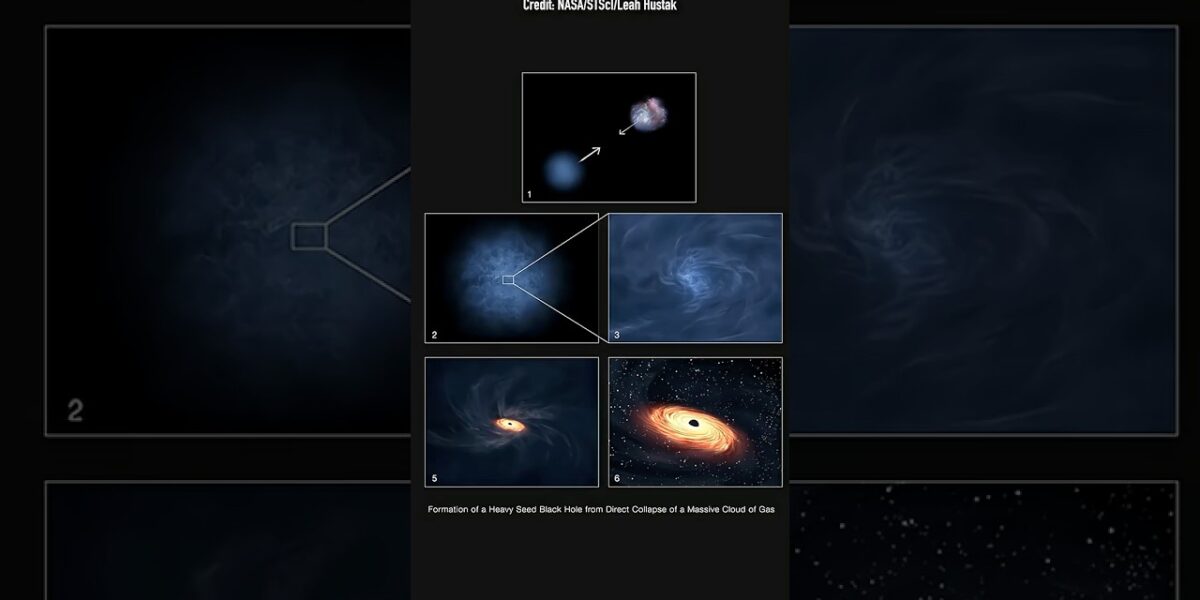
This temporal discrepancy has led scientists to hypothesize about alternative formation mechanisms. The concept of a ‘direct collapse black hole’ proposes a cosmic shortcut. Instead of forming a star first, a massive cloud of gas, under specific conditions, could bypass the stellar phase altogether.
In this scenario, the gas cloud would collapse directly under its own gravity, forming a black hole with an initial mass around a thousand times that of the Sun. This ‘seed’ black hole would then have a significant head start in its growth, making it more plausible for supermassive black holes to exist in the early universe.
While direct collapse black holes have been a theoretical staple in cosmological simulations, helping to kickstart the growth of early supermassive black holes, direct observational evidence has remained elusive. Until now.
Simulating the Invisible: A Glimpse into the Early Universe
The research by Pikuchi and their team digs into what a direct collapse black hole would actually look like to our telescopes. They ran sophisticated simulations, modeling the expected light signatures emitted from the gas clouds surrounding these hypothetical objects. The results are striking.
Their simulations produced a spectrum of light that closely matches observations made by the JWST. Specifically, the team analyzed the light emitted by a gas cloud composed primarily of hydrogen.
The simulation showed that when dust—heavier elements produced by earlier generations of stars—is present within this gas cloud, it significantly alters the light. The dust absorbs and re-emits light at different wavelengths, creating a unique spectral fingerprint.
The critical finding is the remarkable agreement between the simulated spectral signature of a direct collapse black hole shrouded in dusty gas (represented by a purpley-red line in their analysis) and the actual spectrum observed from a distant, faint object designated as a ‘little red dot’ by JWST (shown as a blue line). This visual and spectral correlation is a powerful indicator that we might be observing the signature of a direct collapse black hole for the first time.
Explaining Other Cosmic Anomalies
Beyond matching the spectral data, the direct collapse black hole model offers potential explanations for other puzzling characteristics of these early cosmic objects. One such enigma is the surprisingly low amount of X-ray emission detected from these ‘little red dots’.
The direct collapse scenario requires the surrounding gas to be incredibly dense. This extreme density would act as a shield, allowing only the highest-energy X-rays to escape, thus explaining the observed faintness in X-ray wavelengths.
The paper by Pikuchi and collaborators argues that their simulated direct collapse black hole model can account for a multitude of properties observed in these distant objects, properties that have been difficult to reconcile with other theoretical frameworks.
What Comes Next?
This research represents a significant step forward in our quest to understand the origins of the most massive structures in the universe. The compelling alignment between simulations and JWST observations demands further investigation. The scientific community will undoubtedly scrutinize these findings, and future observational campaigns will likely target similar objects to confirm or refute this hypothesis.
The implications of confirming the existence of direct collapse black holes are profound. It would not only solve a long-standing astrophysical mystery but also refine our models of early universe cosmology and galaxy formation.
Understanding how these supermassive black holes seeded and grew is crucial for comprehending the evolution of the cosmic web and the structures that populate it today. This discovery, if validated, would open a new window into the universe’s most formative epochs, offering a glimpse into the very beginnings of cosmic structure.
As astronomers continue to explore the cosmos with increasingly powerful instruments like JWST, we can expect more such revelations that challenge our understanding and expand the frontiers of human knowledge. The universe, it seems, still holds many more secrets, waiting to be uncovered.
Source: What is a direct collapse black hole? (YouTube)

Related Articles

Gravitational Waves Reveal Universe’s Deepest Secrets
Humanity's ability to detect gravitational waves has advanced dramatically, with observatories now capturing nearly one black hole merger daily. These cosmic events are not only spectacular but also crucial for testing Einstein's theories and understanding the universe's fundamental nature. Future upgrades promise even greater insights.


Astrophysicist Shares Breast Cancer Journey & Science Insights
Astrophysicist Dr. Becky Smethurst shares her breast cancer diagnosis journey and emphasizes the importance of evidence-based medicine over unproven treatments. She also discusses her passion for space and scientific discovery.


Universe’s End Time Shrinks Dramatically
New research suggests the universe's end may arrive much sooner than previously thought, with a revised timeline of 10 to the power of 78 years. This 'heat death' theory posits that all matter will decay, not just black holes. While still an immense duration, it's a significant shift from earlier predictions.