Germany’s Export Powerhouse Faces Unprecedented Challenges
Germany's 'Made in Germany' export model faces significant challenges due to shifting global markets and intensified competition from China. Factors like state-backed advantages and a non-level playing field are testing the long-standing economic prowess of Europe's largest economy.


Germany’s Export-Oriented Economy at a Crossroads
Germany, long celebrated for its robust ‘Made in Germany’ brand and its prowess as a global export powerhouse, is facing a period of profound structural decline. The traditional economic model, heavily reliant on open markets and predictable trade relationships, is being severely tested by geopolitical shifts, increased global competition, and the unique economic strategies of emerging powerhouses like China. This evolving landscape raises critical questions about the future sustainability and adaptability of Germany’s industrial might.
Shifting Global Markets and Political Uncertainty
The foundational pillars of Germany’s export success have historically included access to large, stable markets, particularly in the United States and China. However, these dynamics are rapidly changing. The United States, a key trading partner, has experienced periods of unpredictable trade policy, creating uncertainty for German manufacturers. While a potential change in U.S. government could usher in a more stable and predictable environment, the underlying economic trends suggest a more complex future.
“I think at least the way we’ve known it uh with China and the US as large markets uh that’s no longer so easy in the US we’ll we’ll see there might be a change in government at some point it might get easier again and more predictable most most of all.”
This sentiment highlights a key concern: the erosion of predictability in international trade, a factor crucial for long-term investment and production planning in Germany’s export-dependent economy. The reliance on these major markets now appears riskier than in previous decades.
China’s Rise and the ‘Authoritarian State Capitalist’ Advantage
Perhaps the most significant challenge stems from China’s transformation into a formidable competitor, mirroring Germany’s own export-driven model but with distinct state-backed advantages. China’s ascent as a ‘world export champion’ is not merely a consequence of market forces but is deeply intertwined with its unique economic system.
The transcript points to several factors contributing to China’s competitive edge:
- Non-level Playing Field: Allegations of unfair competition are central to the discussion.
- Artificially Devalued Currency: A weaker currency makes Chinese exports cheaper on the global market.
- Subsidies: Extensive government subsidies provide Chinese industries with a significant cost advantage.
- Innovation Ecosystem: Beyond state intervention, China has fostered a robust and rapidly advancing innovation landscape.
“but with China the problem is that the Chinese model in a in a way in terms of being world export champion is very much the German model uh and but China through the authoritarian state capitalist advantages that they’ve created. uh a non-level playing field, a currency that’s artificially devalued, subsidies, plus also a very very good innovation ecosystem.”
This quote encapsulates the multifaceted nature of the challenge. Germany’s traditional strengths in engineering, manufacturing, and quality are now being confronted by a competitor that leverages state power to create an environment where traditional market competition is significantly distorted. The combination of state support and genuine innovation makes China a particularly formidable rival.
Structural Decline or Necessary Evolution?
The current situation prompts a debate: Is the ‘Made in Germany’ model truly dead, or is it undergoing a necessary but painful structural decline that demands significant adaptation? The high costs of energy, labor, and regulatory burdens in Germany, coupled with the competitive pressures from China and other emerging economies, are squeezing profit margins and impacting the competitiveness of German exports.
Historically, Germany has thrived on high-value, high-quality manufacturing. However, as China moves up the value chain and develops its own innovative capacity, the traditional German advantage is diminishing. The reliance on complex supply chains, often originating from or passing through Asia, also presents vulnerabilities, as demonstrated by recent global disruptions.
Broader Implications for the German Economy
The potential decline of the ‘Made in Germany’ model has far-reaching implications. It affects employment, investment, and Germany’s overall economic standing. The Mittelstand, the backbone of the German economy comprising small and medium-sized enterprises, is particularly vulnerable. These companies often lack the scale and resources to absorb rising costs or to pivot quickly to new markets and technologies.
Furthermore, the challenges faced by the export sector could necessitate a re-evaluation of Germany’s economic strategy. This might involve greater investment in domestic markets, a stronger focus on services, or a concerted effort to foster greater innovation and digitalization within German industries. The energy transition, while a long-term necessity, also presents short-term economic challenges due to high energy costs.
The Path Forward: Adaptation and Resilience
Germany’s economic future hinges on its ability to adapt. This requires addressing internal challenges, such as high energy costs and complex regulations, while also navigating the turbulent international trade environment. Strategic investments in research and development, fostering a more agile regulatory framework, and diversifying export markets will be crucial.
The ‘Made in Germany’ brand is built on quality and reliability, attributes that remain valuable. However, maintaining this reputation in the face of intense global competition and evolving market demands will require innovation, flexibility, and a willingness to embrace change. The coming years will be critical in determining whether Germany can reinvent its economic model or if the current structural decline continues.
Source: Is the 'Made in Germany' model dead or just in serious structure decline | To the Point (YouTube)

Related Articles

US Blockade Tightens Grip: Iran Faces Painful Economic Squeeze
The Strait of Hormuz is a critical shipping lane now under a complex U.S. naval blockade targeting Iranian oil exports. While the U.S. aims to squeeze Iran economically, Tehran's high pain tolerance and control over escalation present significant challenges. The situation risks global trade disruption and economic shocks.


US Oil Sanctions on Iran Spark Global Price Fears
New U.S. sanctions on Iran are drawing sharp criticism from China and sparking fears of higher global oil prices. While intended to pressure Iran, analysts suggest the measures could inadvertently disrupt supply and increase costs worldwide. The situation unfolds amidst ongoing ceasefire talks and broader geopolitical tensions.
Iran Strait Blockade Risks Global Confidence, General Warns
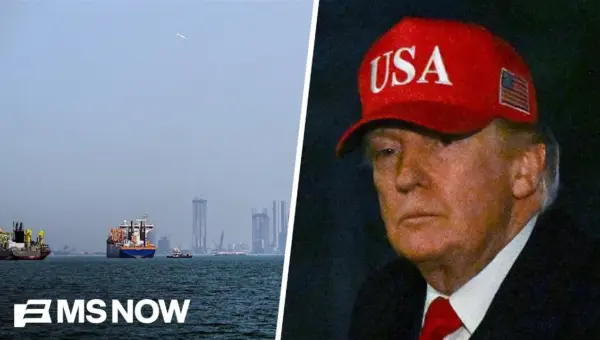
Retired Army General David Petraeus warns that Iran's actions in the Strait of Hormuz could cripple global shipping confidence. U.S. forces are working to clear mines, but restoring trust among energy companies is paramount. The situation highlights the complex challenges of maritime security and international diplomacy.