Russian War Losses Stir Unease in Kremlin’s Heartland

Russia’s Vastness Tested by War’s Unseen Cost
For over four years, Russia’s strategy in the ongoing conflict has relied heavily on its immense size. This geographical expanse allows different regions to exist in separate realities, masking the war’s full impact. While one town might mourn its losses quietly, another might seek jobs, and many remain detached, influenced only by state television.
However, this insulation is showing signs of strain as even staunch war supporters begin to grapple with casualty figures. Simple arithmetic, once confined to calculations, is now translating into thousands of missing men from specific cities, a reality that slogans cannot easily control.
Geography as a Shield for War’s Toll
Russia’s sheer size creates vast distances that separate not just cities, but entire ways of life and expectations. This makes cross-country travel difficult and expensive, leading some regions to feel like distinct entities.
This disconnect is evident when people inquire about services in other Russian regions as if they were foreign, or when citizens from specific republics need to assert their nationality. This highlights a stark contrast with the nation’s public pronouncements on unity and greatness.
Life in smaller, provincial towns often remains unknown to residents of major cities like Moscow or St. Petersburg. Even these towns can be better off than truly forgotten areas, which may lack basic services like paved streets or reliable internet. These overlooked places, where news rarely emerges and people live in isolation, become invisible blind spots in the national narrative.
This geographical fragmentation enabled the state to manage the war’s human cost for an extended period. Losses were dispersed across more than 80 regions that had little interaction or understanding of each other.
The country’s size acted as a political shield, distributing the damage and disguising it as localized tragedy rather than a national crisis. This vastness, promoted as a sign of strength, became a cover for a devastating national disaster, allowing an authoritarian state to sustain heavy losses longer than a more connected nation could.
The Sacred Taboo of Counting the Dead
In any conflict, casualty numbers are more than just figures; they are potent political and emotional tools. In authoritarian systems, these numbers are often treated as state secrets, shrouded in carefully chosen language.
Human losses are particularly sensitive and have been manipulated throughout history. For example, Stalin’s initial claim of 7 million Soviet dead in World War II was later revised to 20 million, and then 27 million, showing how official figures served political needs rather than objective truth.
Currently, Russia’s official reported losses of servicemen remain at 5,937, a figure from 2022. Despite the passage of time and changes in leadership, this number has not been updated.
Acknowledging the true scale of losses would challenge many established narratives. Instead, the focus remains on reporting Ukrainian casualties, with some state media claiming over 1.5 million Ukrainian soldiers killed, though interpretations of this figure vary, including wounded soldiers.
This discrepancy highlights the propaganda’s goal: to direct attention away from Russian losses. Pro-war commentators and media outlets often inflate Ukrainian casualty claims while treating Russian losses as an abstract, undefined quantity.
Terms like “a lot” or “huge” were acceptable, but precise numbers were considered dangerous. Even so-called experts, like Alexey Podberezkin, focused on Ukrainian equipment losses while ignoring Russian casualties, revealing a significant analytical and moral void.
When the War Camp Begins to Count
The pressure to acknowledge losses has begun to emerge not from official channels, but from within the pro-war camp itself. This shift is significant because it indicates a growing unease among even radical supporters. In the summer of 2025, Pavel Gubarev, a prominent figure, suggested that Russian losses had reached a point where the war should end, framing casualties as a limiting factor.
By early 2026, the conflict had surpassed the duration of major World War II campaigns on the Eastern Front. This symbolic milestone prompted some pro-war actors to engage in direct calculations.
The neo-Nazi Rusich Group’s Telegram channel, for instance, outlined figures for contract soldiers, mobilized personnel, and private military company fighters, estimating a deficit of nearly 1.5 million unaccounted individuals. Although this arithmetic is imprecise, it represents a crossing of the line from vague commentary to explicit counting.
More Yuri Podolyaka, a widely followed pro-war blogger, estimated that between 315,000 and 415,000 Russians had been killed. This figure, previously associated with opposition media, was now being pronounced by a prominent voice within the pro-war information sphere. This is a significant crack in the official narrative, especially when state propaganda’s own exaggerated ratios of Ukrainian to Russian losses, when applied, suggest a similar casualty count for Russia.
A Lost City the Map Still Pretends Exists
When casualty figures reach hundreds of thousands, they translate into the scale of entire Russian cities. A reported death toll exceeding 300,000 is equivalent to the population of a regional center like Ivanovo or Belgorod. This means that over four years, the equivalent of a Russian city has vanished, not due to natural disaster, but because of a war initiated without clear benefit and with immense human cost.
The dispersed nature of these losses across remote villages, industrial towns, and various military units prevents a concentrated political shock. The state can maintain the illusion of national stability by treating peripheral lives as acceptable sacrifices.
However, the casualty graph only moves in one direction; it does not improve spontaneously. Each passing month, each new contract signed under duress, and each family receiving devastating news adds to the accumulating pressure.
The war’s duration, combined with its bloodshed and perceived pointlessness, is straining public patience. While prolonged conflict alone can be managed, and high casualties can be euphemized, the combination of these factors creates a dangerous situation for the state.
The significance lies not in the discovery of new secrets, but in the mass audience hearing truth-shaped numbers spoken within their own information ecosystem. When the equivalent of an entire city’s worth of men hovers over public discourse, framing the war as a distant necessity becomes far more difficult.
Why 2026 Could Become the Year of Losses
In closed systems, public opinion often emerges slowly and indirectly, through fragments and symbolic moments. Understanding the public mood in Russia, where free speech is restricted, relies on interpreting subtle cues.
However, fundamental issues like human losses cannot remain buried forever. Unlike ideology or official narratives, casualties directly impact daily life, entering homes and personal conversations.
After four years of recruitment drives, mobilization pressures, and propaganda, the narrative supporting the war is becoming fragile. This is not due to increased bravery or state humanity, but because mathematics is persistent and grief is cumulative.
The issue of losses may shift from a background discomfort to a central political question in 2026. The Kremlin understands this danger, as evidenced by its continued adherence to the outdated figure of 5,937 and its focus on inflated enemy casualty numbers.
When Russians begin to seriously consider their own losses, and the national conversation shifts from slogans to the price paid, the emotional logic of the war will begin to collapse. This does not signal an imminent regime change or an automatic end to the conflict.
However, the long-standing formula of distance, silence, and abstraction may finally be wearing thin. For a government that has relied on obscuring tragedy across a vast territory, this represents a significant and dangerous development.
Source: IT FINALLY HAPPENED! Z-Propagandists CONFRONTED Putin About ENORMOUS Losses. (YouTube)

Related Articles
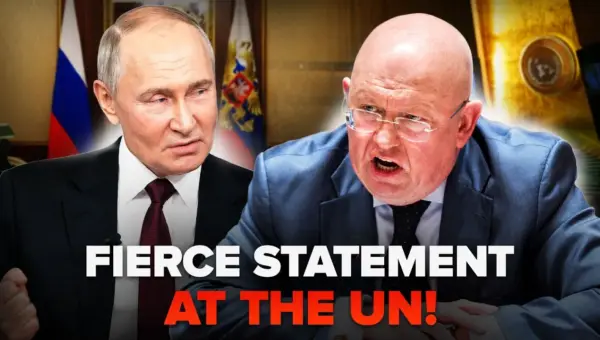
Russia’s UN Envoy Mocks Ukraine as ‘Expendable’
Russia's UN envoy Vasily Nebenzya sparked controversy by calling Ukrainians 'expendable material' and blaming the West for prolonging the war. Ukraine's UN representative countered with stark casualty projections for Russia. Meanwhile, the EU is moving to approve a 90 billion euro aid package for Ukraine, while internal criticism emerges from Russian pro-war channels regarding infrastructure defense.
Iran Nuclear Talks Stall Amidst Enrichment Dispute
Discussions on Iran's nuclear program are stalled, with uranium enrichment remaining a key point of contention. Meanwhile, a Ukrainian diplomatic gambit involving the name 'Don Land' aims to capture U.S. attention. The EU is proceeding with significant financial aid for Ukraine, despite fluctuating U.S. sanctions policy impacting Russian oil.

Vlogger’s Plea Sparks Kremlin Panic, Unites Russian Women
A beauty vlogger's online plea for internet access during emergencies has unexpectedly shaken the Russian government. Victoria Bonya's viral video prompted reactions from Kremlin officials and communist leaders, highlighting public discontent. The incident reveals cracks in Russia's propaganda machine and a growing assertiveness among Russian women.