Russia Mimics Ukraine’s Drone Tactics, Falls Short
Russia has attempted to replicate Ukraine's successful drone warfare tactics by creating its own "drone wall." However, analysis suggests these efforts have fallen short, with Ukraine maintaining a technological and tactical edge. The conflict highlights the rapid evolution of drone warfare and the ongoing race for innovation.

Russia Mimics Ukraine’s Drone Tactics, Falls Short
Both Ukraine and Russia are constantly trying to find the best ways to use drones in modern warfare. They are both experimenting with how to make reconnaissance and attack drones as effective as possible.
Russia has recently tried to copy some of Ukraine’s successful drone strategies, but their efforts have not been as successful. This comes as new analysis from experts Rob Lee and Demetro Putyata reveals Russia’s attempts to create a “drone wall” of their own.
Ukraine’s innovation with drones has often come out of necessity. In 2022 and 2023, Ukraine had fewer weapons and less ammunition than Russia. Drones became a crucial tool to make up for this difference.
Ukraine has led the way in developing and using drones. However, 2025 has seen Russia start to catch up and narrow this gap.
Russia’s “Drone Wall” Experiment
Last summer, Russia experimented with different ways to use its unmanned aerial systems (UAS). The Russian military is always looking for the most effective methods.
They collect data to see how to best use FPV drones, “loitering munitions” (drones that can circle a target before attacking), and other types of UAVs. One of these experiments was a “drone wall” concept, similar to Ukraine’s defensive approach but designed to help with offensive attacks.
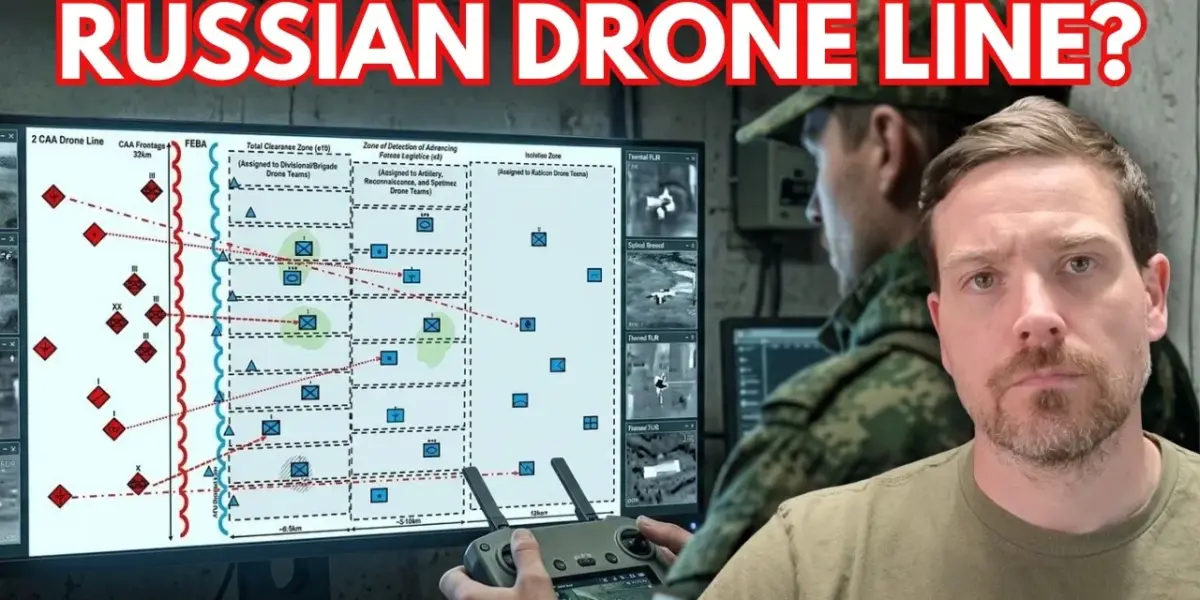
Two Russian armies, the Second and Sixth Combined Arms Armies, tested this idea in different areas. The Second Army divided its front line into three zones: 0-5 km, 5-10 km, and over 10 km past the enemy’s front line. Different types of drone units were assigned to each zone, with specialized, well-funded units called “Rubicon” handling targets far behind the front lines.
The Sixth Army had a different breakdown of zones: 0-5 km, 5-25 km, and 25-35 km. Both armies decided how many drones could be used per day and which types of drones were best for certain areas. For example, “loitering munitions” were used for deeper targets, while FPV drones were used closer to the front.
After these initial tests, the entire Center Group of Forces in Russia decided to use a similar system. They also divided their front into 0-5 km, 5-10 km, and over 10 km zones.
The areas beyond 10 km were assigned to elite Rubicon units or special brigades. This was a significant effort, with Russia reinforcing these units heavily, especially in areas that were a main focus of their efforts.
Ukraine’s Different Approach
While Russia was experimenting with its offensive “drone wall,” Ukraine was focusing on increasing its ability to strike various Russian targets. Ukraine also pays attention to protecting its forces from enemy drones. Russia is working to build a large system of hundreds of small radar units to create a “radar field” and is increasing the number of anti-drone crews.
One Russian regiment is reportedly planning to have about 16 anti-drone crews per regiment, each with four small radar units. Ukraine is also developing its own anti-drone crews, but experts suggest Ukraine might not be focusing enough on the technical side, like radar systems. This could be a mistake, as it might reduce Ukraine’s ability to destroy Russian drones effectively.
Meanwhile, Ukraine is having success with its strike drones, hitting Russian logistics and air defense systems 70-80 km behind the front lines. They are using both expensive and very cheap drones.
For example, they use Ukrainian and American-made strike drones costing around $350, along with more expensive German systems. Ukraine has also significantly lowered the cost of its ISR (Intelligence, Surveillance, and Reconnaissance) drones, from $70,000-$80,000 to $10,000-$12,000.
Why This Matters
Despite Russia’s “drone wall” experiments and reinforcement, their advances have been slow. Ukraine has developed effective ways to counter these tactics.
This shows that simply copying an idea doesn’t guarantee success. Russia’s approach, while structured, hasn’t overcome Ukraine’s ability to hold its ground.
The concept of a “kill zone” is also being re-examined. Experts like Demetro Putyata argue that a true kill zone means the enemy cannot move, hide, or receive supplies. While drones can increase the chances of being hit, current “kill zones” are more accurately described as “increased zones of observation and striking.” Soldiers are still able to rotate and receive supplies, even within 5 km of the front lines, using various tactics and equipment.
The loss of Starlink internet for Russia in January also impacted their drone capabilities. Before the blockage, Russia used Starlinks on various drones to hit targets up to 50 km behind the front lines. Without this, Russia has lost some of its ability to strike deep into Ukrainian territory, giving Ukraine a significant advantage in operational-level strikes.
Implications, Trends, and Future Outlook
Ukraine has consistently led in drone innovation, driven by the need to compensate for fewer resources. Russia is now catching up, but Ukraine still holds an edge in talent and innovation. Russia’s development of elite units like Rubicon, with specific tasks like targeting logistics and UAS teams far behind the front lines, has provided a new capability that regular Russian units lack.
The focus is shifting towards “middle strike” capabilities. Ukraine is increasingly using drones with larger warheads, like FPV drones, capable of destroying buildings and command posts.
They also use smaller drones to take out vehicles. This combination of heavy and light middle strikes, along with the increasing quantities of these drones, is creating significant problems for Russia.
Ukraine’s defense industry is highly innovative, and Western companies are also contributing advanced technology. This fusion of Ukrainian ingenuity, Western capital, and expertise gives Ukraine a long-term advantage. While Russia will adapt and develop countermeasures, Ukraine’s current technological edge suggests a positive trend for their capabilities.
Historical Context
The use of drones in warfare has rapidly evolved since the early 2000s. Initially used for reconnaissance, drones have become potent strike platforms.
The conflict in Ukraine has accelerated this evolution, with both sides constantly adapting tactics and technology. Russia’s “drone wall” is a direct response to Ukraine’s successful drone warfare, highlighting the ongoing cycle of innovation and counter-innovation in modern conflict.
The term “kill zone” itself has become a point of discussion. Historically, it implied an area where enemy movement and survival were nearly impossible.
However, in the context of modern drone warfare, the term is being used more loosely. Experts like Putyata emphasize that a true kill zone involves total denial of enemy activity, which is not yet consistently achieved even within several kilometers of the front lines.
The impact of communication technologies like Starlink has also been crucial. Its availability allowed for highly precise drone operations at significant distances.
Russia’s loss of access, while Ukraine retains it, has created a notable disparity in operational-level strike capabilities. This highlights how critical infrastructure and technology can shape battlefield dynamics.
Experts Rob Lee and Demetro Putyata are continuing to track these developments. Their new publication on Substack, “Two Marines,” offers regular updates on battlefield changes, tactics, and technology, providing valuable insights into the ongoing conflict.
Source: Russia Tried to Reshape Drone Warfare (YouTube)

Related Articles


Ukraine’s Drone War Shifts Battlefield Dynamics
Ukraine's strategic shift to drone warfare is reshaping the battlefield as Western aid dwindles. The nation's innovation in this area forces Russian adaptation and challenges Moscow's objectives. Observers note Russia's resilience despite high casualties, while Ukraine's drone advancements offer potential for future technology transfer.


US Eases Russian Oil Sanctions Amid Drone Strikes
The US has extended a waiver on Russian oil sanctions for 30 days, allowing shipments already at sea to proceed. This comes as Ukraine continues drone strikes on Russian oil refineries, prompting Russia to bolster its air defenses. Meanwhile, Belarus faces increased scrutiny over military activity near Ukraine's border. Former President Trump has also hinted at a new operation targeting Cuba, and the EU is testing its joint defense response mechanisms.


Putin Faces Unprecedented Pressure Amidst Ukraine War
President Putin is reportedly under unprecedented stress due to the ongoing war in Ukraine. The conflict has resulted in a massive refugee crisis and significant Russian casualties, marking one of Europe's largest wars since World War II. International sanctions and military aid continue to shape the geopolitical landscape.