Lightship RV’s Trek Drive Revolutionizes EV Towing
Lightship RV's Trek Drive system revolutionizes EV towing by actively powering the trailer, dramatically reducing range loss. A recent 80-mile test with a Rivian R1S showed incredible efficiency, making long-distance EV adventures a real possibility.

Lightship RV’s Trek Drive Revolutionizes EV Towing
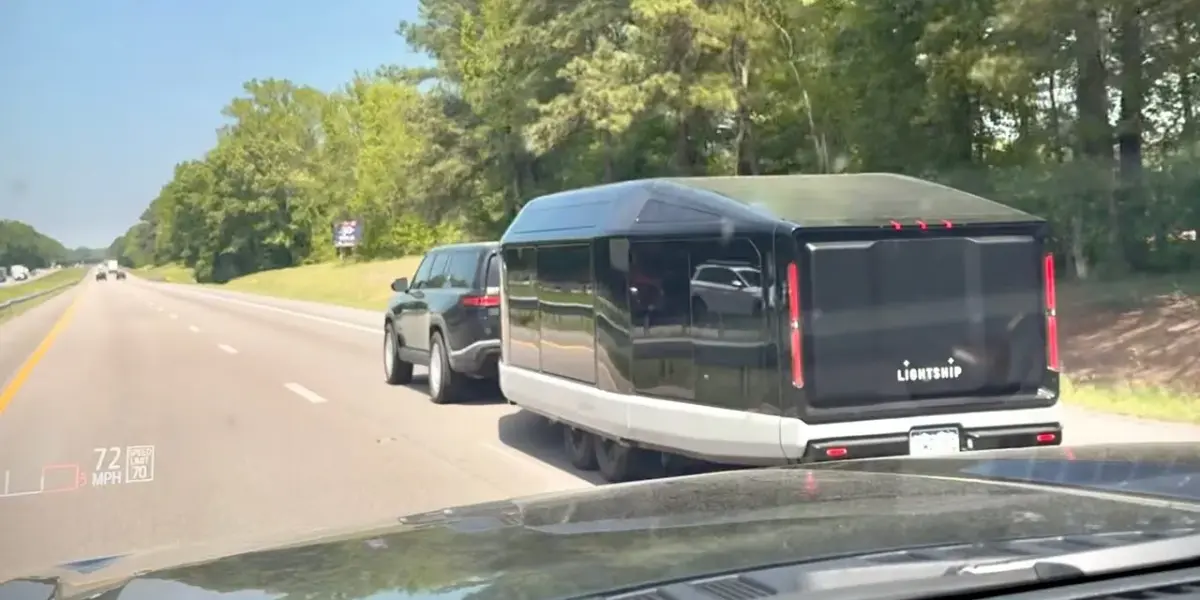
The dream of towing a travel trailer with an electric vehicle just got a massive boost. Lightship RV’s innovative Trek Drive system promises to make towing almost drag-free, allowing EVs like the Rivian R1S to pull a nearly 8,000-pound trailer with surprising efficiency. In a recent test, the Trek Drive system proved its worth, enabling a Rivian R1S to tow the Lightship RV a significant distance without running out of power.
Trek Drive: The Key to EV Towing
Towing with an electric vehicle has always been a challenge. The added weight and aerodynamic drag of a trailer drastically reduce an EV’s range, often making long trips impossible.
Lightship RV’s Trek Drive system is designed to combat this problem. It’s an integrated battery pack and motor system within the RV itself that actively offsets the drag created by the trailer.
This system essentially powers the trailer, reducing the strain on the tow vehicle. The claim is a “drag-free” towing experience, and initial tests suggest it comes remarkably close. Without Trek Drive, the Rivian R1S, with only 30% charge, would never have made the 80-mile journey to the Out of Spec track.
First Impressions: The Lightship RV Experience
The Lightship RV is an impressive piece of engineering, even in its early production stages (this was VIN number six). It’s a collapsible bumper-pull RV that aims to offer a premium camping experience. Prices start around $155,000, but with the essential Trek Drive system, the cost climbs to over $170,000, with the tested unit likely nearing $200,000.
Inside, the RV offers a comfortable living space, with the shower experience being a particular highlight. However, there are some early production quirks. The reviewer noted minor fit and finish issues, such as bubbling counters and a shower drain that leaked onto the floor.
Lightship is aware of these issues and plans to address them in future models. Despite these small flaws, the overall design, lighting, and floor plan are impressive.
Putting Trek Drive to the Test
The main event was the 80-mile tow from the farm to the Out of Spec track. The Rivian R1S started with a 30% state of charge, while the Lightship RV was fully charged to 100% with its 78 kWh battery pack. The goal was to see if the Trek Drive system could enable the R1S to complete the journey.
Before hitting the road, the RV had to be collapsed into its road mode. This involved closing doors, retracting stabilizers, and lowering the canopy.
While most of this process was smooth, some minor frustrations arose, like a stubborn main door that required a hard slam to latch. The reviewer also noted that some components felt a bit less premium due to the need for lightweight, moving parts.
The Tow Begins: Trek Drive Engages
Hooking up the RV to the Rivian R1S was straightforward, though the sheer size of the RV presented some visibility challenges for the R1S, highlighting the need for tow mirrors. Once connected, the system needed a little coaxing to engage Trek Drive. The reviewer had to apply a firm trailer brake signal to get the system to activate.
Once engaged, the Trek Drive system was transformative. The Rivian R1S, which initially estimated a significantly reduced range, began to perform exceptionally well.
The RV’s system provided a substantial boost, estimated at around 73 kW, making the towing experience feel almost effortless. The reviewer described it as feeling like the vehicle was in “sport mode.”
Real-World Efficiency and Performance
Throughout the 80-mile journey, the efficiency numbers were astounding. On back roads at speeds between 55-65 mph, the setup achieved an incredible 2.37 miles per kilowatt-hour, nearly matching the R1S’s efficiency without a trailer. Even when merging onto the highway and cruising at 70 mph, the efficiency remained strong at around 2.4 miles per kWh.
The Trek Drive system’s ability to offset the trailer’s drag was the primary driver of this efficiency. The system even tricked the Rivian’s computer into thinking the nearly 8,000-pound trailer weighed only 2,000 pounds, demonstrating the effectiveness of the aerodynamic design and the powered assist. The reviewer noted that while the R1T might offer slightly more stability, the R1S handled the load admirably.
Verdict: A Glimpse into the Future of EV Towing
The Lightship RV with Trek Drive is more than just a luxury camper; it’s a significant step forward for electric vehicle towing. While early production models have some minor build quality concerns, the core technology – Trek Drive – is a resounding success. It effectively removes the primary barrier to EV towing: range anxiety.
The system allows EV owners to extend their adventures without being tethered to charging stations. For those looking to tow with their electric trucks or SUVs, the Lightship RV with Trek Drive offers a compelling, albeit expensive, solution.
The technology is so advanced that it makes towing an electric trailer feel almost normal, a feat previously thought to be years away. The journey to the Out of Spec track was completed with 13% charge remaining in the Rivian, proof of the system’s capabilities.
Source: I Couldn't Have Made This Towing w/out TrekDrive! Lightship RV Extends Range Massively (YouTube)

Related Articles


Audi Confirms Electric TT Successor Will Arrive in 2027
Audi has officially confirmed that an electric successor to the TT, known as the Concept C or C Sport, will launch in 2027. The car will be built on the platform intended for the electric Porsche 718 Cayman, moving forward regardless of Porsche's own production plans. Audi believes this electric sports car aligns with their vision and has more flexibility to introduce it.

Kia EV3 Electrifies America: Cute Crossover Arrives This Fall
The Kia EV3 compact electric crossover is set to launch in the U.S. this fall as a 2027 model, offering impressive range and modern tech. With an estimated 320 miles of range and a competitive price point, it aims to challenge rivals like the Chevrolet Equinox EV and Tesla Model Y.


Scout’s $60K Price Tag: Will It Last?
Scout has announced an ambitious $60,000 starting price for its upcoming electric truck and SUV. However, past industry trends suggest this figure may increase significantly by launch, as new manufacturers recoup massive development costs. The final price will be critical for Scout's market success.