New Comet Could Dazzle Skies With Naked-Eye Visibility
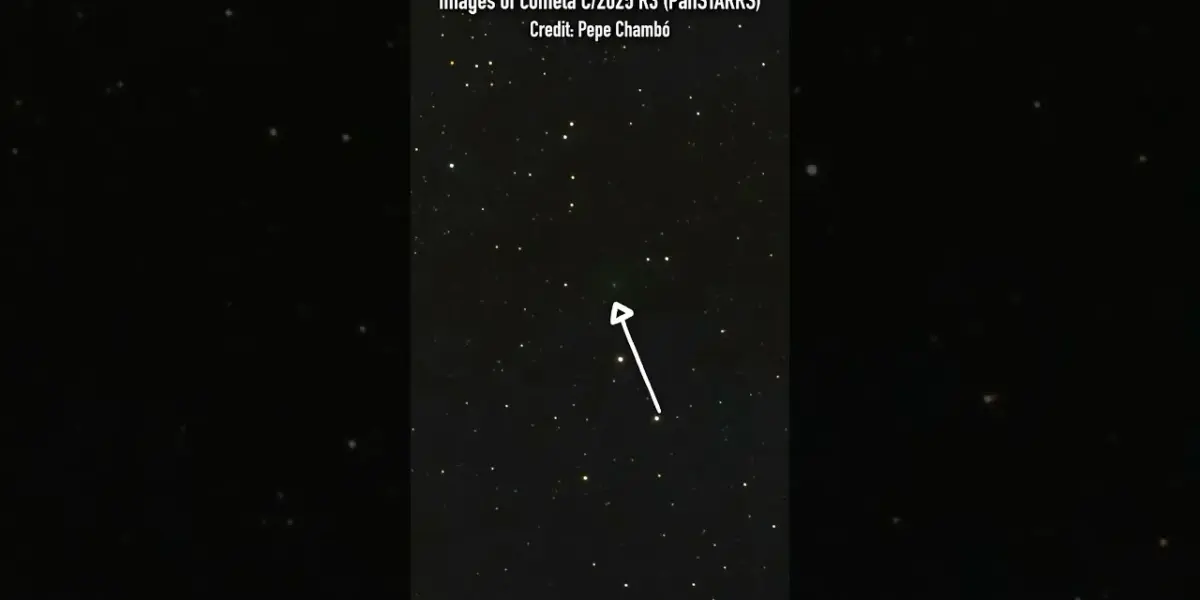
Comet C/2025 R3 (PanSTARRS) is expected to make its closest approach to Earth on April 19th, with predictions suggesting it could become bright enough to be seen with the naked eye. This icy visitor from the outer solar system offers a rare and potentially dazzling celestial display.

New Comet Could Dazzle Skies With Naked-Eye Visibility
Astronomers are buzzing about Comet C/2025 R3 (PanSTARRS), a celestial visitor that might soon put on a spectacular show, potentially visible to the naked eye. This icy wanderer is on a long journey, swinging back towards the inner solar system for the first time in an astonishing 160,000 years. Its closest approach to Earth is expected on April 19th, making this a prime opportunity for skywatchers.
Comets are essentially dirty snowballs made of ice, dust, and rock that orbit the Sun. As they get closer to the Sun, the ice heats up and turns into gas, creating a glowing cloud called a coma and often one or more tails that can stretch for millions of miles. This process makes them visible from Earth, sometimes as faint smudges and other times as brilliant streaks across the night sky.
An Unpredictable Journey
The exact brightness of C/2025 R3 remains a mystery, adding an element of suspense to its upcoming visit. Scientists base their predictions on the behavior of similar comets they have observed in the past. However, comets are famously unpredictable, much like a mischievous cat with a mind of its own.
Past observations of comets show a wide range of brightness. Some comets only become visible with powerful telescopes, appearing as faint as the planet Neptune. Others can become incredibly bright, easily seen without any special equipment, shining as brightly as prominent stars.
Potential for a Dazzling Display
Current predictions for Comet C/2025 R3 range dramatically. Some forecasts suggest it might only be visible with binoculars, appearing as faint as Neptune, which is a dim planet in our night sky. This would still be a significant observation for many amateur astronomers.
However, other predictions are far more exciting. These optimistic forecasts suggest the comet could shine as brightly as the stars forming the ‘W’ shape of the constellation Cassiopeia. If this happens, C/2025 R3 would be easily visible to anyone looking up at the night sky, no telescope or binoculars needed.
Historical Context and Future Prospects
The Oort Cloud, from where this comet originates, is a theoretical shell of icy objects thought to surround our solar system far beyond the orbit of Pluto. Objects from this distant region rarely venture into the inner solar system, making each visit a unique event.
The last time a comet of this magnitude was visible to the naked eye was in 2020 with Comet NEOWISE, which captivated millions. The anticipation for C/2025 R3 is building, offering a chance for a similar awe-inspiring experience. Scientists will be closely monitoring its approach and brightness as it nears the Sun.
What Comes Next
The coming weeks will be crucial for astronomers and skywatchers. As Comet C/2025 R3 (PanSTARRS) draws closer to the Sun and Earth, its true brightness will become clearer. Its closest approach to Earth is on April 19th, but its peak visibility may occur slightly before or after this date.
Whether it becomes a faint smudge in a telescope or a brilliant beacon in the night sky, this comet’s journey offers a valuable opportunity to study these ancient remnants of our solar system. The data gathered will help scientists better understand the composition and behavior of comets.
Skywatchers should keep an eye on astronomy news for updated viewing predictions as April 19th approaches.
Source: Will Comet C/2025 R3 (PanSTARRS) get bright enough to see with the naked eye? #shorts (YouTube)

Related Articles

Webb Telescope Reveals New Cosmic Secrets
The James Webb Space Telescope has selected its next batch of scientific projects, promising new insights into alien worlds and the early universe. Researchers will use Webb to study exoplanet atmospheres, investigate distant galaxies, and explore objects within our own solar system.


Gravitational Waves Reveal Universe’s Deepest Secrets
Humanity's ability to detect gravitational waves has advanced dramatically, with observatories now capturing nearly one black hole merger daily. These cosmic events are not only spectacular but also crucial for testing Einstein's theories and understanding the universe's fundamental nature. Future upgrades promise even greater insights.
Cosmic Hum Hints at Gigantic Black Hole Mergers
Astronomers are using networks of rapidly spinning pulsars, nature's precise cosmic clocks, to detect the faint hum of merging supermassive black holes. New research is now focusing on pinpointing individual merger events, moving beyond the general background noise to understand these colossal cosmic collisions.