Europa’s Ocean: A New Twist on Habitability
New research suggests Europa's ocean may be less habitable than thought due to mineral transport challenges, while the detection of ammonia offers a counterpoint. Meanwhile, SpaceX plans a million satellites, Artemis 2 faces delays, and AI assists Mars rovers.

Europa’s Ocean: A New Twist on Habitability
The icy moon of Jupiter, Europa, has long been a prime candidate in the search for extraterrestrial life. Its vast subsurface ocean, hidden beneath a thick shell of ice, offers a tantalizing environment. However, recent research, building on decades of exploration, is adding complexity to our understanding of Europa’s potential habitability, suggesting that the journey of essential minerals and elements from the moon’s crust to its ocean may not be as straightforward as once thought.
Minerals from Below: A Challenging Pathway
A cornerstone of the argument for life on Europa is the potential for geological processes to deliver minerals from its rocky interior into the ocean. Scientists have explored various mechanisms, including hydrothermal vents, fault lines, and seismic activity. Yet, research conducted by Dr. Paul Burn and colleagues indicates a significant challenge: a lack of a consistent, continuous mechanism that effectively transports these vital minerals from the crust into the ocean. This ‘bottom-up’ approach, crucial for providing the chemical building blocks for life, appears to be less robust than previously assumed.
Minerals from Above: A Glimmer of Hope?
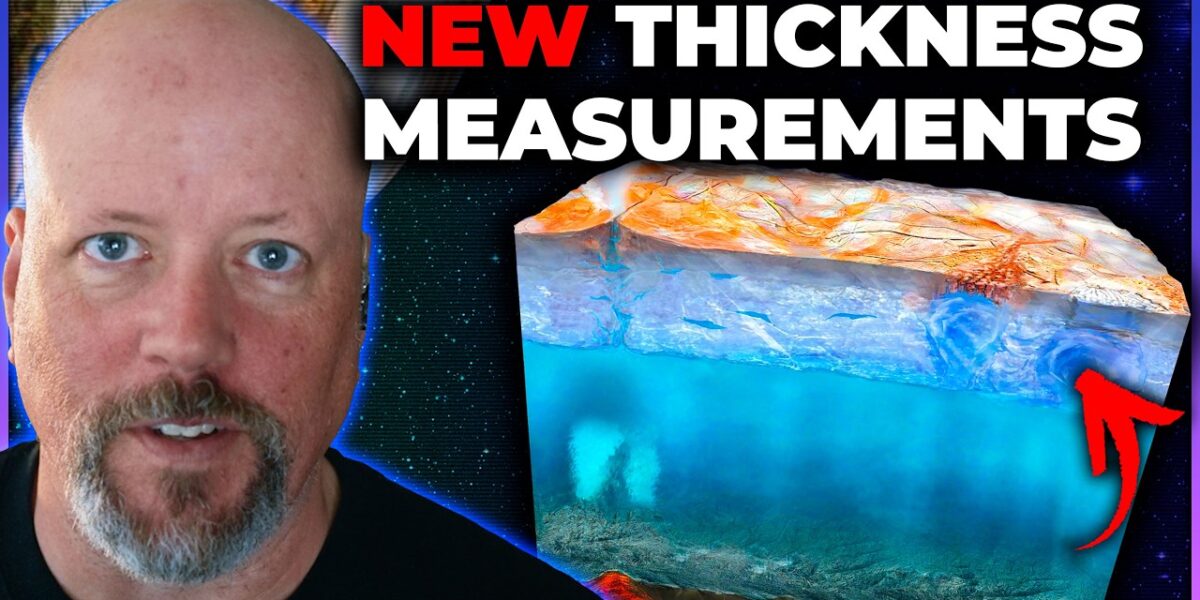
In light of these challenges, attention has turned to a ‘top-down’ approach: the possibility that space dust falling onto Europa’s surface can eventually make its way into the ocean through cracks and fissures in the ice. The thickness of this ice shell becomes a critical factor. NASA’s Galileo spacecraft provided early hints of this variability, revealing ‘chaotic terrain’ where the ice appears to have fractured and potentially mixed with material from below. More recent data from NASA’s Juno spacecraft, using its microwave radiometer, has estimated the ice shell’s thickness to be between 3 and 30 kilometers. This wide range significantly impacts the feasibility of the top-down delivery mechanism; a thinner shell (around 3 km) would allow for more material exchange, while a thicker shell (30 km or more) would pose a greater obstacle. If the ice is composed of pure water ice, estimates suggest a thickness of up to 40 km, further complicating the prospect of surface materials reaching the ocean.
Ammonia: A Surprising Discovery
Adding another layer to the Europa puzzle, scientists re-examining archival data from the Galileo mission have detected a faint but significant presence of ammonia on Europa’s surface, particularly near the moon’s fractured regions. Ammonia is unstable in the harsh space environment, meaning its presence suggests a relatively recent upwelling from Europa’s interior. Crucially, ammonia contains nitrogen, an element essential for life as we know it. This discovery suggests that materials potentially used by life are indeed reaching the surface from subsurface reservoirs, a finding that seems to contradict the idea of an exceptionally thick and impermeable ice shell. This ongoing investigation highlights the need for more advanced observations.
The Europa Clipper: A Mission for Answers
To resolve these ambiguities and provide definitive answers, NASA’s Europa Clipper mission is set to revolutionize our understanding. Scheduled to arrive at Europa in the coming years, the spacecraft will conduct 50 close flybys. Its sophisticated ice-penetrating radar system is designed to map the subsurface ice, revealing the depth of cracks and reservoirs, and crucially, to determine the location and extent of the ocean beneath. Europa Clipper represents the next critical step in our quest to understand this enigmatic moon, pushing the boundaries of what our current instruments can achieve.
Artemis 2: A Delayed Lunar Journey
In other space exploration news, NASA’s Artemis 2 mission, the first crewed flight of the Space Launch System (SLS) rocket and Orion spacecraft around the Moon, has experienced a delay. The mission, initially slated for a late 2024 launch, has been postponed to early March 2025. This decision follows a series of challenges encountered during critical pre-launch tests, including a hydrogen leak detected during a ‘wet dress rehearsal’ – a practice run where the rocket is fueled and all launch procedures are simulated. Additional issues with the Orion crew module’s hatch pressurization also contributed to the delay. These setbacks are not uncommon in complex space missions, where precise alignment with lunar windows and rigorous safety checks necessitate flexibility. The delay allows engineers to address these technical hurdles and ensure the mission’s success.
AI on Mars: Guiding the Rovers
The challenges of communicating with Mars rovers, such as Perseverance and Curiosity, are significant due to the vast distances involved, resulting in communication delays of up to 40 minutes round trip. This limitation can slow down scientific operations. In an innovative experiment, NASA has explored the use of artificial intelligence to assist in rover navigation. The large language model Claude, developed by Anthropic, was given the same geological data and route planning information as human operators. Claude was then able to autonomously plan a route for the Perseverance rover through Martian terrain. While the communication delay still exists, this demonstration suggests a future where more advanced, onboard AI could enable rovers to make critical decisions in real-time, accelerating scientific discovery without human intervention.
SpaceX’s Ambitious Satellite Plans
SpaceX continues to push the boundaries of space infrastructure with ambitious plans that dwarf previous proposals. Following its initial plan to launch 30,000 Starlink satellites, the company is now reportedly considering a staggering deployment of up to one million satellites. These would not be solely for communication; the vision includes launching ‘data center satellites’ into orbit using the Starship vehicle. This concept addresses the growing constraints on terrestrial data centers, which face limitations in power, processing, and physical space. The idea is to leverage the virtually limitless power and space available in orbit, potentially reducing hardware requirements and beaming computational results back to Earth. Elon Musk has envisioned a future where terawatts of computing power are launched into space, possibly sourced from robotic facilities on the Moon. To facilitate this, SpaceX may go public and merge with XAI, a company focused on AI development, creating a unified entity for satellite production and launch. While the concept is groundbreaking, significant questions remain regarding the economic viability and the immense cost associated with launching such a massive constellation compared to terrestrial solutions.
Blue Origin’s Focus on New Glenn
In the competitive landscape of spaceflight, Blue Origin has announced a pause in its suborbital New Shepard program to concentrate resources on its heavy-lift New Glenn rocket. After successfully completing 38 flights and carrying 98 passengers above the Karman line, Blue Origin is shifting its focus to the development and launch of the much larger New Glenn. This strategic move could have implications for NASA’s Artemis program, particularly if SpaceX encounters further delays in delivering its lunar lander for the Artemis 3 mission. Blue Origin’s lunar lander offering could become a crucial alternative, allowing NASA to maintain its schedule for returning humans to the Moon.
Building Blocks of Life in Deep Space
The universe continues to reveal its astonishing capacity to produce the fundamental ingredients for life. Astronomers have announced the detection of ‘theophene,’ a ring-shaped sulfur-bearing hydrocarbon, in a gas cloud 27,000 light-years away near the Milky Way’s center. This molecule, composed of 13 atoms, is significant because it’s a larger sulfur-containing molecule than previously observed in space. Theophene is known to be produced in biochemical reactions on Earth. This discovery adds to a growing list of complex organic molecules, including amino acids and sugars, found in interstellar clouds, reinforcing the idea that the raw materials for life are abundant throughout the cosmos and were likely delivered to early Earth, making the emergence of life a potentially inevitable process.
Lava Tubes on Venus: A Hidden Possibility
While lava tubes have been identified on the Moon and Mars as potential shelters from radiation, their existence on Venus remains an open question. Recent research suggests that Venus, with its similar gravity and composition to Earth, could harbor these subterranean structures. Scientists have conducted simulations indicating that lava tubes with widths of several hundred meters could remain stable on Venus, given its volcanic activity. However, current high-resolution imaging of Venus’s surface dates back to the 1990s from NASA’s Magellan mission, lacking the detail to confirm such features. Future missions with enhanced imaging capabilities are needed to search for surface indicators like pit chains and skylights that could point to underlying lava tubes, offering potential protected environments for future exploration.
Neutron Star Collisions and Distant Galaxies
New simulations from NASA offer insights into the dramatic merger of neutron stars. These simulations model the interaction of the extremely powerful magnetic fields of two neutron stars as they collide, predicting intense gamma radiation. This research could help astronomers identify potential signals indicating an impending neutron star merger, possibly even offering a pathway to understanding the formation of magnetars, the most magnetic objects known in the universe. Meanwhile, the James Webb Space Telescope continues to break records, with the newly identified galaxy candidate ‘MZ-14’ observed at a redshift of 14.44. This corresponds to a time just 280 million years after the Big Bang, revealing surprisingly massive and mature galaxies with heavier elements present much earlier in cosmic history than previously theorized.
Source: New Data on Europa // Crazy SpaceX Plans // NO Artemis 2 in February (YouTube)

Related Articles


AI Reshapes Economy: New Wealth Opportunities Emerge
Artificial intelligence is set to dramatically reshape the global economy within five years, creating both challenges and significant wealth-building opportunities. Experts emphasize the need to adapt by learning AI skills, drawing parallels to how past technological shifts democratized access to knowledge and investment strategies.


AI Misdiagnoses Medical Cases 80% of the Time
A recent U.S. study reveals that AI chatbots are misdiagnosing medical conditions in 80% of cases, highlighting significant risks in relying on artificial intelligence for health advice. Personal stories shared by individuals demonstrate how online self-diagnoses led to incorrect treatments and prolonged suffering, underscoring the irreplaceable value of human medical professionals.


Magnificent 7 Stocks Surge Amid Market Uncertainty
Tech giants, the 'Magnificent 7,' are surging despite market fears, showing technical breakouts and strong growth potential. Amazon invests heavily for long-term gains, while Google deepens its AI capabilities. Meta refocuses on core strengths, and Apple's services business continues its impressive expansion.