Quantum Entanglement Defies Speed of Light Limit
Einstein's critique of quantum mechanics led to the EPR paradox, suggesting faster-than-light correlations. Bell's theorem and subsequent experiments confirmed this apparent non-locality, challenging our understanding of reality.


Quantum Entanglement Defies Speed of Light Limit
In a discovery that continues to challenge our fundamental understanding of reality, physicists have found compelling evidence that phenomena within quantum mechanics can appear to operate faster than the speed of light. This groundbreaking insight, stemming from Einstein’s early critiques and later experimental verification, suggests that the universe might be far stranger and more interconnected than previously imagined.
Einstein’s Early Doubts and the Paradox of Gravity
The concept of a universal speed limit, famously set by Albert Einstein’s theory of relativity at approximately 299,792 kilometers per second (186,282 miles per second), is a cornerstone of modern physics. However, the very nature of gravity itself once posed a significant challenge to this principle. Isaac Newton’s theory of universal gravitation proposed that gravitational forces act instantaneously across any distance. This idea deeply troubled Newton himself, who described it as an “absurdity.” Einstein, in 1905, further elaborated on this, demonstrating that instantaneous action-at-a-distance could lead to paradoxes. He showed that observers moving at different speeds could disagree on the order of events, potentially leading to a scenario where an effect could precede its cause. For instance, if the Sun were to vanish, Newton’s theory implied we would feel its gravitational absence instantaneously. However, Einstein’s special relativity dictates that information, including gravitational effects, cannot travel faster than light. It took Einstein another decade to reconcile gravity with relativity, leading to his theory of general relativity in 1915. This revolutionary theory posits that gravity is not a force but a curvature of spacetime caused by mass and energy. Changes in this curvature, like the disappearance of a star, propagate as ripples, or gravitational waves, at the speed of light. This resolved the paradox, establishing that gravitational effects are indeed local and bound by the cosmic speed limit.
Einstein’s Thought Experiment and Quantum Mechanics
While Einstein’s general relativity adhered to the speed of light limit, his attention turned to the burgeoning field of quantum mechanics, a theory that describes the behavior of matter and energy at the atomic and subatomic levels. Einstein, along with many of his contemporaries, including Niels Bohr, was instrumental in developing quantum theory. However, Einstein harbored deep reservations about its implications. In 1935, he presented a famous thought experiment at the Solvay Conference, designed to highlight what he perceived as a fundamental flaw in the prevailing “Copenhagen interpretation” of quantum mechanics. The experiment involved an electron fired towards a detection screen. According to quantum mechanics, the electron is described by a wave function that spreads out. Upon hitting the screen, the electron is detected at a single point, its location determined by the probability distribution of the wave function. Einstein’s crucial question was: if the electron is detected at one point, why doesn’t its wave function, which has collapsed instantaneously everywhere else, still allow for the possibility of detecting the same electron at another distant point moments later? This implied that a measurement at one location seemed to instantaneously influence the state of the electron’s wave function across vast distances, a phenomenon Einstein termed “spooky action at a distance” and believed violated the principle of locality inherent in relativity.
The EPR Paradox and Entanglement
Einstein, along with his colleagues Boris Podolsky and Nathan Rosen, further refined this critique in their seminal 1935 paper, now known as the EPR paper. They proposed a thought experiment involving a pair of entangled particles, such as an electron and a positron, created from the decay of a photon. Entangled particles are intrinsically linked; their fates are intertwined regardless of the distance separating them. If the initial system had zero total spin, then the spins of the entangled electron and positron must always be opposite to conserve spin. Quantum mechanics states that until measured, each particle exists in a superposition of possible spin states. However, measuring the spin of one particle instantaneously determines the spin of the other, no matter how far apart they are. For example, if the electron’s spin is measured along a certain axis and found to be “up,” the positron’s spin along the same axis must instantaneously be “down.” This instantaneous correlation, the EPR paradox argued, implied that either quantum mechanics was incomplete and there were “hidden variables” predetermining the particles’ states locally, or that it violated relativity by allowing faster-than-light influences.
Bell’s Theorem and Experimental Verification
For decades, the EPR paradox remained a subject of intense theoretical debate, largely dismissed by many physicists, including Bohr, who maintained that quantum mechanics was a complete description of reality and that questions about what particles are “doing” when not observed were meaningless. The prevailing attitude, often summarized as “shut up and calculate,” sidelined foundational questions. However, in the 1960s, physicist John Stewart Bell revisited the EPR paradox. Bell devised a mathematical framework, now known as Bell’s theorem, that established a testable inequality. This theorem demonstrated that if local hidden variables existed (as Einstein suggested), there would be a limit to the correlations between measurements on entangled particles. If, however, quantum mechanics was correct and non-local influences were at play, these correlations could exceed Bell’s inequality. The implications were profound: an experiment could finally differentiate between Einstein’s preferred local reality and the spooky, non-local quantum world.
The experimental verification of Bell’s theorem began in the 1970s and 1980s with pioneering work by physicists like Alain Aspect. These experiments involved creating entangled pairs of photons and measuring their properties (like polarization) using detectors that could be independently oriented. The results consistently violated Bell’s inequality, showing correlations stronger than any local hidden variable theory could explain. These findings strongly supported the predictions of quantum mechanics, including its seemingly non-local nature.
The Multiverse Interpretation and Future Implications
The implications of these experiments are far-reaching. While they don’t allow for faster-than-light communication (as the outcomes are still random and cannot be controlled to send information), they suggest that the universe is interconnected in ways that defy classical intuition. Some interpretations of quantum mechanics, such as the Many-Worlds Interpretation, propose that every quantum measurement causes the universe to split into multiple parallel universes, each representing a different possible outcome. In this view, when one entangled particle is measured, its wave function collapses in one universe, while the corresponding state of its entangled partner is realized in another. This could resolve the apparent paradox of instantaneous influence by suggesting that the “influence” is simply the realization of a predetermined correlation across different branches of reality.
The ongoing study of quantum entanglement and Bell’s inequalities continues to push the boundaries of our knowledge. Future experiments aim to refine these tests, closing any remaining loopholes and exploring the potential applications of entanglement in quantum computing, quantum cryptography, and quantum teleportation. The discovery that the quantum realm operates with apparent non-locality, defying the cosmic speed limit in correlation, not communication, remains one of the most profound and awe-inspiring revelations in the history of science, inviting us to reconsider the very fabric of existence.
Source: There Is Something Faster Than Light (YouTube)

Related Articles
Heisenberg’s 1925 Quantum Leap Still Puzzles
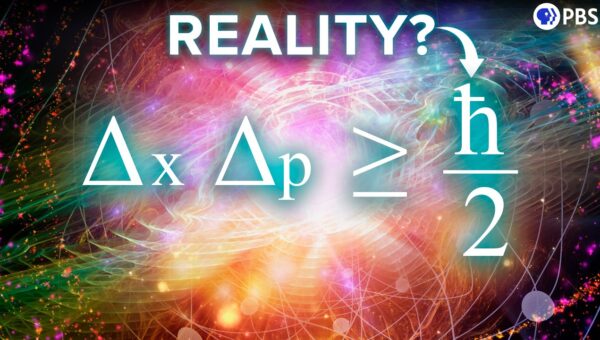
In 1925, Werner Heisenberg's groundbreaking work laid the foundation for quantum mechanics, a theory that revolutionized physics but whose fundamental implications remain a profound mystery 100 years later. This exploration delves into the birth of this strange new physics.


Dirac’s Equation: The Accidental Discovery of Antimatter
In 1928, Paul Dirac's relativistic electron equation unexpectedly predicted the existence of antimatter. Initially met with skepticism, the discovery of the positron in 1932 confirmed this groundbreaking concept, revolutionizing our understanding of the universe.

Quantum Mystery: Fields or Potentials?
The Bohm-Aharonov effect, demonstrated experimentally, suggests quantum particles are influenced by magnetic potentials even when magnetic fields are absent. This challenges classical physics' view of potentials as mere mathematical tools.