Galactic Core Revealed: Webb and ALMA Map Milky Way’s Dense Heart
Astronomers are using ALMA and JWST to create the most detailed images yet of the Milky Way's dense, star-forming galactic center. These observations reveal surprising insights into star birth and the environment surrounding our supermassive black hole.

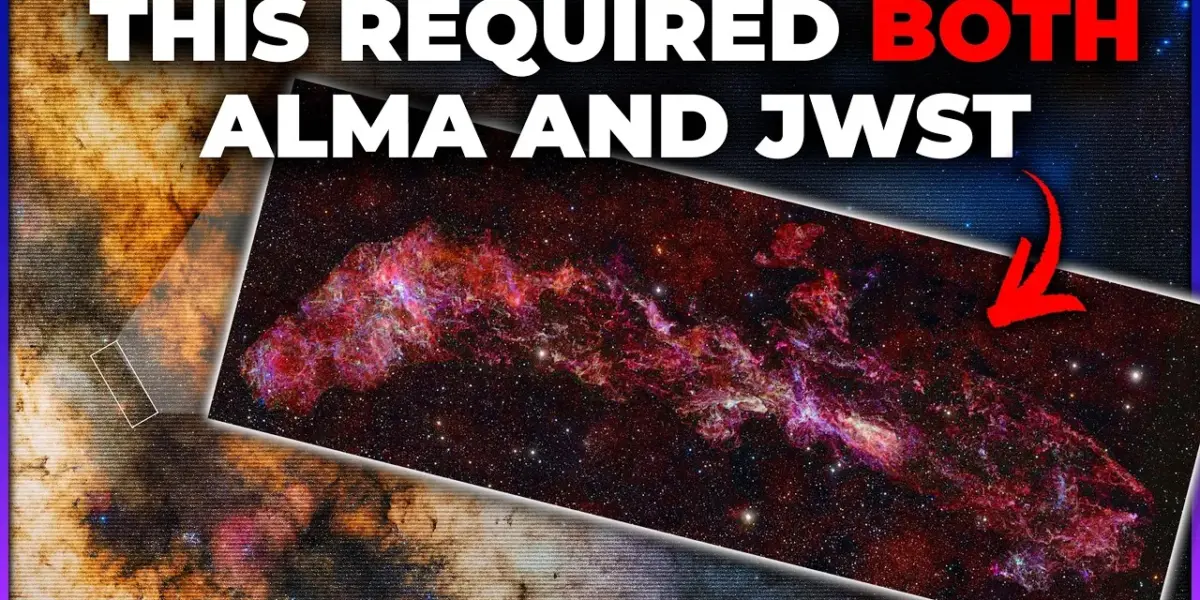
Galactic Core Revealed: Webb and ALMA Map Milky Way’s Dense Heart
Astronomers are peeling back the veil on the Milky Way’s enigmatic center, a region previously obscured by vast clouds of gas and dust. Using the cutting-edge capabilities of the Atacama Large Millimeter/submillimeter Array (ALMA) and the James Webb Space Telescope (JWST), scientists are constructing the most detailed images yet of our galaxy’s bustling, star-forming core, offering unprecedented insights into how stars are born and how matter fuels the supermassive black hole at its heart.
A Stellar Metropolis Like No Other
Imagine standing at the center of the Milky Way. Unlike our relatively sparse solar neighborhood, where stars are separated by parsecs, this galactic core is a maelstrom of stellar activity. Here, stars are packed at densities akin to globular star clusters, with thousands of stars potentially within a single cubic parsec.
This extreme proximity, however, comes with a dramatic visual difference. Depending on your exact location, the sky could be brilliantly illuminated by nearby luminous stars, or plunged into utter darkness by opaque clouds of molecular gas, far denser than any found closer to home.
While globular clusters are known for their dense stellar populations, the galactic center offers a unique mix. It hosts the ancient, Sun-like stars common to galactic bulges, but is also populated by a vibrant, young generation of massive, luminous stars that emit intense ultraviolet radiation. This duality makes the galactic center a unique laboratory for studying stellar evolution and galactic dynamics.
Piercing the Cosmic Fog
For decades, the galactic center has been a ‘zone of avoidance’ for visible light telescopes. Thick blankets of molecular hydrogen and dust absorb and scatter starlight, rendering the region invisible to our eyes and traditional optical instruments.
However, astronomers have developed sophisticated tools to circumvent this cosmic obscuration. ALMA, with its ability to observe at millimeter and submillimeter wavelengths, and JWST, with its unparalleled sensitivity in the infrared spectrum, can penetrate these dusty veils.
Dr. Adam Ginsburg, an associate professor at the University of Florida and a co-principal investigator of the ACES (The Galactic Center Core Environmental Survey) Collaboration, is at the forefront of this exploration. His team is using ALMA to map vast swathes of the galactic center with unprecedented resolution, aiming to answer fundamental questions about accretion onto the supermassive black hole Sagittarius A* and the processes governing star formation in this extreme environment.
ALMA’s High-Resolution Gaze
Previous observations of the galactic center at wavelengths between infrared and radio had a resolution limit of about 10 arcseconds. While sufficient for some studies, this blurring meant that many individual sources and fine structures were indistinguishable. The ACES survey, utilizing ALMA, has achieved resolutions significantly better than this, allowing astronomers to resolve details previously hidden.
ALMA observes several key components in the galactic center: dust emission, which glows brightly at these wavelengths; plasma emission from ionized gas; and spectral lines from various molecules. The latter is particularly crucial, as it allows astronomers to map the motion and distribution of gas through Doppler shifts. By targeting specific spectral lines of molecules like HNCO and HCl+, which act as tracers of the bulk gas, the ACES team can study gas kinematics with velocities as low as 100 meters per second.
“In the galactic center, carbon monoxide, our usual go-to tracer for molecular gas, is optically thick,” explains Dr. Ginsburg. “There’s just too much of it, and it confuses our measurements. So, we turned to slightly less abundant molecules that still trace the bulk gas but allow us to resolve the motions better.”
The Star Formation Puzzle
One of the most perplexing aspects of the galactic center is its surprisingly low rate of star formation, despite the abundance of dense gas. Theoretically, the conditions should be ripe for widespread star birth. While the gas temperatures in the galactic center are slightly warmer (around 50 Kelvin compared to 20 Kelvin in other dark clouds), this difference alone isn’t thought to be sufficient to suppress star formation so dramatically.
“We’re trying to understand why gas gets dense without forming stars,” Dr. Ginsburg notes. “Is it just the temperature? We think other effects are at play.” ALMA’s high-resolution data is helping to untangle this mystery by revealing the intricate motions of the gas.
If gas is moving outward, away from potential collapse points, it could explain the lack of star formation. Conversely, inward motion would suggest imminent star birth.
The survey also identified regions rich in complex organic molecules, such as methanol and methyl formate. These molecules, typically requiring higher temperatures to be released from dust grains, are strongly associated with the formation of high-mass stars. This suggests that while overall star formation might be suppressed, the sites where it does occur are exceptionally active, producing massive stars that significantly impact their surroundings.
Webb’s Infrared Vision
Complementing ALMA’s observations, the James Webb Space Telescope provides a crucial infrared perspective. JWST’s ability to peer deep into the infrared spectrum allows it to see through even denser dust clouds than ALMA and to observe cooler objects. The ACES team has used Webb to study specific regions within the galactic center, including Sagittarius B2, a colossal molecular cloud renowned as the most active star-forming region in our galaxy, potentially even surpassing the famous Orion Nebula in its current output.
Sagittarius B2 is particularly interesting because it hosts the formation of high-mass stars, similar to those found in the R136 cluster within the Tarantula Nebula. These massive stars, potentially exceeding 200 solar masses, are comparable in scale to star-forming regions observed in the early universe. This makes Sagittarius B2 a vital analogue for studying the conditions under which the first stars and globular clusters formed billions of years ago.
A Window into the Early Universe
The conditions within Sagittarius B2 offer a unique opportunity to study phenomena that were common in the early universe but are rare today. “The conditions are so much denser, hotter, just everything is more extreme in those small zones,” Dr. Ginsburg explains. By studying these intense star-forming nurseries, astronomers can gain insights into the physics that governed galaxy and star formation when the universe was young.
The analogy extends to the formation of globular clusters. While many globular clusters formed in the early universe and still orbit in galactic halos, those that may have formed within the galactic disk likely were torn apart by gravitational forces over time. The intense, dense environments like Sagittarius B2 might represent the closest modern analogues to the conditions that birthed these ancient stellar collections.
The Black Hole’s Subtle Influence
While the ACES survey focuses on gas and star formation, the supermassive black hole, Sagittarius A*, looms large at the galactic center. Currently, its direct influence on the surrounding gas and star formation appears to be indirect. While accretion events can produce X-ray echoes detectable from afar, they don’t significantly alter the dynamics or heat the gas.
At distances of a few parsecs from the black hole, the gravitational influence of the dense nuclear stellar cluster and the nuclear stellar disk—the stars themselves—dominates over the black hole’s gravity. Thus, it is the collective pull of stars, rather than the black hole’s singular mass, that primarily shapes the behavior of gas and drives star formation in the immediate vicinity.
What Lies Ahead?
The analysis of the ALMA and Webb data is ongoing. Scientists are meticulously fitting models to the observations, classifying newly identified sources, and refining estimates of star formation rates. Future observations promise even greater detail.
ALMA itself is undergoing an upgrade (the Wideband Sensitivity Upgrade) that will significantly increase its bandwidth and sensitivity, allowing for even more comprehensive surveys. Astronomers also plan to utilize ALMA’s interferometry capabilities to achieve higher resolutions in selected regions and explore different frequency windows. These advancements will continue to refine our understanding of the Milky Way’s dynamic core, revealing the intricate processes that shape galaxies and shedding light on the universe’s most formative epochs.
Source: Largest Image of The Heart of The Milky Way (YouTube)

Related Articles


Astrophysicist Shares Breast Cancer Journey & Science Insights
Astrophysicist Dr. Becky Smethurst shares her breast cancer diagnosis journey and emphasizes the importance of evidence-based medicine over unproven treatments. She also discusses her passion for space and scientific discovery.


Universe’s End Time Shrinks Dramatically
New research suggests the universe's end may arrive much sooner than previously thought, with a revised timeline of 10 to the power of 78 years. This 'heat death' theory posits that all matter will decay, not just black holes. While still an immense duration, it's a significant shift from earlier predictions.


Artemis 2 Crew Captures Stunning Earth Views from Moon Orbit
The Artemis 2 mission has captivated the world with stunning images of Earth from lunar orbit and record-breaking distances. Meanwhile, proposed NASA budget cuts, new insights from the James Webb Telescope, and novel approaches to exploring Mercury highlight the dynamic nature of space exploration.