White Dwarf Dyson Spheres: A Tiny Star’s Big Energy Solution
Astronomers are exploring the possibility of building Dyson spheres around compact white dwarf stars, which offer a long-lasting and stable energy source. Meanwhile, the Vera Rubin Observatory promises near real-time astronomical discovery, and new data challenges models of supermassive black hole formation in the early universe.

White Dwarf Dyson Spheres: A Tiny Star’s Big Energy Solution
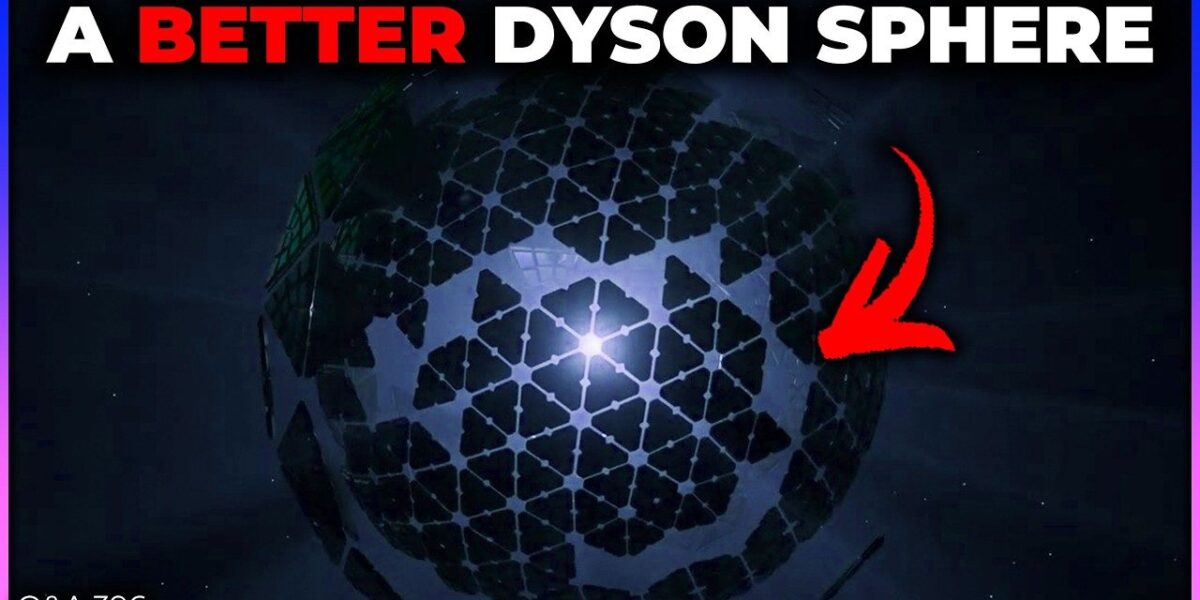
The concept of a Dyson sphere, a hypothetical megastructure that completely encompasses a star to capture its energy, has long been a staple of science fiction and astronomical speculation. Typically imagined around Sun-like stars, these colossal constructs would require immense resources. However, a fascinating new perspective suggests that a more compact and potentially more achievable version of a Dyson sphere could orbit a white dwarf, the dense, cooling remnant of a star like our Sun.
The Allure of White Dwarfs
White dwarfs are the stellar embers left behind after a star with a mass up to about eight times that of our Sun exhausts its nuclear fuel. They are incredibly dense, packing roughly the mass of the Sun into a volume similar to that of Earth. Despite their small size, they remain incredibly hot for billions of years, with surface temperatures reaching tens of thousands of Kelvin. Crucially, they possess a ‘habitable zone’ – a region where temperatures could allow for liquid water. For a white dwarf, this zone is surprisingly close, extending to about four times the distance between the Earth and the Moon, or roughly one million kilometers from the star’s surface.
This proximity offers a significant advantage for Dyson sphere construction. Instead of needing to encircle a star millions of kilometers in radius, a civilization could build its energy-capturing structure within a much smaller orbital radius. The material required would be less, and the energy output, while lower than that of a main-sequence star, would be sustained for an extraordinarily long time. White dwarfs are predicted to cool down over trillions of years, a timescale vastly exceeding the current age of the universe.
A Pause in the Cooling
Adding to the potential longevity of a white dwarf as an energy source is a peculiar phenomenon: some white dwarfs appear to pause their cooling process. This is thought to be related to internal structural reorganizations, possibly involving the crystallization of their core. This pause could buy billions of additional years of stable heat output, providing an even more extended period for an advanced civilization to thrive.
Furthermore, white dwarfs are less active than main-sequence stars. They do not produce the violent solar flares that could strip away a planet’s atmosphere or disrupt delicate technologies. Their relative dimness also makes any orbiting civilization harder to detect, offering a degree of natural stealth. The existence of planets around white dwarfs has already been confirmed, suggesting that the necessary raw materials for such a megastructure could be available within the star system.
Vera Rubin Observatory: Real-Time Cosmic Discoveries
The Vera C. Rubin Observatory, formerly known as the Large Synoptic Survey Telescope (LSST), is poised to revolutionize our understanding of the universe, particularly transient astronomical events. Unlike traditional telescopes that might release large, processed datasets periodically, Rubin’s operational model is designed for near real-time data flow.
The observatory, located in Chile, will continuously image the sky over its planned 10-year mission. Each patch of sky will be revisited dozens of times. This frequent re-imaging allows astronomers to stack images and detect changes, enabling the identification of phenomena like supernovae, moving asteroids, comets, and potential candidates for Planet Nine. The goal is to provide data so quickly that astronomers can trigger follow-up observations with other telescopes while events are still active.
A sophisticated data processing pipeline will filter and flag events of interest in near real-time. While comprehensive, deep-sky surveys will still produce large datasets for later analysis, the system is built to allow astronomers to dip into a continuous stream of information, akin to watching a live stock ticker. This approach ensures that fleeting cosmic events are not missed and can be studied in detail. The observatory aims to offer the best of both worlds: the thrill of real-time detection and the scientific rigor of long-term, high-quality imaging and data analysis.
The Enigma of Supermassive Black Hole Growth
The supermassive black hole at the center of our Milky Way galaxy, Sagittarius A*, has a mass of about 4.1 million solar masses. This constitutes only about 0.1% of the Milky Way’s total mass, which is estimated to be around 1 to 1.5 trillion solar masses. This ratio is considered fairly typical for galaxies in the present epoch of the universe.
However, observations of the early universe, particularly from the James Webb Space Telescope, are revealing a different picture. Galaxies observed just a few hundred million years after the Big Bang appear to host supermassive black holes that constitute a much larger fraction of their host galaxy’s mass, sometimes as much as 10%. This observation challenges the traditional ‘bottom-up’ model of galaxy formation, which posits that galaxies and their central black holes grow gradually over time through mergers of smaller structures.
The existence of disproportionately massive black holes in the early universe suggests alternative formation mechanisms might be at play. One leading hypothesis is ‘direct collapse,’ where massive clouds of gas and dust could collapse directly into a black hole without first forming stars. This would allow black holes to grow much larger, much faster, potentially preceding or at least keeping pace with the formation of their host galaxies. Resolving this discrepancy is a key area of research in modern astrophysics, potentially rewriting our understanding of cosmic evolution.
Magnetars: The Elusive Remnants of Neutron Star Mergers
The question of whether a neutron star merger witnessed by LIGO could have resulted in a magnetar – a type of neutron star with an extremely powerful magnetic field – is a complex one. While scientists looked for specific radio signals indicative of a magnetar remnant following the merger of two neutron stars, no such signal was detected.
This lack of detection could mean several things: the remnant might have been a heavier neutron star, it could have collapsed directly into a black hole, or it might have completely vaporized with no stable remnant left behind. However, LIGO’s primary detection method relies on gravitational waves, which are produced by massive objects moving and spiraling around each other. Once the two neutron stars merge and form a stable, non-rotating object (like a black hole or a perfectly spherical neutron star), the emission of detectable gravitational waves ceases.
Therefore, LIGO cannot directly observe the aftermath or identify the type of remnant formed after the gravitational wave signal has ended. While astronomers are continuously exploring ingenious methods, such as looking for asymmetrical events that might produce lingering gravitational waves, the current capabilities of gravitational wave observatories are limited to the dynamic, inspiraling phase of neutron star mergers. The precise origin and evolution of magnetars remain an active area of investigation.
The Universality of Physics
A bonus question explored whether the laws of physics are consistent across the entire universe. This fundamental question probes the core of our cosmological models. While we cannot definitively prove that physics operates identically in the most distant and ancient reaches of the cosmos, all current observational evidence strongly supports this assumption. From the spectral analysis of light from distant galaxies to the behavior of cosmic microwave background radiation, the physical constants and laws we observe appear to be remarkably constant throughout space and time. This universality is a cornerstone of our ability to understand and model the universe.
Source: Alternative Dyson Spheres, Vera Rubin's Data, Source of Magnetars | Q&A 396 (YouTube)

Related Articles


Giant Gamma-Ray Bubbles Discovered Above and Below Milky Way
Two enormous gamma-ray bubbles, stretching 50,000 light-years, have been discovered above and below the Milky Way. Their distinct high-energy emissions and sharp edges suggest a powerful, sudden event in our galaxy's past, possibly linked to its central supermassive black hole.


New Research Challenges Fermi Bubble Origins
Scientists have long debated the origin of the giant gamma-ray-emitting Fermi bubbles above and below the Milky Way. While a supermassive black hole was the leading suspect, new simulations suggest supernovae activity alone might be responsible, reopening the mystery.


Vera C. Rubin Observatory Unlocks Sky’s Secrets for All
The Vera C. Rubin Observatory's vast data is now publicly accessible, empowering astronomers worldwide to make new discoveries. Innovations in star shades and spacesuits promise to accelerate our exploration of exoplanets and the solar system.